• Skip to primary navigation
  • Skip to main content
  • Skip to primary sidebar
  • Skip to footer
  • Site Index
  • Fall Homesteading
  • Shop
    • Profitable Homesteading System
    • Jumpstart Your Homestead
    • Organized Chicken Keeper
    • G.O.A.T. Herd Management System
    • The Ultimate Planner for Breeding Goats
    • Couponing for Beginners Planner
  • Nigerian Dwarf Goats for Sale
    • Nigerian Dwarf Goats
  • About

Mranimal Farm

All About Silkies, Nigerian Dwarf Goats & More

menu icon
go to homepage
subscribe
search icon
Homepage link
  • Site Index
  • Fall Homesteading
  • Shop
  • About
  • Contact
  • ×
    Home

    Blog

    How to Make Money Homesteading - 15 Homestead Money Making Ideas

    By MrAnimal Farm

    How to Make Money Homesteading - 15 Homestead Money Making Ideas

    If you are currently a homesteader or if you are thinking about starting a homestead, you may wonder how to make money homesteading or farming.
    chicken sitting on eggs

    There are several ways to make money homesteading or farming .  These can range from things that will make a little extra cash to things that could potentially replace your "traditional" job as your income.

    It is always nice to have a few ways that your homestead is bringing in money in order to support the time and effort you put into all of the endeavors. You never know when you may need to make an extra $1,000 a month.

    Once you have reviewed these ways to make money homesteading, checkout these profitable homesteading worksheets so you know exactly what you are making!

    Here are 15 Ways to Make Money Homesteading

    Money Saved

    Ok, so this might not be the most intuitive way to make money.  However, it is likely that if you are growing your own food, producing your own meat or other products that your cost for the high quality of these items will be less than if you were purchasing an equal quality product in the store.

    Most homesteaders will also be using everything on their homestead which decreases waste.  This money saved puts extra money in your pocket. Check out our free guide on how we save money homesteading for more details on saving money.

    Selling Pigs

    You can raise pigs to butchering age and sell the processed meat product or sell  piglets.

    Selling Milk
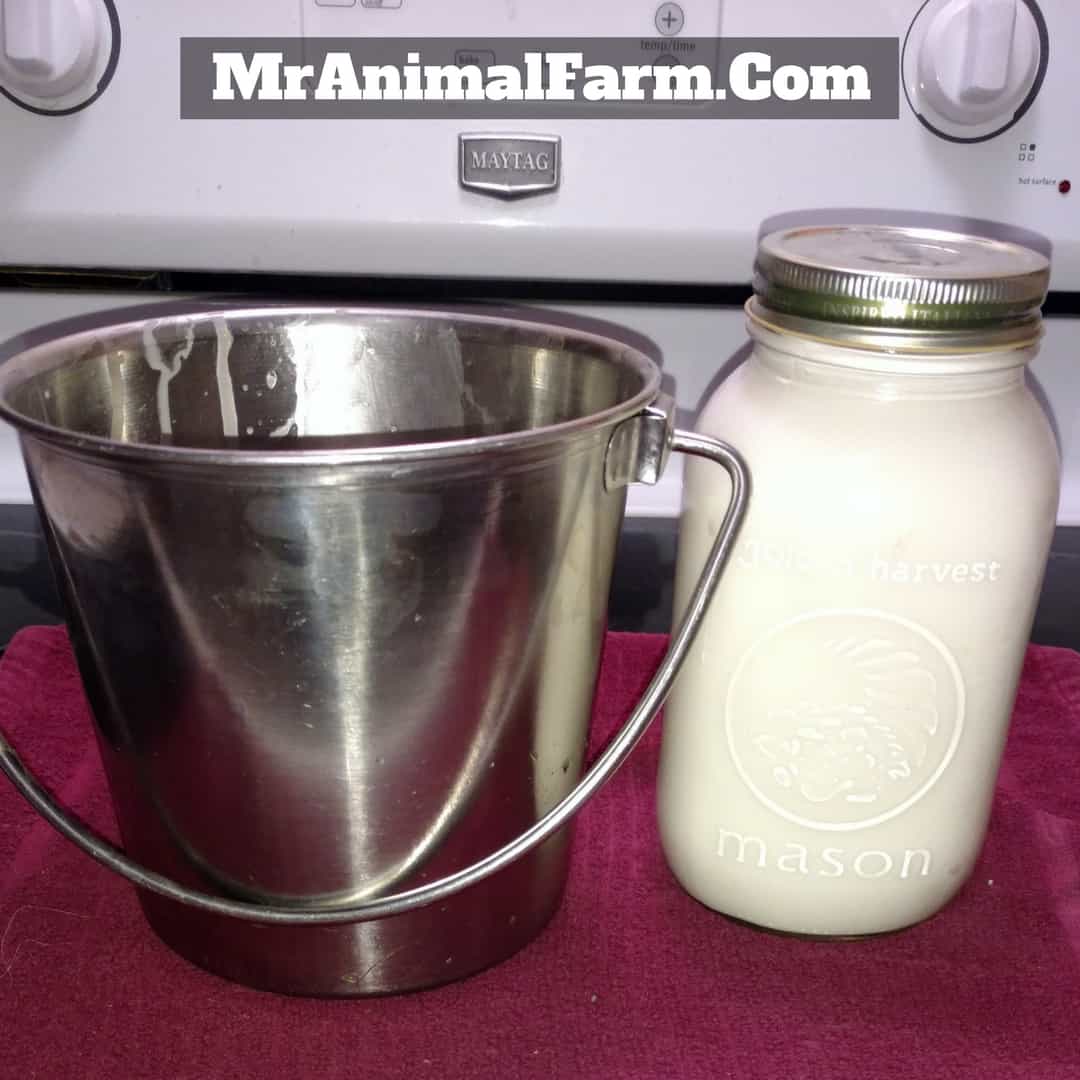
    goat milk and milk pail

    You can do herdshares or sell raw milk from your farm (if your state allows).  Or sell the milk for pets/animal consumption. 

    Some states do require a permit even to sell for animal consumption, so be sure  to look up your state specific rules.

    Selling Goats

    You can sell baby goats either for dairy, meat, or wool.  If this sounds like something you would enjoy you can learn all about Raising Goats with one of our courses!

    For more details, check out how to make money raising goats.

    Selling Cows

    Just like with pigs, you can raise the cows to butchering age and sell the processed meat or sell young cows.

    How to make money homesteading and farming with chickens

    Selling Chicken

    You can sell butchering age chickens or you can butcher and sell the processed meat.  Some states allow you to process and sell yourself.  Others you must take to a certified processor.

    So, make sure you know all of your states requirements before selling any homegrown meat.

    Selling Hatching Eggs

    You can keep breeding chickens and sell their fertile eggs.  Depending on the breed, hatching eggs can sell for a good amount of money. Some more rare breeds, like Silkie Chickens, can be in pretty high demand.

    You will likely want to be NPIP certified for this. All that means is your chickens have been disease tested and that other chicken owners can be confident their flock won't catch any chicken illnesses from your birds.
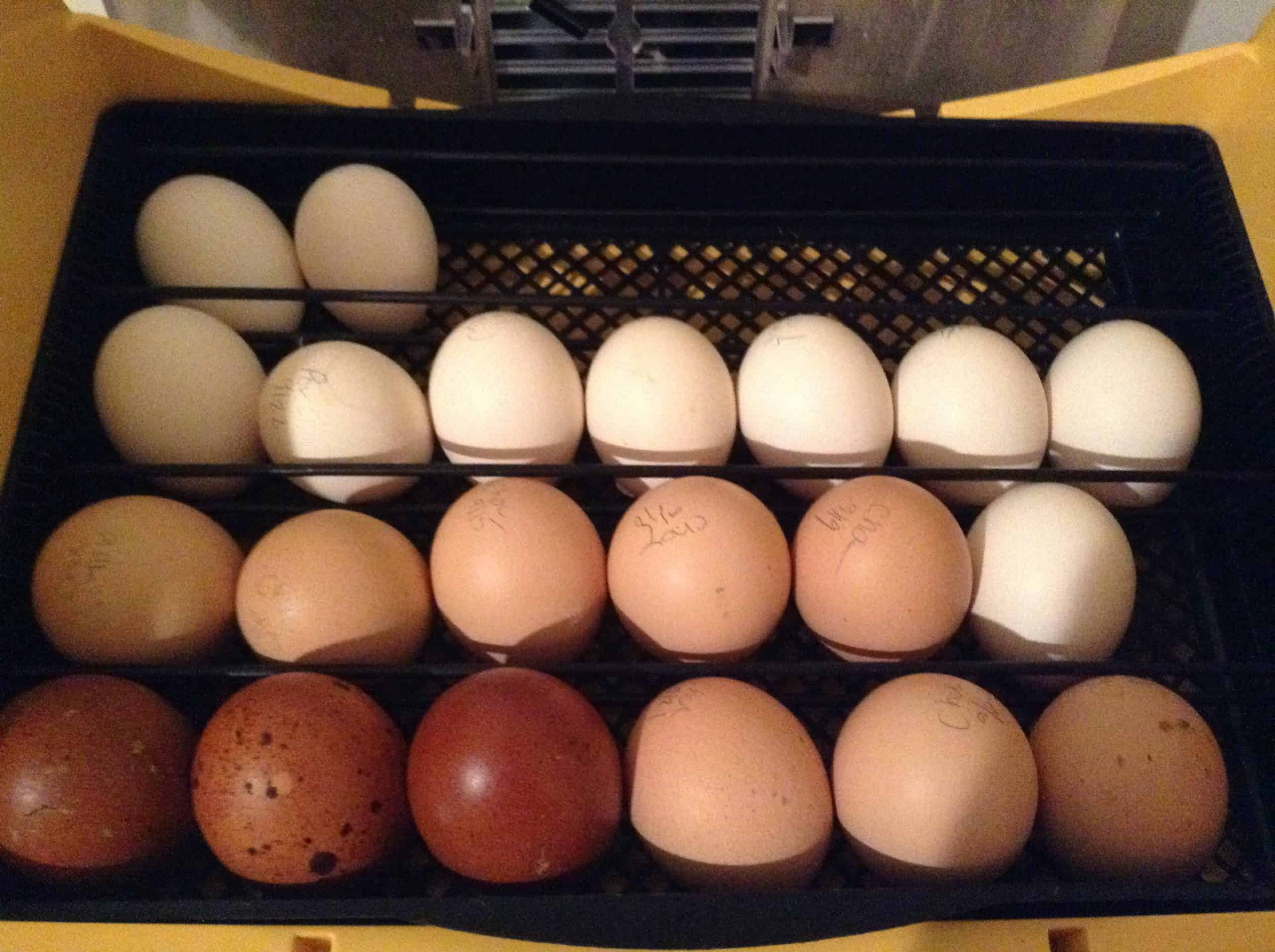
    hatching eggs

    Selling Chicks or Pullets

    You can hatch your own chicks and sell them as day-olds or raise them to be old enough to tell their sex and sell the girls as laying hens for a premium price.

    Here are some more ideas on how to make money with chickens.  We average about $500/mo here on our homestead!

    Not sure how to incubate chicks or even where to start with raising chickens?  Check out How to Get Started Raising Chickens.
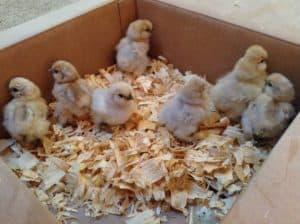
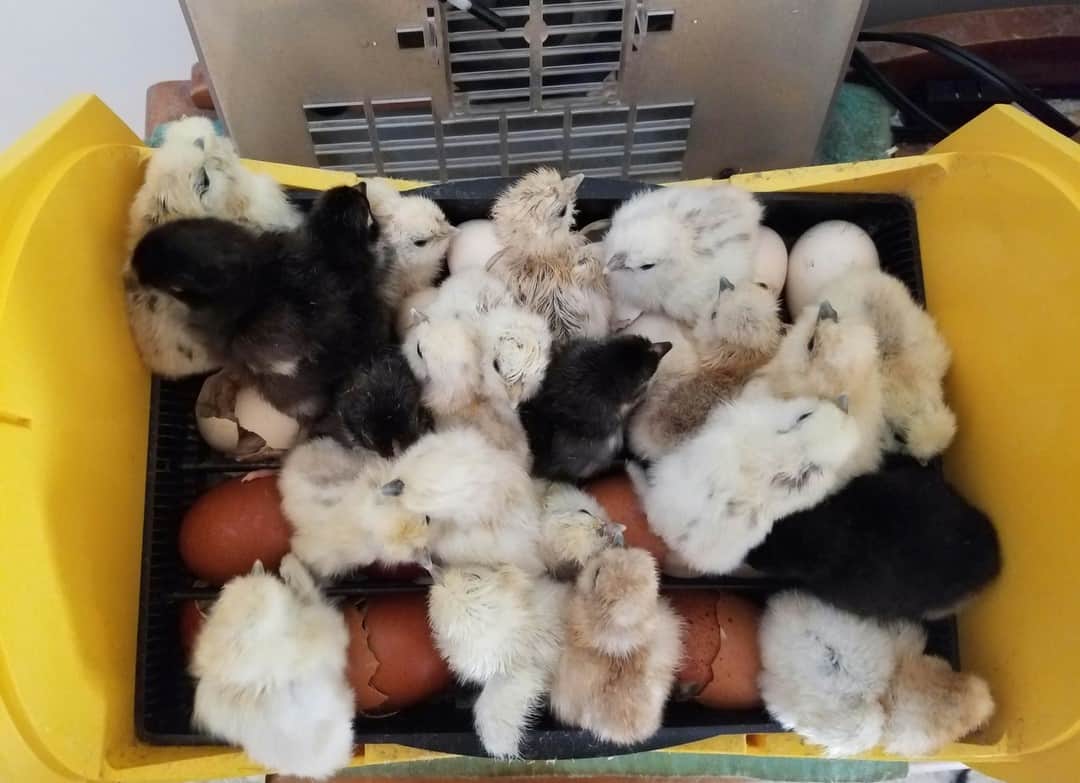
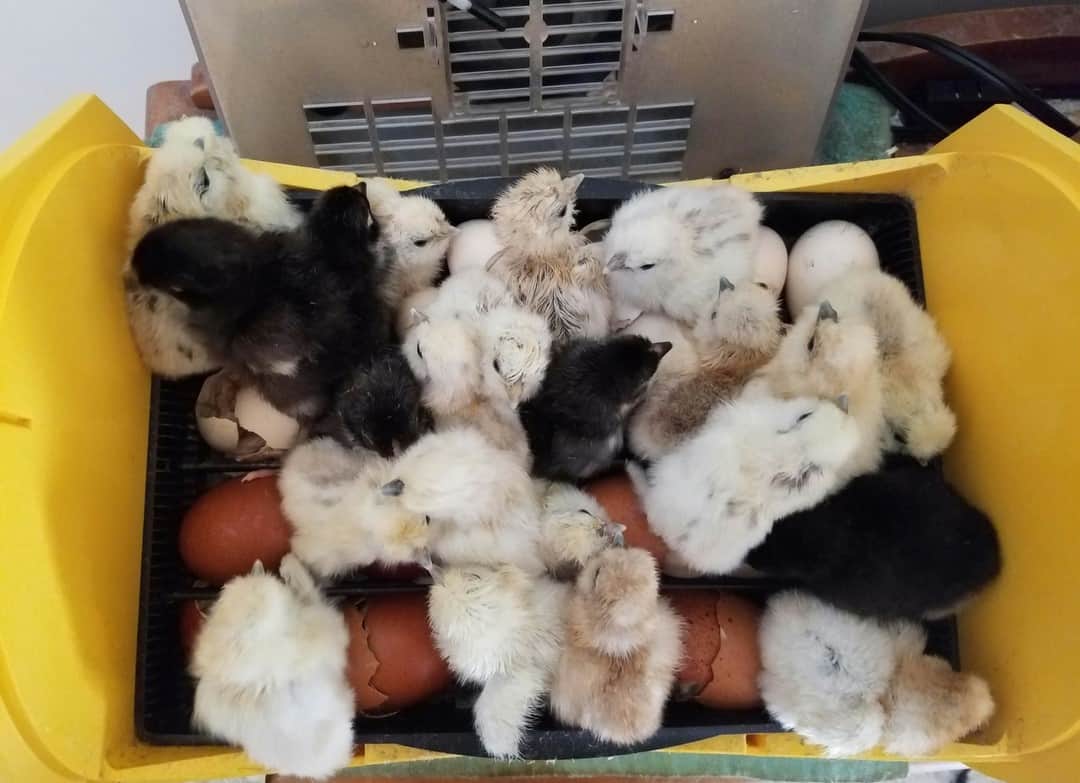
    silkie chicks in box

    Selling Homemade Soap

    If you are a soapmaker (or you can learn to be a soapmaker), you can sell your own homemade soap.  This is a great value added product if you have dairy goats.

    Selling Eating Eggs

    You can get extra laying hens and sell their eggs as eating eggs.  This is a great way because it won't take much extra time.

    Make sure that you have the right breeds for your flock to get the most eggs!
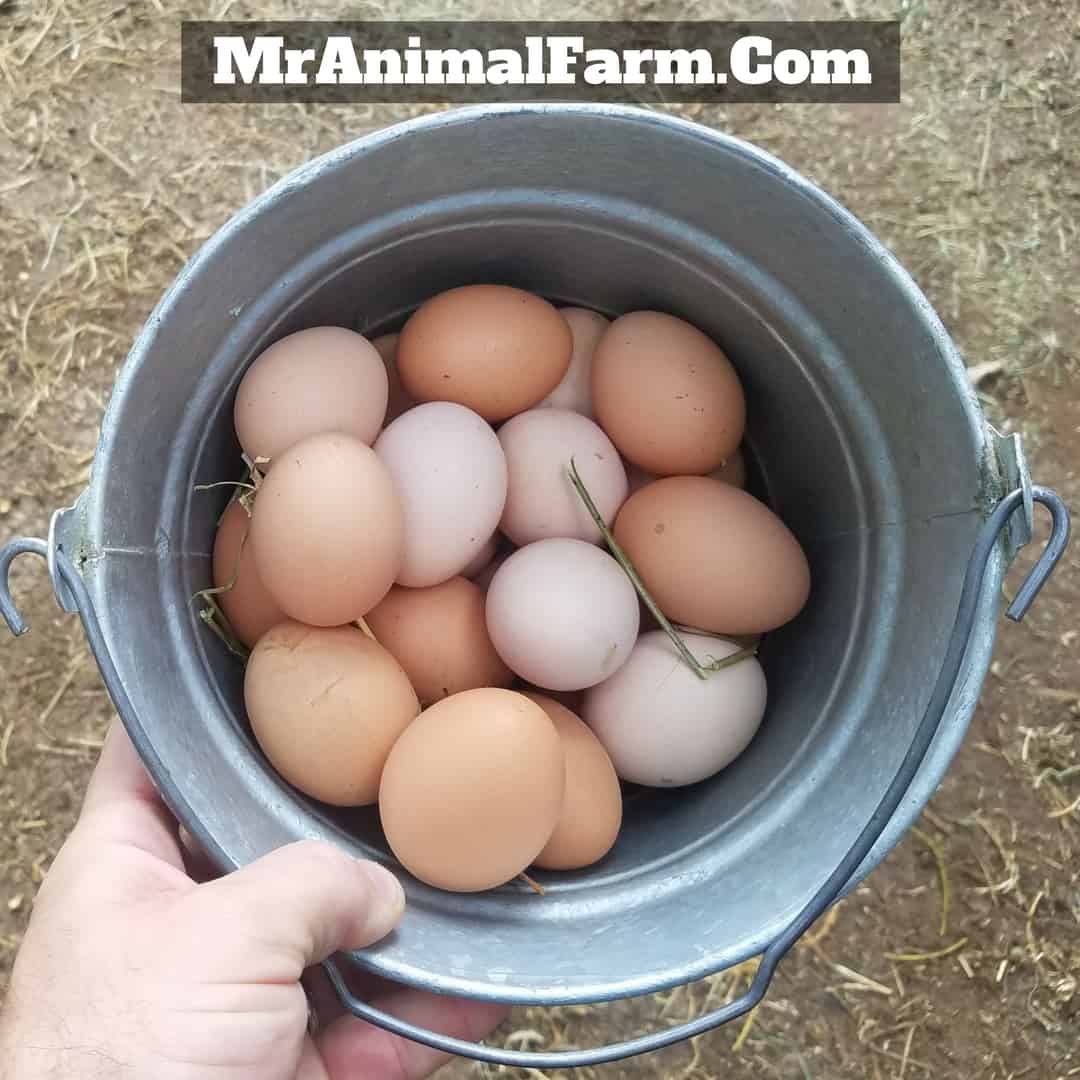
    eggs in a metal bucket

    Selling Wool/Fiber

    If you have wool or fiber animals such as angora goats you can sell their fiber.  If you are a good spinner, you can sell it spun.

    Or you can spin your wool/fiber and make products like sweaters and throws to sell!  Making full products like these will appeal to more than just other homesteaders which opens up your customer base!

    How to make money with food

    One of the most notable ways is through traditional farming. You can farm a whole host of fruits and vegetables to make money.

    Selling Fruits

    If you have fruit trees or a berry patch you can sell your extra fruit at local farmer's markets.  Or you can have a  you pick stand at your farm.
    blueberries in a bowl

    Selling Vegetables

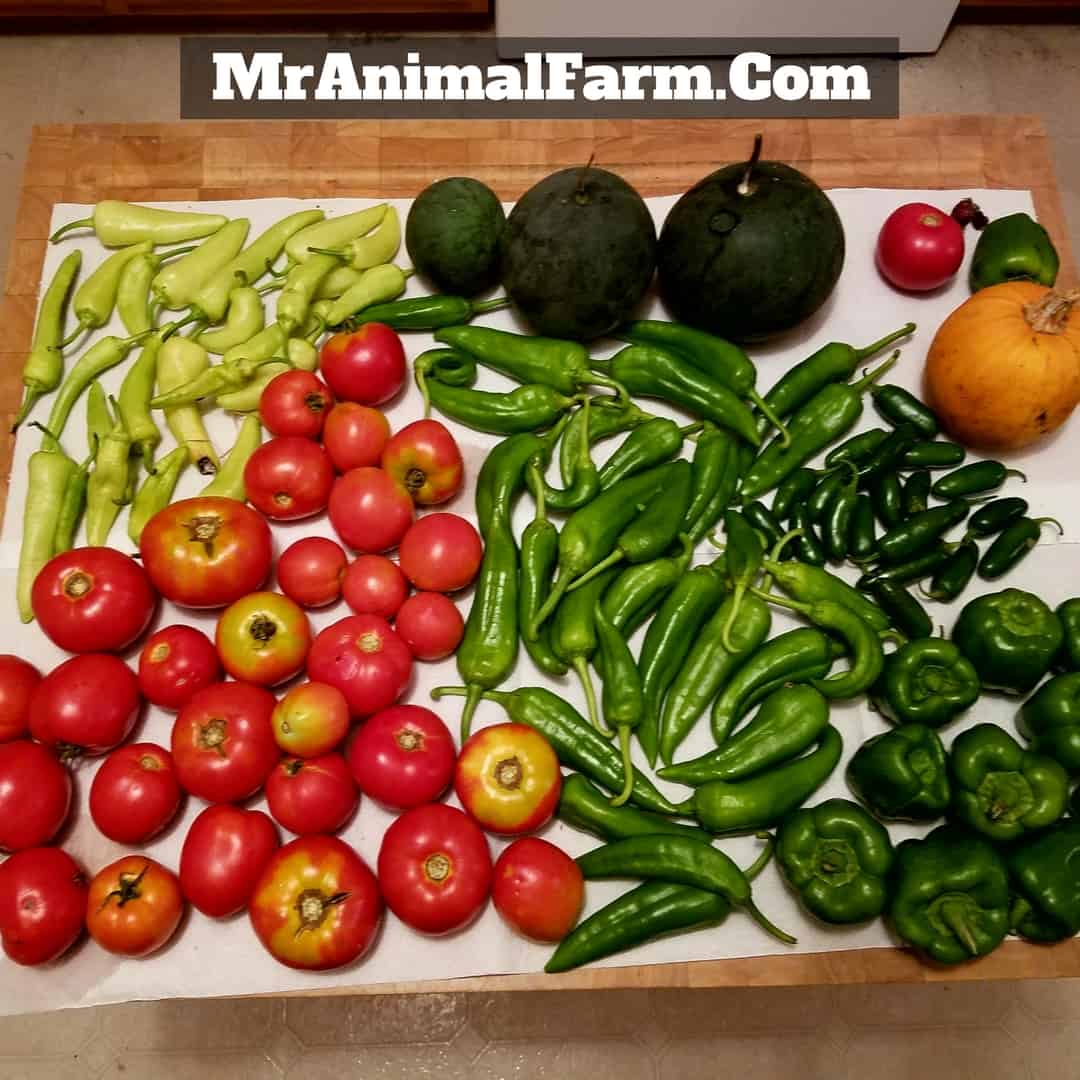
    One way to make money homesteading is with your garden!  You can grow extra vegetables in your garden and sell them at your local farmer's markets or to local restaurants.
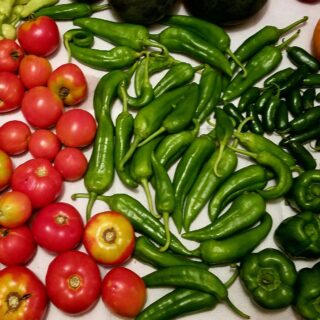
    tons of vegetables in a butcher block

    Create a CSA

    You can take the eating eggs, meat products and fruits and vegetables listed above and create CSA packages where you have customers that pay a price to get a varied supply of items each week.

    Selling Baked Goods

    You can get a certified home kitchen and make baked goods such as pies, cakes or other items.

    apple pie

    All of these ideas can help you make money homesteading.  Of course, you will want to look into your local laws.

    Most states have specifics around things like selling processed meat, baked goods, raw milk and the like.  This information can usually be pretty easily found by looking at your state's Department of Agriculture.

    If you have kids on the homestead, teaching them to be self-sufficent is also important.  Here are 11 jobs for kid entrepreneurs!

    BONUS IDEA:

    Another way some homesteaders make money homesteading is by running an online blog and/or selling ebooks and courses so that they can help others learn the crafts of homesteading.

    You can also "make" money by saving more money. Doing things like decreasing your chicken feed cost, building your own goat pens, and freezing food so it lasts longer, are all ways to keep money from going out and, in a sense, give yourself a raise.

    If you are planning to use some of the ideas to make money homesteading or farming, make sure that you figure out your cost to make the product and then sell the product for more than it costs you.  That way you are sure what your profit is.

    For more information on how to make money homesteading and farming, check out the profitable homesteading worksheets we use to run our homestead like a business!


    Make Money Homesteading

    Best Goat Dewormer

    By MrAnimal Farm

    Parasites can be a big problem for you and your goat herd. We understand how difficult and frustrating it can be to try and find dewormers that will work for your herd in your area. Here is what we have found to be the best goat dewormer available.

    goat standing in grass

    How To Find The Best Goat Dewormer

    It is one of the worst feelings to have one of your precious Nigerian Dwarf Goats sick and not being able to do much to help her. It is not uncommon at all for goats to carry a certain worm load. It varies from area to area, but since they often eat low to the ground near their poop, it is almost impossible to keep them from getting any parasites.

    So, instead of eliminating parasites completely, modern goat farmers have to settle for maintaining a healthy level of parasites. Unfortunately, parasitic life cycles are much, much, MUCH faster than ours or a goats, and can start to develop a resistance to many dewormers.

    When do you worm?

    Talk to any older farmer and they will likely tell you to worm your livestock on a regular schedule. At one point in time, that worked to keep parasite levels low and was not a problem. However, this overuse of worming medication has led to a huge resistance problem across the country.

    Now, it is a better practice to check your goats individually and only treat when you start to notice an issue. Dewormer should be used sparingly.

    So, how do you know what symptoms to check for?

    Famacha Score

    The Famacha test is one of the quickest and easiest ways to tell if your goats have an acceptable worm load. You simply pull down your goat's eyelid, exposing the mucus membrane, and gauge the red color on a scale of 1 to 5. A 1 is a deep red and a 5 is a barely visible pale pink.

    One of the more common parasites for goats is the barber pole worm. It gets it's name because it looks like a barber pole with it's red and white twisted stripes. The barber pole is an internal parasite that makes small cuts on the inside of the goat's stomach and feeds off of the blood.

    The reason the Famacha scale works so well is it is essentially measuring your animal's level of anemia. The more pale the eyelid, the more anemic your goat may be. This is more common in the spring and summer when animals are grazing more often.

    The University of Rhode Island and Virginia Tech did a study and detailed a process and reference cards. You can find the study here with instructions and pictures.

    If you need more help keeping your goats healthy and well taken care of, check out the G.O.A.T. Herd Management System - worksheets, calculators, supply management and more to keep your goats in tip top shape while cutting down on time.

    Access the G.O.A.T. Herd Management System Here

    Diarrhea And/Or Wet Stool

    I'm sure you are quite familiar with what it looks like when a goat poops. Small, round pellets that scatter all over the place. It's like you hit the jackpot on the world's worst gumball machine.

    However, when your goat has a higher worm load than normal they will start to get get diarrhea or their poop will start to clump together. Aside from Famancha, this is generally the first sign you'll notice when there may be an issue.

    Dull Coat

    A sure fire way to tell if your goat is starting to carry a big worm load is their coat will start to look a bit duller than normal. Generally, a goat will have a thick, shiny, and healthy looking coat.

    When they are fighting off parasites, their coat is one of the last places to get any resources and starts to lose it's luster. Keep an eye out for them looking less vibrant than usual.

    Lethargy

    Goats are prey animals; meaning that they do not show that they are sick or injured until very late in the game. That is so, in nature, they do not appear to be the weakest member of the herd and susceptible to predator attacks.

    So, if you goat is starting to show signs of lethargy, things can be getting worse. They will often separate themselves from the rest of the herd or lag behind when the herd moves to a new grazing spot. You will likely not see them climbing on their goat toys except to maybe sun themselves. They sun more often and for longer periods of time because their body will not have the energy to maintain a core temperature.

    Weight Loss

    The last sign to look for is weight loss. If you feel along their back, just at the shoulder blades, you can feel a slope of muscle on either side of the spine. The "slope" should feel like a triangle or an "A" shape. If it is more narrow or non-existent, your goat is too thin.

    Severe weight loss can lead to other issues with your goat too so we like to add in a little sweet feed or black oil sunflower seed/alfalfa pellet mix to help them get back to a healthy weight.

    Worm Load

    As we mentioned previously, it isn't uncommon at all for your livestock to carry a certain level of parasites. You will need to check with your vet to determine what is a healthy versus unhealthy worm load.

    If your goats are experiencing any of the above symptoms, or a combination of them, you may want to have your vet run a fecal analysis. This will allow them to approximate the level of parasites in their system and the best course of action.

    If you have a microscope, you can also run your own fecals with just a few extra supplies (slides, beakers, test tubes, and glass stirrers). After a while, you will get to understand what a "good" fecal looks like compared to a "bad" fecal and make a treatment plan on your own.

    Types of Dewormers

    There are several different types of dewormers you should add to your goat medical supplies cabinet. However, we will just focus on 3 (plus one we like to add in) that are most commonly used with goats;

    - Ivermectin, or "clear" (example: Cydectin)
    - Benzimidazoles, or "white" (example: Valbazen)
    - Imidothiazole, or solid (Prohibit, Levamisole, etc)
    - Copper bolus supplement

    Ivermectin or "Clear" Dewormers

    Ivermectin and moxidectin are both macrocyclic lactones and clear dewormers. This is obviously because they are always found as clear gels or liquids. Ivermectin can be used to treat a wide variety of gastrointestinal parasites, as well as, topical pests like lice.

    If you are not seeing results from dosing with Ivermectin, you can switch it up and use moxidectin as treatment. Moxidectin is most commonly seen in livestock treatment as Cydectin. Cydectin is a bit more potent than Ivermectin and should not be used at the same time.

    Benzimidazoles or "White" Dewormers

    Benzimidazoles are known as white dewormers. Dewormers in this class typically are a white liquid or paste. Benzimidazoles contain both fenbendazole (Safe-Guard) and albendazole (Valbazen).

    One advantage benzimidazoles have over other dewormers is they are the only ones that treat and eliminate tapeworm. Depending on which one you use a tapeworm treatment regimen lasts 1 to 3 doses .

    If you're does are pregnant you will want to hold off on using Valbazen, or any albendazole. They are known to cause issues and can trigger your goat to abort .

    Imidothiazole or Solid Dewormers

    Imidothiazole, or solid dewormers, come in bolus, powder, or food additive forms. The most popular versions are Levamisole (Prohibit) and Rumatel (medicated feed additive).

    Personally, we have had the most luck using Levamisole. Its an older dewormer and has not been used widely in goats. Because of this, most parasites (at least in our area) have not yet built up a resistance to it.

    Copper Bolus

    Copper isn't technically a deworming medication. The reason we include it in this list is because it gives an extra shield of defense for your goats. A copper bolus is a small gel capsule filled with copper shards. If you break one open it is full of bits of metal filings (it kinda looks like the Wooly Willy magnet toys we had when we were kids).

    When they goat ingests the bolus, the gel cap dissolves and the copper is dispersed in the goats stomach. Without getting too deep into the science behind it, basically, the copper shards act as tiny little knives and physically cut the parasites up.

    Since it is a physical treatment there is not way for the parasite to build up a resistance to them. You can also give these on a schedule. In our area we give copper twice a year but it can vary depending in the amount of copper in the soil. Double check with your vet to make sure.

    Pro-tip: Skip the bolus gun and stick the capsule in a marshmallow. Our goats think they're getting a great and love it!

    Combining treatments

    Some farmers (and even vets) will recommend treating with multiple dewormers. Some will even say to use all 3 of the above at once. Obviously, we think you should defer with your vets judgement if they are used to handling goats.

    Over worming contributes to a buildup of resistance very quickly. So, if you are treating with multiple medications at once, in our opinion, you are speeding up the process of resistance in your parasites.

    Instead of combing several dewormers, we usually stick with one of the above and add in a copper bolus. The reason for this is parasites can't build up a resistance to the physical attack of the copper and the combination of two treatments will give your goat the advantage.

    If our goat's eyelids are a little lighter than we would like, we will sometimes give them a triple treatment of dewormer, copper bolus, and Red Cell iron supplement. You can over dose your goat with too much iron so make sure to ask your vet their recommended dose.

    Conclusion

    These goat dewormers are, in our opinion, the best goat dewormers you can buy. As always, check with your vet to see which of these is most effective in your area as parasites resistance can vary geographically. For additional information, we always use this Cornell study as a good guide for dosing information.

    If you need more help keeping your goats healthy and well taken care of, check out the G.O.A.T. Herd Management System - worksheets, calculators, supply management and more to keep your goats in tip top shape while cutting down on time.

    Access the G.O.A.T. Herd Management System Here
    pinterest image of 2 goats grazing. text reads, "the best goat dewormers"

    For more on goats

    [pt_view id="89114c7qgm"]

    How Much Does a Goat Cost Right Now?

    By MrAnimal Farm

    How Much Does a Goat Cost

    So, how much does a goat cost? It seems like a simple enough of a question. But the answer has a few more layers than a simple dollar amount.

    You have to take a few things into consideration when figuring up the cost of goats. First, there is the initial cost of purchasing the goat. But, then there are also the costs of getting the things you need for you goat as well as ongoing costs for the goats care.

    Keep reading below for all the details on how much you can expect to pay from purchase through care for your goat.

    four goats lying together outside. text reads, "How much does a goat cost? everything you need to know"

    So, how much does a goat cost?

    A goat can cost from free up to $3000 or more depending on breed, location and quality of the goat. Typically, you will pay about $50 to $150 for a wether, around $150 to $500 for bucks, and between $350 and $700 for does.

    The price can still fluctuate considerably depending on the goat's purpose (milk, meat, fur), it's progeny, and whether or not it is registered. Many other things also factor into the cost of a goat, such as, shelter, feed, fencing, and general maintenance.

    We will take a look below at how much you can expect to pay for each part of owning a goat.

    Goat Care and Maintenance

    How much is your goat going to cost for ongoing expenses after you factor in the initial goat purchase price?

    Food

    Your goats are going to need to eat. If you have plenty of browse and pasture land, that can help cut down on your total cost. But goats eat more than just grass. In fact, the list of what goats can eat is rathe long.

    Your biggest and most reoccurring feed expense will probably be hay. A good quality hay will give your goats the nutrients they need, keep their rumen running properly, and provide them with warmth and insulation when it's cold (they will ALWAYS find a way to pull it down for bedding).

    Prices will vary depending on your area but in our region of the US hay runs anywhere from $4/bale for straw and upwards of $8 or more/bale for high quality alfalfa hay. When we milk regularly we feed alfalfa hay. When we aren't milking we like to feed a mid range orchard grass/alfalfa mix.

    Our average hay delivery is around $350 - $400 for 50-55 bales and will last about 6 weeks for 20 goats.

    Supplemental feed

    It is entirely possible to just feed hay and pasture and have a perfectly happy and healthy herd. But if you don't have good land for grazing or can't find a decent hay supplier, you may need to supplement their feed to make sure they are getting all of the nutrients their bodies require.

    Usually, this will come in the form of a pellet feed, compressed alfalfa, or a sweet grain. When we have a goat that needs to put on a little extra weight, we tend to give them a mix of alfalfa pellets and black oil sunflower seeds.

    The price of these bags will vary but you can expect to spend somewhere in the $12 to $15 range for a 50 pound bag of feed.

    Fencing and Shelter

    Goats hate, hate, HATE! getting wet. If it's raining and they don't have anywhere to go, they will be miserable. So they are going to need a shelter with a reliable roof and enough walls to give them a wind break. basically, they just need somewhere to stay warm and dry.

    You can always go the make your own goat pen and make your own shelter. You can also repurpose old tool sheds (or buy a new one).

    Fencing is incredibly important with goats. They are energetic, fun, and most of all, curious creatures. They love, love, LOVE! to explore. If you have a weakness in your fence, they WILL find it and they WILL bounce around freely through your neighbors backyard...even if that neighbor is a few acres away (trust me).

    You will need to factor in the cost of building a goat fence or making an area that is secure for your herd. We have gone down this road and can also help offer some goat fencing tips and tricks to cut those costs down.

    Goat Health and Wellness

    I've heard many farmers say that goats are in a race to die. While we think that is a bit dramatic, we can't deny that goats seem to have a penchant for getting sick or injured (maybe it has to do with their aforementioned curiosity).

    Whatever the reason may be, your goats are going to need medical care. You can always be prepared and make sure you have the essential goat medical supplies on hand.

    But you will also need a good livestock vet. Unfortunately you can't just take your goats to a regular vet like for your dog or cat (no, not even dwarf goats). We are lucky in that we found a vet that also runs a regular vet. So their prices for a checkup are about the same as a household pet.

    Need some help to keep your goats healthy and maintained? The G.O.A.T Herd Management Binder has you covered from supplies to routine care reminders.

    How Much Does a Goat Cost for the initial purchase?

    The intial purchase price for goats will vary depending on breed, sex, quality and registration status. But here are some averages that we have seen for registered goats within and around our region (the Mid-Atlantic area of the US) are:

    Wethers (Neutered Male Goats): $50 - $150

    Bucks (Intact Male Goats): $250 - $500+

    Does (Female Goats): $500 - $2000+

    I will add the caveat that stellar bucks (intact male goats) and/or does (female goats) could go into the thousands but these prices are around what you should generally expect.

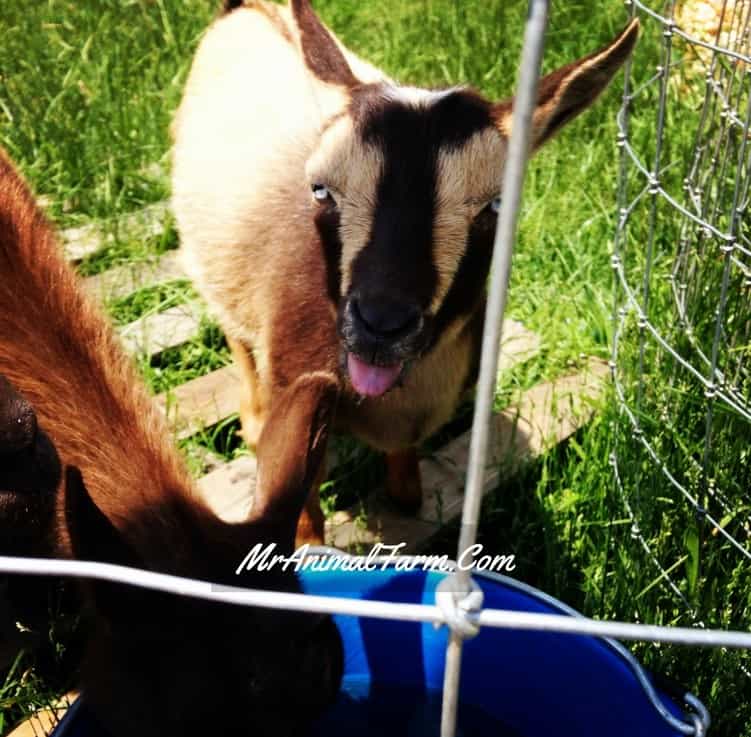
    goat waiting for another to finish drinking
    Cute goat picture for no reason.

    How much are baby goats?

    These are for adults as well as the baby goat price. Pricing is based on genetics so there will likely be no difference between the two.

    The only time there will be significant price differences is when an adult has been proven or when selling a bred doe or doe in milk. Those factors will increase the price of the adult goat.

    Registered vs Unregistered

    Registration is one of the biggest influences over the price, no matter the goat breed.

    Some people don't care about having registered goats. Some are completely comfortable buying a goat off of Craigslist or at auction.

    These are almost always going to be unregistered goats. Goats without registration papers are definitely cheaper but also carry a lot more uncertainties. The only information you have is what the goat owners can tell you (and you have to take them at their word)

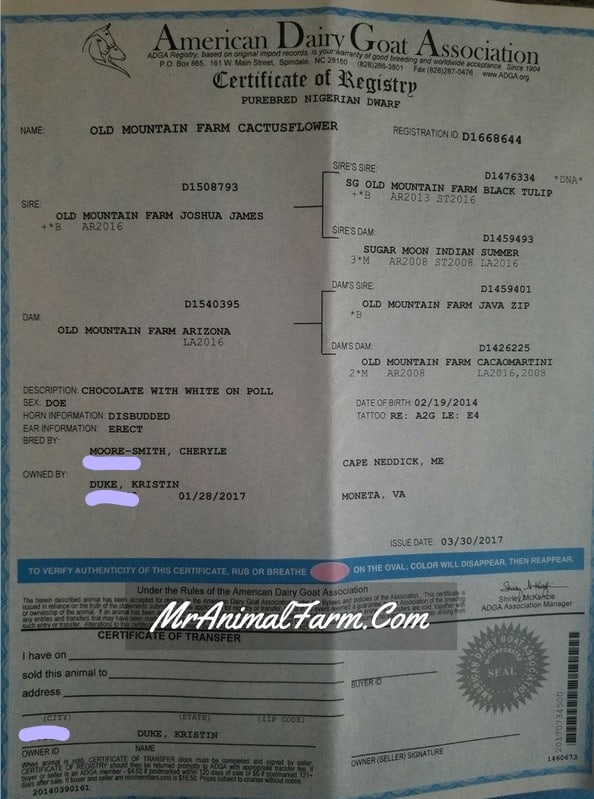
    Goats with registration papers often have a record of their family history. This history let's goat owners track desirable traits and make accurate predictions about future generations.  If you will be breeding goats, having them registered makes it much easier to plan breedings because of this.

    ADGA Goat registration certificate

    For example, if you want good milking dairy goats, you will likely want goats with family histories of high milk production. Registered goats are able to go through milk testing and gain milk stars (Not sure what a milk star is? Here's a whole list of goat terms for you).

    If a goat is not registered, it is much more difficult to determine if a new baby goat is going to produce the volume of milk you will need.

    Registration also creates a personal history for that specific goat. Any honors it has received is added to its record. So, if a goat has placed well in shows or has a proven record of top notch kids, registration will reflect all of this information.

    Personally, from a health perspective, we are more comfortable buying from goat owners that have gone through the registration process. We feel that when goat owners go through the inconvenience of having their herd registered, it is more likely (but not always the case) that they also practice good herd disease management.

    Because of all of the above mentioned reasons, purebred, registered goats are almost always going to cost more. You can use the registration information to help make a breeding goats plan.

    Bucks Vs Does Vs Wethers

    Another factor in price is the gender of the goat. As a general rule, wethers are the cheapest option, does are the priciest, with bucks falling somewhere in the middle.

    If you want pet goats or a companion animal for another goat, you will likely want a wether. Wethers are neutered male goats that have been castrated. Since wethers have no functional purpose (as breeding or dairy goats) they are usually pretty cheap. In fact, sometimes a breeder will offer a discount or even send a wether along with a purchased doe for free.

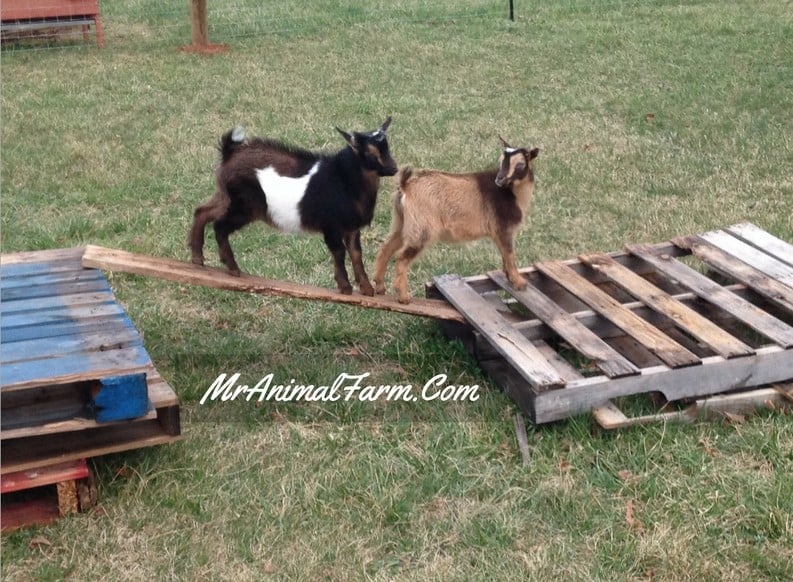
    2 goats playing on a stack of old pallets
    Wethers make great companions for does.

    Bucks range in price depending on their pedigree. A proven buck can go for thousands of dollars but the laws of supply and demand can really make the price vary. Since most people only need a buck or two for a herd of dozens of girls it can sometimes be difficult to sell a good buck and thus will drive the price down.

    Does are almost always the most expensive, especially if they are registered. Does are the goats that will give you milk and more cute baby goats. Because they have so much opportunity for added value to your herd, they are the most expensive.

    Location

    Your location will also influence how much a goat costs. Some areas have a ton of goat farmers while others are spread out. This is another case of supply and demand. If you live in an area with a lot of herd options, you will likely pay less than in an area with a single super star filled herd.

    If you need more help keeping your goats healthy and well taken care of, check out the G.O.A.T. Herd Management System - worksheets, calculators, supply management and more to keep your goats in tip top shape while cutting down on time.

    Access the G.O.A.T. Herd Management System Here
    pinterest image of goat grazing. text reads, "how much does a goat cost?"

    For more about goats...

    [pt_view id="89114c7qgm"]

    14 Gifts for Chicken Lovers

    By MrAnimal Farm

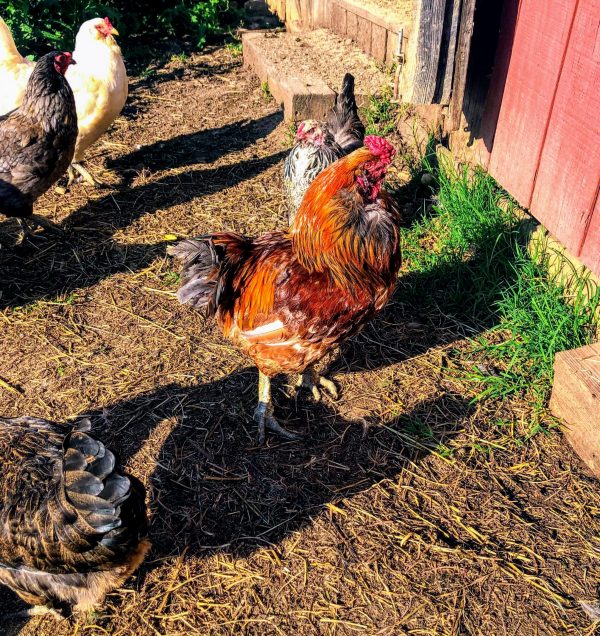
    red easter egger rooster

    Do you know someone who is a Crazy Chicken lady (or man)?  What are the best gifts for chicken lovers?

    Red Easter Egger rooster

    Often times, the best gifts - for birthdays, anniversaries, Christmas and other holidays - are items that incorporate what we love and enjoy. 

    So, if you know someone (or maybe you, yourself) are a chicken lover, take a look at these awesome gift ideas for chicken lovers!  You're sure to find one that they will love!

    We have broken these chicken gift ideas down into 4 general categories:  actual chickens, practical gifts for chicken farmers, chicken themed gifts and chicken jewelry.

    Check out these Awesome Gifts for Chicken Lovers!

    Gifts for Your Actual Chickens:

    What could be a better gift for a chicken lover than, well.....actual chickens?!  Of course, before you buy anyone (even a crazy chicken lady) a live animal you should make sure they have the time, space, money to care for them. No matter how much kids love them, you should always double (maybe triple) check with their parents before giving them live chicks, as well.

    But, if you have the go ahead, getting actual chickens make some great gifts for your chicken loving friend.  You have a few different options you could purchase:

    1) New babies

    You could buy day old chicks for your chicken lover.  You can have chicks shipped or you can find a local chicken breed to purchase from.

    Make sure that you know about all the different chicken breeds and choose the breeds that the person you are buying them for will like the most.  For example, if they love pet chickens get them a breed like silkie chickens and not a dual purpose breed.

    2) Hatching eggs

    Another option you can go for is to buy hatching eggs as a gift for a chicken lover.  Make sure the person knows how to incubate eggs properly.

    3) The Organized Chicken Keeper: A Flock Management System

    The Organized Chicken Keeper gift is kinda for both chickens and their keeper. This is the exact system we use to manage our flock of over 100 chickens and stay ahead of any health concerns that may come up. It also includes a free copy of our chicken feed guide soft you can provide your chickens with all the right nutrients and save money without compromising quality.

    4) Chicken Swing For Their Chicken Coop

    Believe it or not, chickens can get board too. You can help cut their boredom a little bit by giving them some things to do. Hang a chicken swing somewhere in the chicken coop and they will have a blast trying to keep their balance while other chickens try to swing too. They have fun and, honestly, it's also pretty funny to watch!

    Gifts for Chicken Farmers

    If you know a person who is not just a chicken lover or chicken backyard farmer, but is actually a chicken owner, you may want to go with a more practical or useful chicken gift.  Chicken owners are chicken lovers who make a profit with chickens.

    1) Eco glow

    An Eco Glow is one of the best gifts for chicken farmers.  Young chickens need a heat source and heat lamps can be dangerous and have a short life span.  Eco glow's are a radiant heat source to keep your babies safe without using a heat lamp.

    2) Brooder

    A new brooder, rather it be a small premade one or a big wooden chick brooder that you make is a perfect gift for chicken lovers.  True chicken lovers and chicken farmers will always have tons of baby chicks running around and having plenty of space for them is really important.

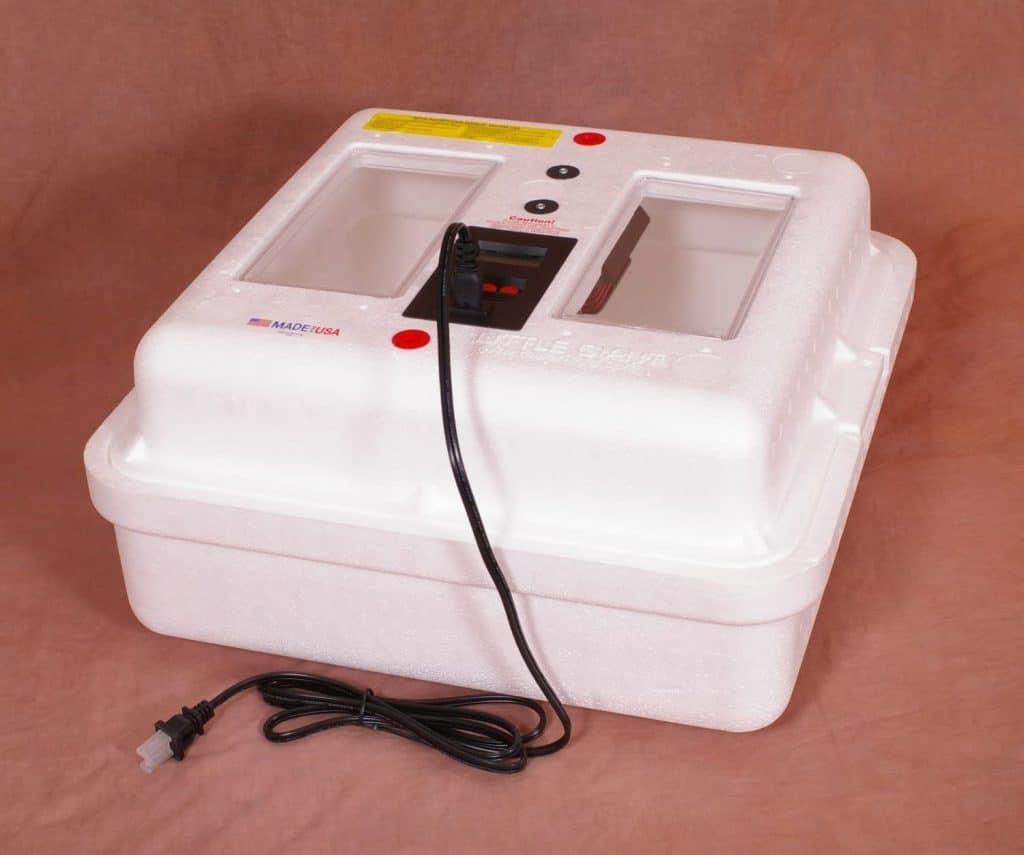
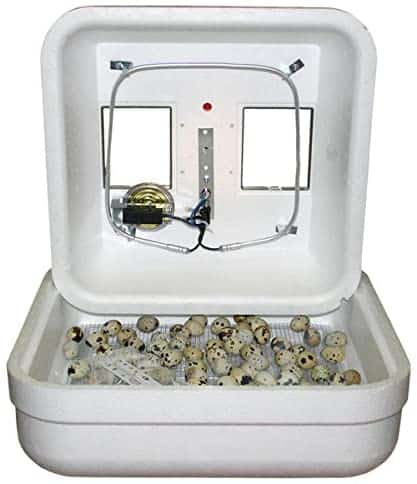
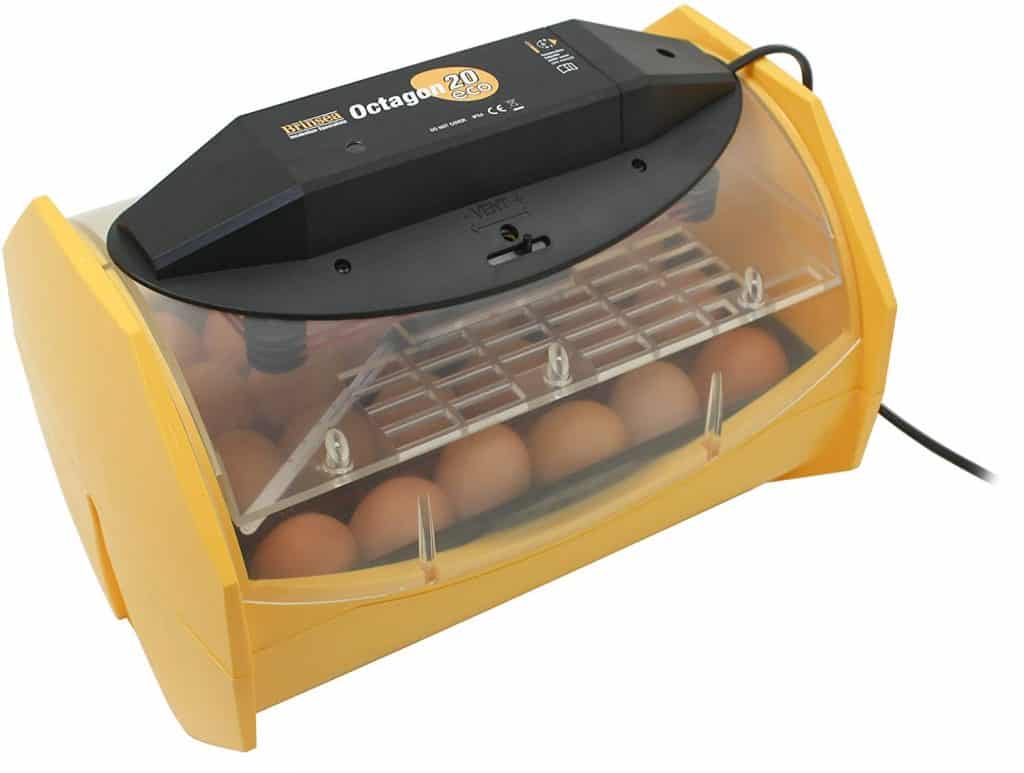
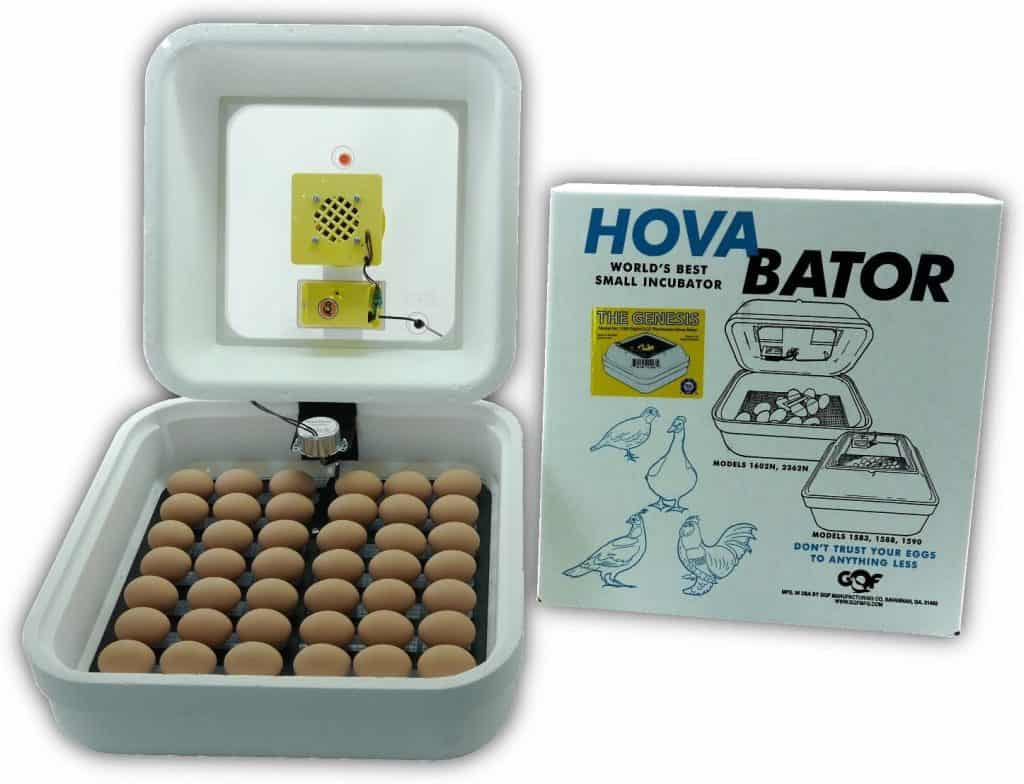
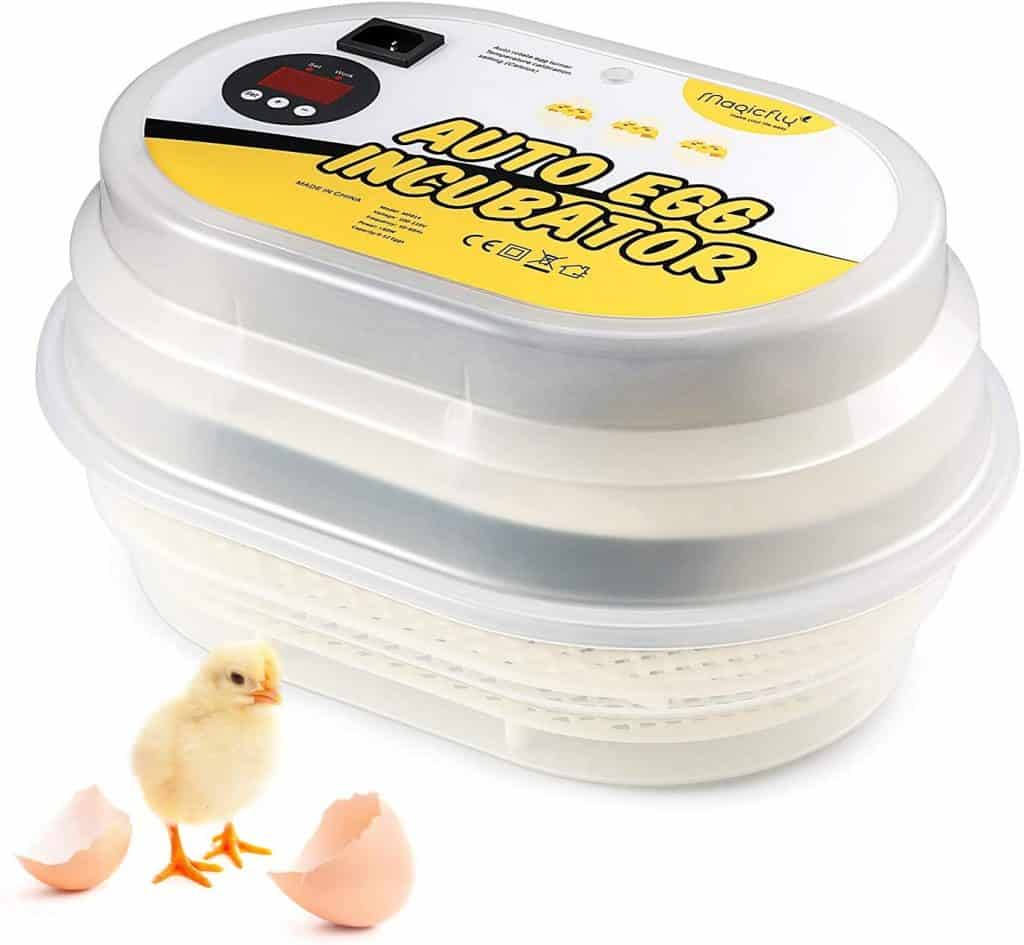
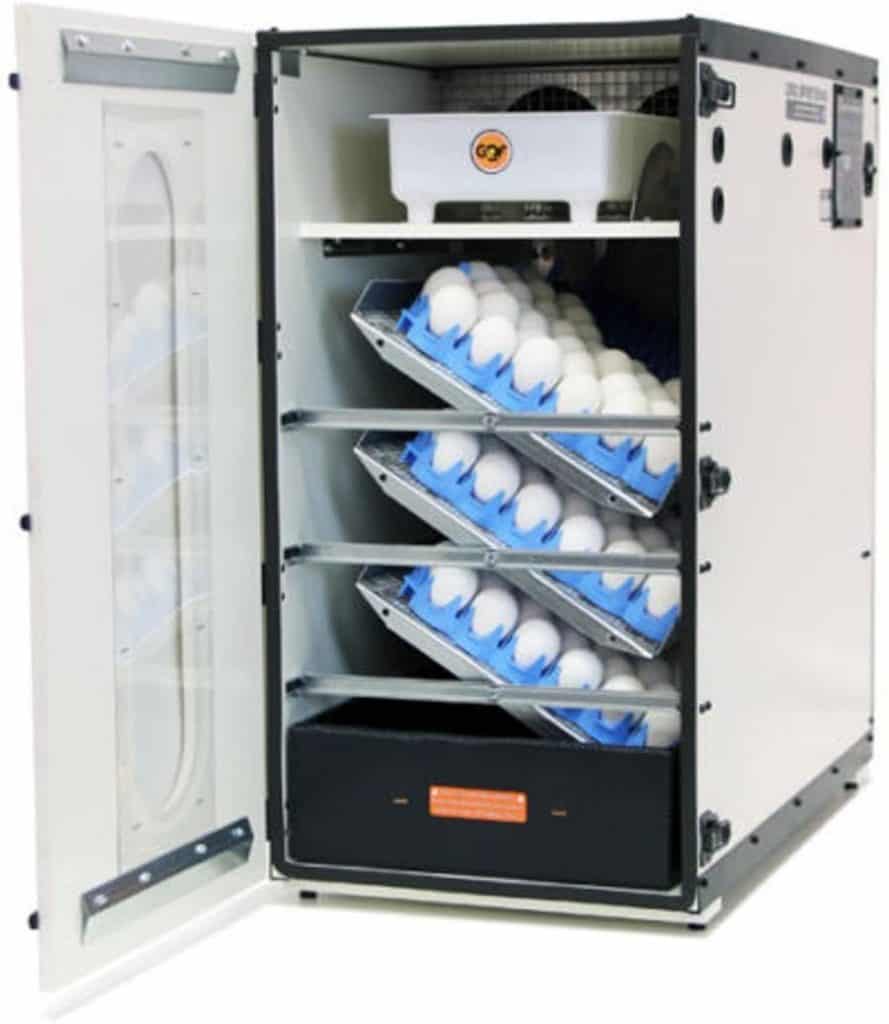
    3) Incubator

    You can splurge if you are buying a gift for a HUGE chicken lover and get them a cabinet incubator so that they can hatch ALL THE CHICKS!

    Or, you can be a little more reasonable and get a smaller little incubator so they can hatch some of the chicks 🙂

    4) Egg Trays or Egg Apron

    You'll need to have items to collect all the eggs your chickens are laying.

    Egg Trays for storage.  If the person you are buying for gets a lot of eggs, I recommend these egg flats.  If they get a smaller amount, I recommend smaller egg cartons.

    Egg Apron or egg basket for while you are out collecting eggs.

    5) Egg Cartons

    When you raise chickens for fresh eggs you will no doubt break a few. Over time, egg cartons can get pretty nasty and have to be thrown out. Giving a gift like this will please even the most skeptical of chicken keepers.

    6) Hand Warmers

    If you know a chicken farmer who is selling baby chicks, they will go through a LOT of hand warmers.  Hand warmers can be used to transport chicks to their new homes locally OR they can be used when shipping live chicks.

    7) Profitable Homesteading Worksheets

    These worksheets could be the best of the gifts for chicken farmers.  They can help an aspiring chicken farmer figure out their actual revenue and expenses.  They can also help them track goals and grow their business.

    Chicken themed gifts:

    1) Shirts

    You can't go wrong with a fun t-shirt for most any occassion.  In the realm of chicken theme gifts, chicken theme shirts are probably the top choice.  Here are some cool chicken shirts.

    2) Coffee mug

    Is your chicken lover also a coffee lover?  Getting a chicken themed coffee mug is one of the most awesome (and practical) chicken gifts that you can choose.

    These two are my favorites:  The Love Chickens mug and this funny saying chicken mug

    3) Socks

    Ok, so in terms of chicken themed gifts, these socks may be a little less practical and just a little more fun.  But, who doesn't like fun?

    If you are going to get chicken themed socks, just go all in and get these crazy knee high chicken socks!

    4) Leggings

    Need another one of the chicken gifts for her (or him, we don't judge)?  Try some chicken themed leggings!

    I especially love the cute, simple pattern on these chicken leggings.

    Chicken Jewelry:

    1) Chicken Earrings

    Need some cute chicken jewelry?  Chicken earrings are a fun gift to give your chicken loving friends!

    2) Chicken Bracelet

    This is the ABSOLUTE cutest chicken bracelet and would is a great piece of chicken jewelry that any chicken lover would enjoy.

    From this list of 14 Gifts for Chicken Lovers, you're sure to find at least one or two gifts that will meet your needs.  And maybe a few gifts for yourself too 😉

    If you need more help with taking care of your chickens, check out The Organized Chicken Keeper for a complete system for managing their health through keeping their supplies stocked and coop clean.

    Access The Organized Chicken Keeper Here

    Gifts for Farmers That Are Useful ALL Year Round

    By MrAnimal Farm

    Gifts for Farmers

    Getting gifts for farmers is tough business. Often times, minimalism comes along with the homesteading lifestyle. If you don't need it, you probably don't want it. This can prove a bit frustrating for your loved ones when the holidays come around and it's time to buy gifts for farmers and ranchers.

    Gifts for Farmers text over barn with snow on it

    So, what do you do in this situation? What do you get a farmer for Christmas? Fortunately there are some things that every homestead needs and most of them are useful all year round!

    So the next time your non-homesteading loved one asks what you want this holiday season, point them to this list of the top farmer gift ideas that are useful ALL year round.

    You may even want to get really specific and find some gifts for chicken lovers, gifts for goat lovers, gifts for gardeners or gifts for food preservers too!

    25 Awesome Gifts For Farmers

    Clothing

    Coveralls

    Working outside, especially with animals, can be pretty dirty work. And while we accept that often times things can get messy, it doesn't mean we like it, especially on our clothes (I'm talking about poop here).

    That is what makes coveralls such a great gift idea for farmers. They keep your clothes from getting too nasty and from wearing out too quickly.

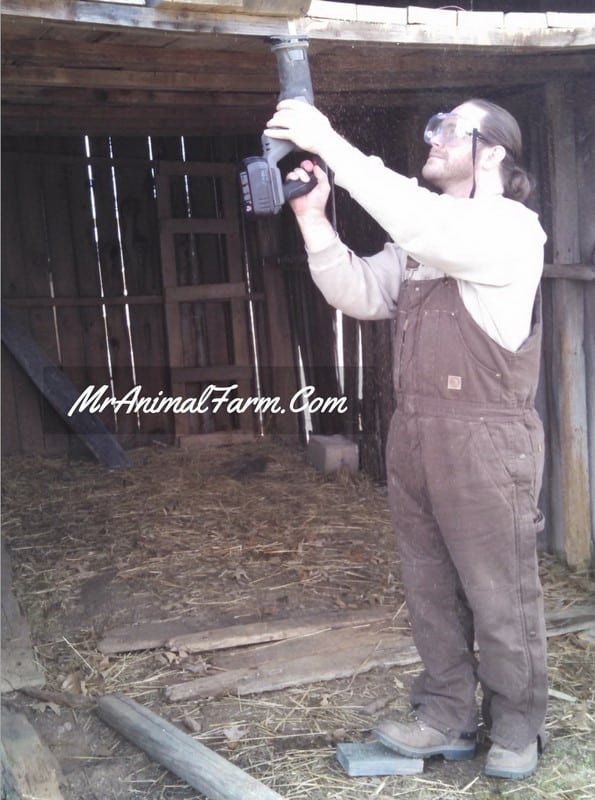
    wearing coveralls while sawing goat stall

    Plus, some have insulation (men and women) which is great for keeping you warm in the colder months. They come in non-insulated (men and women) too. Since they come in both men and women's styles, they make great mother's day and father's day gifts for farmers.

    Boots

    A good pair of rubber muck boots are invaluable. Nothing is worse than being stuck outside working hard with soggy shoes. Rubber muck boots (men and women) are heavy duty, sturdy, and oftentimes have insulation.

    Plus, they are quick to just slide on when you have to run out the door to take care of an emergency project. Water proof boots make an awesome gift for farmer dad, mom, or just anyone.

    Heavy-Duty Work Gloves

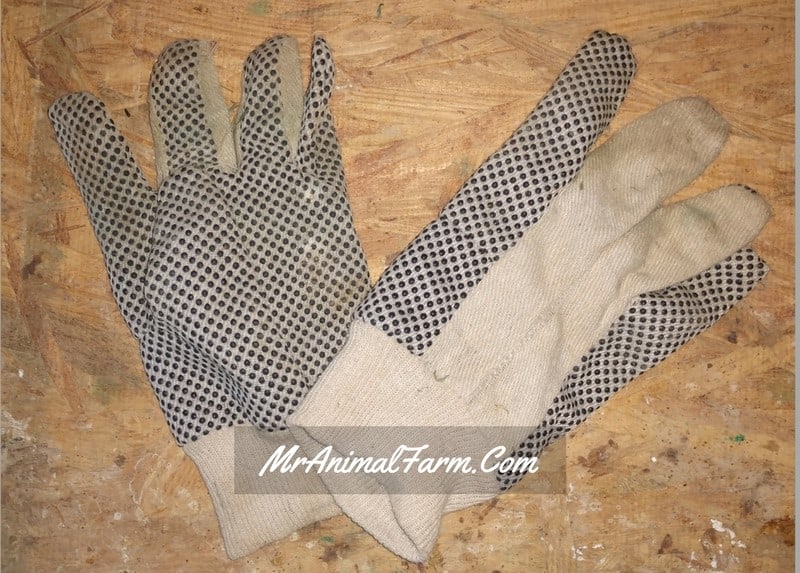
    Homesteading involves a lot of working with your hands and your hands will definitely suffer. A quality pair of heavy-duty thermal lined gloves is one of the best and most useful farmer gifts. They will save your hands from the wear and tear of rigorous farm work.

    work gloves on a piece of wood

    So when it comes to digging, stretching barb-wire, or freeing a groundhog that is caught in your fence (true story), your hands will appreciate this gift for many years to come.

    Single Use Gloves (Throwaway Gloves)

    Sometimes your hands need warmth and protection but also require a bit more dexterity. This is where single use or "throwaway" gloves are handy (pun absolutely intended). The great part about these gloves is despite being known as single use or throwaway, they are actually pretty durable.

    single use gloves

    I have a single pair from a six pack I bought months ago that are still going strong. These gloves are great for tasks like stacking hay and holding screws or nails (they will not provide much protection for a poorly aimed hammer).

    Thermal Under Clothes

    Thermal underwear may be the gift you threaten your kids with when they won't behave but buy some for a farmer and you will see their eyes light up. They are light weight but hold in a ton of heat for those cold Winter days on the homestead. Combine these with some boots and coveralls and you will have a very happy (and cozy) homesteader. Get them for farm boys and farm girls.

    A Heavy Coat

    Last, but certainly not least, a good waterproof, hooded, work coat is a god-send (or in this case, a you-send). Some days are so cold and wet that thermal under clothes and coveralls aren't enough.

    guy with goat in lap
    Lap goat not included

    A nice heavy jacket will keep the weather at bay on those days that chill you to the bone.

    Homesteading and Farming Books, Planners and Courses

    If you are looking for a gift for a farmer or homesteader that is still learning, they may enjoy an educational gift.  Here are some books, planners and courses that may make great gifts for hobby farmers or more serious farmers:

    Raising chickens eCourse

    Raising goats eCourse

    Profitable Homesteading Worksheets

    Goat Breeding Planner

    If you need more help keeping your goats healthy and well taken care of, check out the G.O.A.T. Herd Management System - worksheets, calculators, supply management and more to keep your goats in tip top shape while cutting down on time.

    Access the G.O.A.T. Herd Management System Here

    Tools

    Head lamp

    Okay, show of hands. Who has ever had to run outside at night holding a flashlight in their teeth (while the battery died, no less) or use their phone as a light? I can't tell you how many times this has happened to me. An easy fix to this problem is also pretty cheap. Get an adjustable strap head lamp.

    They are comfortable and generally come with super bright LED bulbs. Plus, the LED bulbs use less energy so they are brighter AND last longer than a regular flashlight. I would flip over this gift for farmers!

    Dry erase board

    Sounds like a boring gift. I promise, it isn't. You can write notes for farm hands, feeding instructions for animals, medication schedules, breeding schedules, etc. The possibilities are endless.

    Once you add this to your barn you will wonder how you ever lived without it.

    Pocket Knife

    Pocket knives are one of the best tools you can carry with you on your homestead. In fact, if this were a ranked list of gifts for farmers, a good argument could be made for this to be at the very top. You can always carry the classic Swiss Army Knife which range in sizes and functions. A good Swiss Army Knife means you will always have a tool with you in a pinch.

    Personally, I prefer to carry a single blade knife with a pocket clip. Most of the work I do on our homestead is right next to the workshop, so I don't need to carry around a multi-tool style knife. The single blade is light weight and stays sharp for a long time.

    pocket knife

    Tool Kit

    No farm is complete without a good tool kit. You can get a great basic set of screwdrivers, ratchet, hammer and wrench for a relatively low cost and be prepared for almost any job that comes your way.

    Zip Ties

    Obviously, in a perfect world, as soon as something breaks we would fix it. Unfortunately, this is not a perfect world and there are times when you need to fix something quickly as opposed to permanently. We have found zip ties to work wonders for so many of our quick fixes.

    Need to pull a chicken from small run but they are hiding just outside of arm's reach? Cut a hole in the wire and zip tie it back together. Got an overly excited buck who is pushing his way through a welded wire fence? Zip tie a few sheets of chicken to that section of fence until you can replace it.

    Measuring Tape

    Measuring tapes come in a few varieties. Everyone needs a standard metal measuring tape that can clip to their work belt. It is essential for anyone that has any desire to build anything.

    We also recommend a reel style measuring tape. They often come in measurements of 100 feet or more. They work great for measuring large sections of land like planning a garden or figuring out how much fencing materials to buy.

    Funny Gifts For Farmers

    Maybe you need some gifts for the farmer who has everything. Maybe they just need a good laugh every once in a while. Here are a few funny gifts for a farmer they may enjoy.

    "I Love Farming" T-Shirt

    This shirt is more for the farmer that doesn't mind a little crass humor (you know you know one like that). Give them a good laugh with this provocative t-shirt!

    Cow Poop Coffee Mug

    Every good farmer needs a good cup (or pot, whatever) of coffee to start their day. Why not give them a good chuckle to go along with it with a funny coffee mug?

    Gifts For Farmer Dad

    Here are several ideas that make great father's day gifts for farmers. These can also pull double duty for any farmer husbands out there.

    Wallet Ninja- 18 in 1 Credit Card Sized Multitool

    This is a really handy tool to have with you. It's not possible to ALWAYS have a tool kit with you but the Wallet Ninja will work in a pinch.

    The Old Farmer's Almanac

    You can't go wrong with a copy of the Old Farmer's Almanac. Grab the most recent edition today and get year long updates on things like weather, gardening tips, astronomy, recipes, folk lore, and more!

    Waterproof, Portable, and Rugged Outdoor Bluetooth Speakers

    Nothing makes time fly when working more than some good music. This outdoor, bluetooth speaker boombox is perfect for farm work. It is waterproof, durable, and has a 40+ hour (rechargeable) battery life.

    Farm Girl Gifts

    Men aren't the only farmers out there. There are plenty of women out there just as capable of building a homestead. They deserve some awesome gifts too.

    "Barn Hair, Don't Care" Trucker Hat

    Keeping your hair out of your face is a must when handling just about anything on a farm. The best way to do that is with a stylish baseball cap.

    "Just A Girl Who Loves Cows" T-Shirt

    Sometimes you just want to let the world know who you are. When those times come, wear your love of cows with pride.

    Massagers for Neck and Back Pain Relief

    After a long day working on your farm, a nice massage would be great. This massager is the next best thing to hiring your own personal masseuse (and any guy farmer that says they wouldn't want this too is lying).

    Best Chicken Feeders

    By MrAnimal Farm

    cup of chicken feed

    Your chickens have to eat. And while they may spend all day scratching around the ground eating anything they can find, they do a whole lot better with a high quality feed. You're going to need a good place for them to access that feed. Here is our review of the best chicken feeders available today.

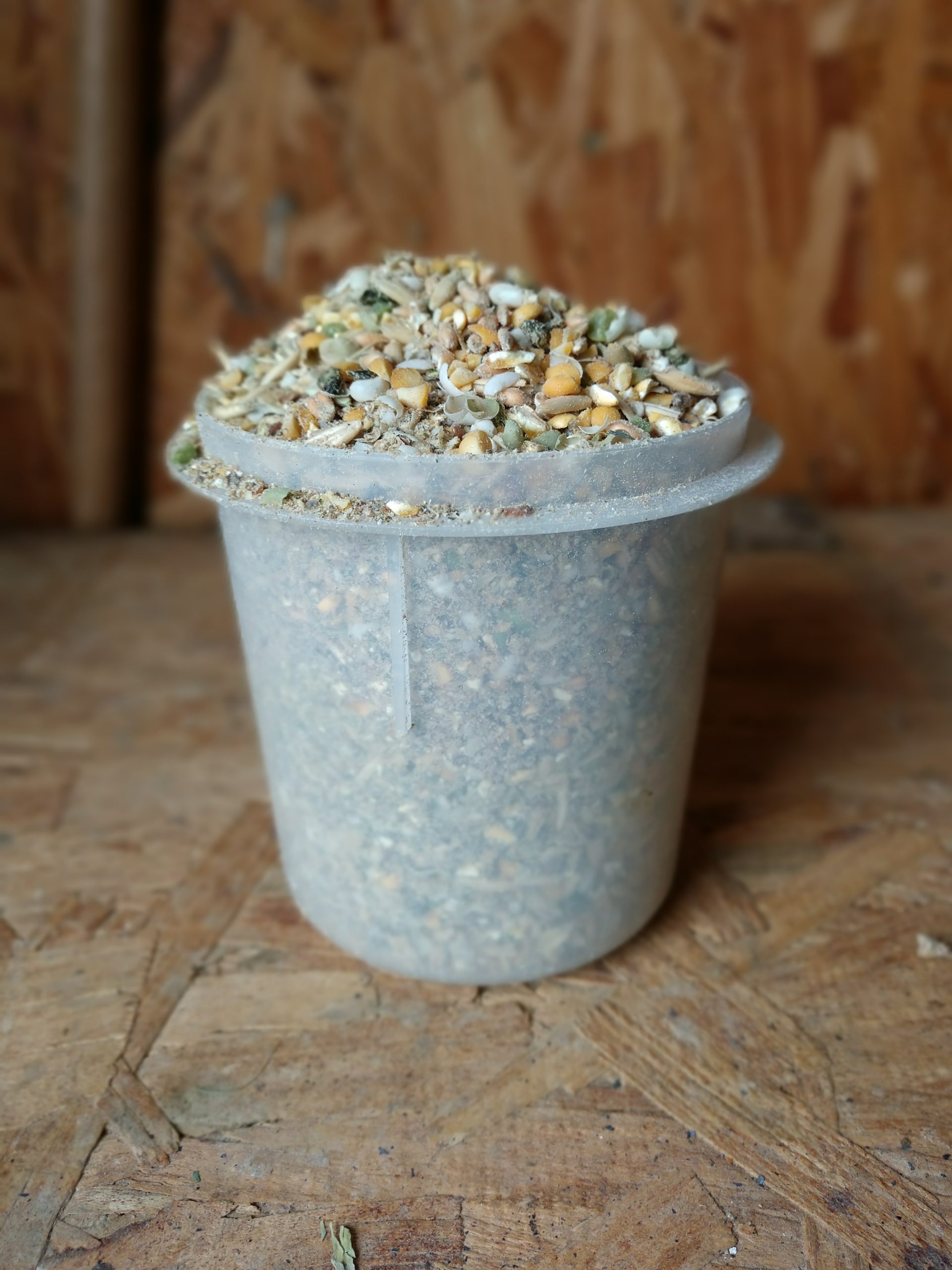
    chicken feed in a plastic cup

    Chickens need 3 things to survive; food, water, and shelter. If you have already built them a chicken coop and picked out the best chicken waterer, all you have left to do is get them a good feeder.

    There are a ton of different styles of feeders (including DIY chicken feeders) and it may be confusing at first. Here is all you need to know to make the best choice for your flock and their needs.

    9 Best Chicken Feeders

    1. Ware Manufacturing Chicken Feeder Trough

    2. Little Giant Large Steel Poultry Feeder Galvanized High Capacity Poultry Feeder, 25 lbs

    3. Duncans Poultry 50 LB Space Saver Wall Feeder

    4. Moultrie Feed Station | Gravity Feeder | UV-Resistant Plastic | 40 lb. Capacity

    5. PestOff Rat Proof Chicken Feeder kit - Rat Proof Poultry Feeder – Weather Proof - 8lbs Capacity

    6. Chicken Feeder-Holds 20 Pounds-Pellets-Crumbles-Grain in Bucket

    7. Hanging Poultry & Gamebird Feeder with Feed Pan, 30 Lb Galvanized Steel

    8. Farm Tuff Plastic Poultry Feeder

    9. RentACoop Treadle Feeder (40 LB) w/ RentACoop 15 LB Capacity Metal Treadle Feeder Extension

    Top Pick

    Out top choice for best chicken feeder is easily the RentACoop Treadle Feeder (40 LB). It is the highest priced model on the list but the security and convenience it provides outweigh the initial investment. Plus, you can purchase additional feeder extensions as the size of your flock increases.

    Types Of Feeders

    Chicken feeders come in three different varieties:

    - free standing
    - hanging
    - automatic/treadle

    Depending on what your specific needs are, you can make use of one or more of the below options.

    Free Standing

    1. Ware Manufacturing Chicken Feeder Trough

    Description: This feeder is a pretty simple design but works great with small flocks. It is your basic feed trough. It also has a wire cage across the top to discourage roosting and scratching.

    Features: Galvanized steel construction, wire scratch guard prevents waste and roosting

    Specifications: Dimensions (L x W x H): 5.12 x 24 x 4 inches, Weight: 1.61 lbs

    Pros:

    - inexpensive
    - heavy duty
    - durable
    - easy to use

    Cons:

    - light weight makes it easy to tip over
    - some chickens can step through wire cage and scratch anyway
    - not good for large flock

    2. Little Giant Large Steel Poultry Feeder Galvanized High Capacity Poultry Feeder, 25 lbs

    Description: This high capacity poultry feeder is super easy to use. It can hold about half of a standard bag of feed and features a chute style design so chickens can eat when they desire.

    The chute has a wire grate across the top to discourage scratching. The unit is also shaped so that a chicken cannot roost on top of the feed and poop in it. This should help cut down on waste.

    Features: comes pre-assembled, galvanized steel construction, holds 25 lbs, works with any type of chicken feed, wall mountable, chute style creates steady food flow, feed saver grid keeps unit from overflowing and chickens from scratching

    Specifications: Dimensions (L x W x H): 12 x 8 x 16 inches, Weight: 8.7 lbs

    Pros:

    - mountable so it won't tip over
    - high capacity
    - small profile saves coop space
    - durable

    Cons:

    - not water proof
    - unit can become clogged
    - only 2 full sized hens can eat at a time
    - flat top allows chickens to roost

    3. Duncans Poultry 50 LB Space Saver Wall Feeder

    Description: Duncan's Poultry Wall Feeder is a high capacity, wall mountable unit. It will hold up to 50 lbs of crumble feed and around 30 of pellets. It is also only 14 inches wide so it can be mounted between wall studs.

    It's galvanized steel frame is heavy gauge and super durable. The lid will stay open for you while you refill and works with any type of chicken feed or supplement.

    Features: holds up to 50 lbs of feed; works with feed, oyster shells, or grit; high capacity but thin enough to mount between wall studs, hinged lid, comes pre-assembled

    Specifications: Dimensions (L x W x H): 14 x 8 x 25 inches

    Pros:

    - cuts down on feed waste
    - eliminates constant refilling
    - wall mountable
    - quality construction

    Cons:

    - advertises 50 lb capacity but some reviews claim closer to 40 lbs
    - may need to be elevated to keep chickens from scratching at feed

    Hanging

    4. Moultrie Feed Station | Gravity Feeder | UV-Resistant Plastic | 40 lb. Capacity

    Description: The Moultrie Feed Station is a simple yet sturdy hanging gravity style feeder. You simply pour up to 40 lbs of feed into the top and gravity pulls it down into the trough opening.

    This unit comes with a mounting strap and can be used to strap to a tree or a post. The construction is a durable, UV resistant plastic so it will not become brittle and crack from being in the sun all day.

    Features: heavy duty, UV resistant plastic construction, 40 lb capacity, includes mounting strap

    Specifications: Dimensions (L x W x H): 10 x 17.5 x 18.8 inches, Weight: 2.3 pounds

    Pros:

    - easy to mount
    - easy to refill
    - inexpensive

    Cons:

    - plastic frame will distort with enough weight making the lid not fit properly
    - loose lid allows moisture to get inside
    - trough design makes it an "all animal" feeder if used outside of coop

    5. PestOff Rat Proof Chicken Feeder kit - Rat Proof Poultry Feeder – Weather Proof - 8lbs Capacity

    Description: This is a pretty clever hanging design. The feed opening is always open. However, if a rodent or other animal tries to pull itself into the feeder, their weight will close the opening.

    That one design aspect is worth the price of admission. If vermin no longer have a food source, they will no longer visit your coop. Which is more hygienic and safer.

    The 8 lb capacity is great for a small flock. It works very well with most dry feeds. It will not work very well with mash or other moist feeds.

    Features: "vermin proof", no special assembly required, 8 lb capacity, works with all dry feeds, easy to clean, easy to refill, money-back guarantee

    Specifications: Dimensions (L x W x H): 15.75 x 8.27 x 8.27 inches, Weight: 2.2 pounds

    Pros:

    - clean design
    - keeps out mice, rats, and other small animals
    - chickens adapt to feeder quickly

    Cons:

    - plastic guard can be chewed by determined animals
    - small opening
    - feed can fall out when chickens peck at food

    6. Chicken Feeder-Holds 20 Pounds-Pellets-Crumbles-Grain in Bucket

    Description: This bucket style hanging feeder is an almost perfect no waste feeder. The port style opening means the chickens must stick their head in the feeder to access the food.

    The port style design means chickens are unable to scratch at the feed and waste it. This unit also includes a No-Roosting cap to keep your chickens from hanging out on top of it.

    It will hold up to 20 lbs of feed and can accommodate up to 6 chickens. It is recommended to have one for every 6 chickens so that they can all eat freely.

    Features: 20 lb capacity, no-roost cap included, bucket style lid keeps water out, resistant to rodents and wild birds, plastic is 100% food grade and BPA free

    Specifications: Dimensions (L x W x H): 10 x 14 x 10 inches, Weight: 2.5 pounds

    Pros:

    - reduces spillage
    - keeps water out
    - RentACoop listens to customer feedback
    - chickens adapt to feeder easily

    Cons:

    - lid can be difficult to remove
    - if chickens peck at feed it can cause a buildup of dust in the feeder
    - ports may be too small for roosters with large combs and waddles
    - small chicks can fall in and get stuck

    7. Hanging Poultry & Gamebird Feeder with Feed Pan, 30 Lb Galvanized Steel

    Description: This is a classic design that you probably think of when you hear "chicken feeder". It's super simple to use. Just dump your feed in the top and the sloped pan in the bottom allows a free flow of chicken feed.

    This unit holds up to 30 lbs of feed and has a 14" feeding pan. You can also find this design in smaller sizes for smaller flocks. It can easily be hung inside your coop and can fit several chickens around it to eat at once.

    Features: galvanized steel, 30 lb capacity

    Specifications: Dimensions (L x W x H): 14.25 x 14.25 x 14.25 inches, Weight: 1.1 pounds

    Pros:

    - easy to use
    - chickens need no training
    - heavy duty design
    - high capacity

    Cons:

    - pegs can be jarred and cause pan to slip loose and spill
    - if not hung, chickens can roost causing it to tip
    - not water proof, at all
    - open top allows roosting chickens to poop into feed

    8. Farm Tuff Plastic Poultry Feeder

    Description: This is the plastic version of the gravity feeder above. It is much less expensive than the metal counterpart but is actually pretty sturdy. It also features plastic guards to discourage chickens from scratching at their feed.

    There is a screw on the top and bottom of the unit that allow you to adjust the flow of the feed. You can also easily hang this unit inside of your coop.

    Features: comes with 6 cups, cups refill themselves, chickens do not have to hit a trigger, hens can dip waddles in large cups for extra cooling

    Specifications: Dimensions (L x W x H): 12.5 x 12.5 x 13.5 inches, Weight: .9 pounds

    Pros:

    - easy to use
    - easy to refill
    - you adjust the flow of feed
    - less expensive than metal version

    Cons:

    - not waterproof
    - open design is prone to allow roosting chickens to poop in their food
    - small chicks can get stuck under the anti-scratch prong in feeding tray

    Automatic/Treadle

    9. RentACoop Treadle Feeder (40 LB)

    Description: This is our overall top pick for best chicken feeder. It is the only automatic/treadle design, as well. It has a metal construction that is sturdy and takes chicken abuse very well.

    The treadle design means the chickens must step on a metal plate in front of the feeder to lift the lid of the trough. Only then can they get access to their food. Since they must keep weight on the plate, it is difficult for them to scratch and waste feed.

    The feed reservoir has a 40 lb capacity and can be expanded up to 70 lbs with the RentACoop 15 LB Capacity Metal Treadle Feeder Extension.

    Features: holds up to 40 lbs (expandable up to 70), lid lock keeps unwanted animals out, pressure plate can be adjusted for smaller bantam breeds, plate design cuts down on spillage, easy 3 step training process

    Specifications: Dimensions (L x W x H): 21 x 14.5 x 14.5 inches, Weight: 27.1 pounds

    Pros:

    - keeps out unwanted animals
    - keeps out water
    - high capacity (up to 70 lbs)
    - easy to train chickens to use

    Cons:

    - materials could be sturdier for the price
    - difficult to assemble
    - smaller breeds, like Silkies, may still have trouble opening lid even when adjusted to lowest setting
    - expensive and cost increases with additional storage capacity

    What To Consider When Buying?

    Before you can make a decision on which feeder you want to buy, here are a few things to consider to help you make a more well rounded and educated choice.

    Type

    As we mentioned there are 3 different types of feeders you can choose from; free standing, hanging, automatic/treadle. Which type is going to best fit the needs of your flock size, coop size, and personal schedule/lifestyle?

    Capacity

    How much feed can the feeder hold? Will it need to be refilled every day or can you fill it once a week?

    If you have a large flock you may want to get a single, high capacity treadle feeder so that you are not wasting much and you don't have to refill as often.

    Flock Size

    The size of your flock will play a major decision in what type of feeder you need. A high capacity treadle feeder may not be necessary for a 4 chicken flock. If you have 20 chickens, you're going to need something bigger than a 3 ½ lb plastic hanging feeder.

    Easy to Clean

    Not to be rude, but chickens can get pretty gross sometimes. If they were your roommate, you would kick them out pronto! What I'm getting at is you will need to clean your feeder from time to time.

    The easier the feeder is to take apart and clean the better. It's a terrible feeling to clean a feeder and then not be able to put it back together.

    Material

    Most chicken feeders are either made of metal or plastic. Both have their benefits and tradeoffs.

    Metal

    A metal feeder is generally going to be heavy and durable. They are capable of supporting a large amount of weight and thus can have a large capacity for feed.

    Metal feeders are often times more expensive than plastic feeders but they usually last for a very long time.

    Plastic

    Plastic feeders are typically more budget friendly than their metal counterparts. They are also a little more fragile and can crack more easily. But, if you care for them a good plastic feeder can last for a long time.

    What type of feeder is best?

    It can really come down to several different variables like the size of your flock, the space you have available, your schedule, etc. If you only have a few chickens and don't mind filling a feeder everyday, a trough may work just fine for you. But if you work late often or have a large flock, you may want something that you fill once a week.

    Where should I put it?

    You will want it to be in a place that it is safe from moisture. You will also want to make it convenient for your chickens to eat as well as to refill.

    Hanging feeders are very popular. If you have an issue with flooding or a rodent problem, you should consider hanging your feeder.

    How Many Feeders Do I Need?

    The average chicken will eat about 4 ounces of feed per day. So you will go through a pound of food per day per 4 chickens. So, if you have a flock of 10 chickens, they will eat about 2 ½ lbs of food per day.

    This means you will need a feeder that can hold a minimum of that amount. This is not factoring in spillage, waste, rodents, wild birds etc. It also means you will refill that feeder every day. If you don't want to refill every day you can either purchase a larger feeder or multiple feeders.

    Top Pick

    Again, our overall top choice is the RentACoop Treadle Feeder (40 LB). It's convenience and ability to expand with your flock is too good to pass up, in our opinion.

    Conclusion

    That's all there is to it! Our full review of the best chicken feeders. Here's to a happy and well fed flock!

    Best Chicken Waterers

    By MrAnimal Farm

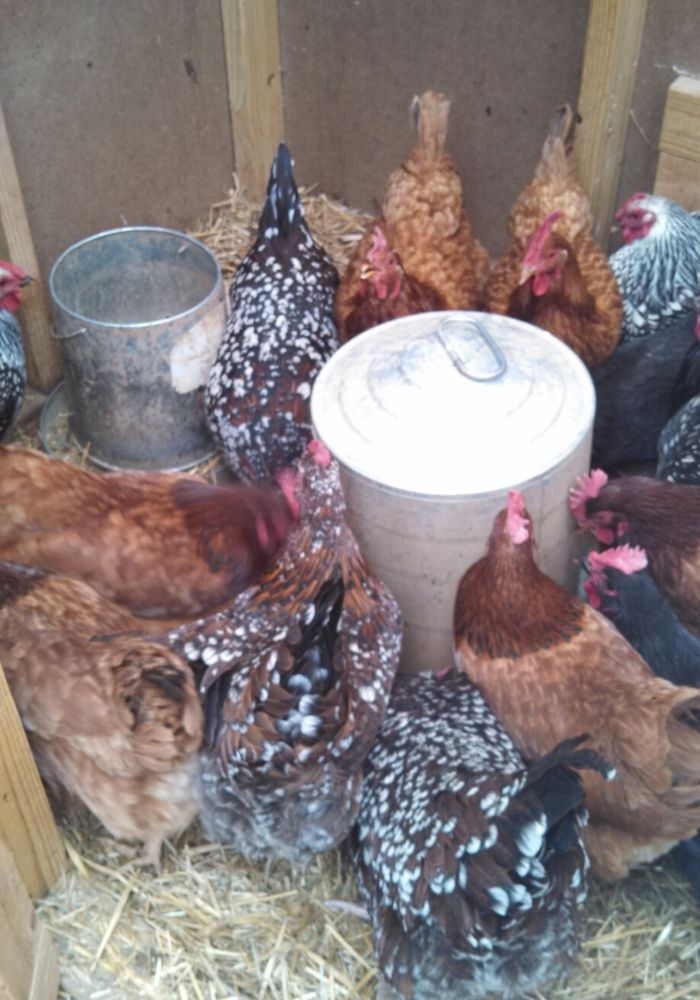
    chickens gathered around waterer

    On a homestead you learn pretty quickly that efficiency is key. If you don't find streamlined ways to do things you will constantly be running fixing little things and never have time for the bigger issues. It may seem like a simple tasks, but having a reliable waterer for your chickens is a HUGE time saver. Here are some of our picks and reviews for the best chicken waterers.

    chickens gathered around best chicken waterers

    Other than feed (which you can give them with one of these DIY chicken feeders), water is the most important thing you can give to your chickens. It is crucial that they have a clean and reliable water source available at all times.

    There are a ton of different types of waterers, made from all types of materials, with a plethora of different features. It can get quite overwhelming to pick one.

    We can help you out with our reviews on 11 of the best chicken waterers available today!

    11 Best Chicken Waterers

    1. Van Ness Stainless Steel Large Dish, 96 Ounce

    2. Farm Innovators Model P-60 60-Watt 1 ½ Gallon Heated Pet Bowl

    3. Little Giant Baby Chick Waterer Base Metal Waterer Base Jar, 1 Quart

    4. LITTLE GIANT Galvanized Double Wall Founts

    5. Harris Farms Plastic Poultry Drinker, 5 Quart

    6. Farm Innovators Model HPF-100 "All-Seasons" Heated Plastic Poultry Fountain, 3 Gallon, 100-Watt

    7. RentACoop 5 Gallon/ 4 Automatic Chicken Nipple Water Cup Chicken Waterer

    8. Fully Automatic Poultry Drinking Machine Chicken Drinking Cup, Chicken Drinking Machine/Poultry Drinking Machine (12 Pieces)

    9. Pack of 6 - RentACoop Automatic Chicken Water Nipple Cup Waterer Kit for Poultry

    10. RentACoop Make Your Own Waterer Kit - Horizontal Side Chicken Nipples + Installation Piece (12 Pack)

    11. Little Giant King Size Automatic Poultry Fount (1.5 Quart) Heavy Duty Plastic Waterer Bowl with Hose Attachment

    More details

    Chicken waterers come in three different varieties:

    - basic (buckets, bowls, water trough, etc)
    - advanced (self contained reservoir, gravity fed, etc)
    - automatic (self monitoring, automatic refills, etc)

    Depending on the size of your flock and available water/electrical sources on your property, one or more of these types of waterers will fit your needs.

    Basic

    1. Van Ness Stainless Steel Large Dish, 96 Ounce

    Description: You can't get any simpler or basic than a metal water dish. Just fill it up and your chickens are good to go.

    This dish is initially designed for a large dog so it holds 96 ounces of water. It features a rubber on the bottom so it won't easily slide around. Since it is made of stainless steel, it is also pretty heavy. The extra weight means it won't easily tip or flip over when your chickens perch on the side of it.

    Features: Stain steel construction, non-skid rubber bottom, 96 ounce capacity

    Specifications: Dimensions (L x W x H): 10.2 x 10.2 x 2.8 inches, Weight: 1.4 lbs

    Pros:

    - inexpensive
    - heavy duty
    - durable
    - easy to break up water when frozen

    Cons:

    - must be manually refilled, quite often with larger flocks and in warmer weather
    - metal design hold cold more easily and freezes quickly
    - water gets dirty easily
    - can be dangerous for chicks and juveniles who fall in and can't get back out

    2. Farm Innovators Model P-60 60-Watt 1 ½ Gallon Heated Pet Bowl

    Description: The next step up from a water dish is this heated water dish. Depending on where you live, a good portion of the year can have temperatures dipping below freezing. When that happens you will have to manually break up the ice so your chickens can drink.

    This heated dish has an internal thermostat that will only activate when temperatures get too low. This will raise the temperature of the water just high enough that it won't freeze. Since it uses a thermostat, you will not be wasting any electricity during warmer days.

    Chickens can be pretty curious and peck things to investigate. The anti-chew coil wrapped cord keeps them from destroying the power cord and keeps them safe from frayed wires.

    Features: heated reservoir keeps water from freezing, even in sub-zero temperatures, has a 1 ½ gallon capacity, thermostat controlled, 5 ft heavy duty cord that has an anti-chew protective coil

    Specifications: Dimensions (L x W x H): 13 x 12.6 x 5.8 inches, Weight: 2.29 lbs

    Pros:

    - high capacity
    - keeps water from freezing
    - anti-chew cord
    - wide base keeps it from tipping

    Cons:

    - must be manually refilled, quite often with larger flocks and in warmer weather
    - water gets dirty easily
    - can be dangerous for chicks and juveniles who fall in and can't get back out
    - short cord limits placement options without extension cord
    - Unit may need to be replaced after a year or two

    Advanced

    3. Little Giant Baby Chick Waterer Base Metal Waterer Base Jar, 1 Quart

    Description: This is the only chick specific waterer on this list. But, if you have chicks, it is really the only one you need. There is not a great variety on chick waterers. Most of the conventional waterers you will see are either too complicated, too dangerous, or both, for a chick to use.

    The design of this waterer is really easy to use. Take a Mason jar, fill it with water, screw the waterer base onto the jar. Then flip it upside down and your babies can drink.

    It is stainless steel and has a wide base so it is next to impossible for them to knock it over. It is also durable so you wont often need to replace it. The basin is shallow and narrow so it is not easy for a chick to fall in and get stuck. Chicks getting stuck in a waterer and drowning is not uncommon and this waterer does a lot to prevent that from happening.

    Features: compact and easy to move around; can fit most Mason jars or 1-quart feeder jar, designed for baby chicks, rounded edges to cut down on chafing and injury, shallow and narrow channel keeps chicks from getting stuck and drowning

    Specifications: Dimensions (L x W x H): 5.5 x 1.13 x 5.5 inches, Weight: .81 lbs

    Pros:

    - universal design allows use with standard Mason jars. No need to purchase additional pieces.
    - designed for chicks so it is safe for them to use
    - stanless steel and durable

    Cons:

    - designed for chicks so you will need a different waterer when they get older
    - depending on how many chicks you have, it will need to be refilled often
    - when used with pine chip bedding, pine can get in water channel and become clogged
    - the hole between the base and the Mason jar can be sharp

    4. LITTLE GIANT Galvanized Double Wall Founts

    Description: This is likely the most common type of chicken waterer you will see. It is made of galvanized steel and is very heavy duty. Your chickens can be as abusive as they like to this waterer and it will not suffer one bit.

    It features a 5 gallon capacity reservoir and is gravity fed. It has a channel large enough for chickens but can also be used with other large fowl breeds i.e. turkeys, ducks, guineas, etc). It's design allows the channel to stay at a consistent level until the internal reservoir is empty.

    We have personally used this type of waterer for years and it always works extremely well. The sloped lid keeps most chickens from roosting and, thus, eliminates droppings from ending up in the water. The narrow design of the channel walls also keep chickens from roosting on the edge and dumping the whole thing over.

    In the colder months of the year you can purchase an additional heated base to use with this waterer. This is a good way to keep your waterer from freezing when temperatures get too low.

    Features: heavy duty galvanized stainless steel, rolled edges keep chickens safe from cuts and injury, tested to be leak proof, sloped top prevents roosting, can safely be used with heated base

    Specifications: Dimensions (L x W x H): 15.2 x 15.2 x 15.2 inches, Weight: 4 pounds

    Pros:

    - high capacity tank (5 gallons)
    - high capacity means refilling less often
    - heavy duty design can handle abuse
    - sloped lid prevents roosting and droppings in water
    - shallow channel and covered reservoir keep water fresh and clean

    Cons:

    - is not cheap
    - when completely full the unit can be quite heavy
    - handle can be flimsy when lifting after filling
    - when water freezes it can be very difficult to open and refill or breakup ice
    - requires an additional unit (purchased seperately) to keep from freezing

    5. Harris Farms Plastic Poultry Drinker, 5 Quart

    Description: Similar to the gravity fed waterer above, this is also pretty commonplace in the chicken coop. The big difference between this and the one above is it is made of plastic.

    Plastic construction has it's benefits. It is easier to clean than metal. It won't rust. It is much, much lighter, and is generally less expensive.

    In our experience with plastic waterers, they work pretty well with a small number of birds. In our breeding pens, they almost all had this or similar waterers. They are easy to refill and keep clean.

    The downside of plastic waterers, of any type, is they do not last for a super long time. If you slip and drop it after refilling, it will likely crack. If it freezes over, the top reservoir piece is usually okay, but the base can crack pretty easily.

    If you use them with a heated base or if you live in a warmer climate, none of this will affect you.

    Features: heavy duty plastic design, easy to fill, easy to clean, can be used with heated base

    Specifications: Dimensions (L x W x H): 10.9 x 9.7 x 10.9 inches, Weight: 1 pound

    Pros:

    - plastic is lightweight
    - less expensive than a metal waterer
    - easy to refill
    - comfortable handle

    Cons:

    - can crack easily if dropped
    - base can crack if water freezes
    - need additional unit (sold seperately) to keep from freezing in cold climates
    - must be refilled manually

    6. Farm Innovators Model HPF-100 "All-Seasons" Heated Plastic Poultry Fountain, 3 Gallon, 100-Watt

    Description: We have another plastic gravity fed waterer as an option. The difference with this unit is that it is heated. If you live in an area with colder winters, you will understand that a heated waterer can save you from a ton of extra work.

    The same concepts apply to this waterer as the others. It has a large reservoir to keep refilling times minimal. The channel for the water is shallow and narrow so it is easy to keep clean.

    Refilling this unit is pretty simple. There is a plug on the bottom that is removable so you can just flip the unit upside down and refill from there. This may be a bit more difficult if you have your cord in an inconvenient location. If you are not able to easily unplug the heating cord, the reservoir is removable, as well.

    Normally, we are more skeptical of a plastic unit due to cracking in freezing conditions. However, this unit is heated and, thus, should not have the same issues.

    Features: high capacity reservoir, heavy duty plastic design, heated to prevent freezing down to 0 degrees F, internal thermostat only heats when needed

    Specifications: Dimensions (L x W x H): 12 x 16 x 12 inches, Weight: 2.25 pounds

    Pros:

    - electric heater keeps it from freezing
    - fills from the bottom so you don't have to remove the lid
    - thermostat only engages heat when needed
    - plastic design is lightweight
    - can be used on the ground or suspended

    Cons:

    - must be refilled manually
    - flat top can encourage chickens to roost
    - roosting can require cleaning more often
    - can overflow if not completely level
    - short electrical cord

    Automatic

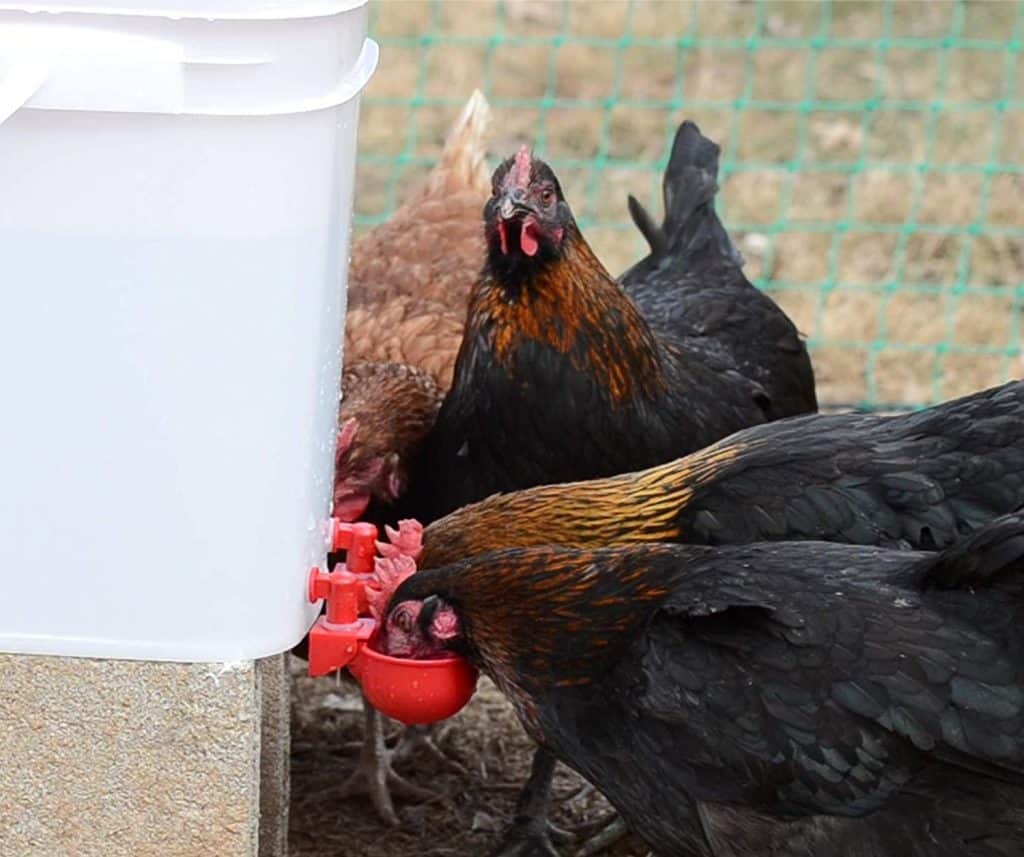
    7. RentACoop 5 Gallon/ 4 Automatic Chicken Nipple Water Cup Chicken Waterer

    Description: This is the first automatic waterer on the list. The cup design is intended to keep down water waste and provide a steady supply of fresh clean water.

    As the chickens drink, the weight of the water decrceases. This causes the cup to lift slightly, opening the valve to the reservoir. Once the cup is full enough, the weight of the cup causes it to lower and close the valve. This process repeats ad infinitum (or at least until the reservoir is empty).

    The reservoir is huge, holding up to 5 gallons of water! The lid is a standard square lid and makes removing and refilling a breeze. The reviews state. as well as the Amazon description, that the attached handle is not strong enough to support the it's weight when full.

    It is recommended setting this waterer on a cinder block in the center of your coop. You can hang it but not from the handle. You will need to purchase an additional strap to hang it safely.

    The reservoir of this unit is able to be heated, however, the heat will not transfer to the individual cups. So, while the water may not freeze in the reservoir, the cups will freeze in really cold temperatures.

    Features: cups refill themselves, chickens do not have to hit a trigger, hens can dip waddles in large cups for extra cooling, can hang with purchase of additional strap

    Specifications: Dimensions (L x W x H): 10 x 12 x 14 inches, Weight: 2.35 pounds

    Pros:

    - easy to setup
    - minimal waste so less time is spent refilling
    - cup system keeps water fresh and clean
    - large lid makes refilling easy
    - cups are large enough for chickens to soak their waddles while drinking allowing them to cool in hot weather

    Cons:

    - cups will not work in freezing conditions
    - cups are so low on the unit that they can break when setting the bucket flat on the ground
    - can leak if not level
    - must be hung and handle is not strong enough. Must purchase additional strap to hang securely.

    8. Pack of 6 - RentACoop Automatic Chicken Water Nipple Cup Waterer Kit for Poultry

    nipple cup waterer

    Description: If you like a more hands on approach, this option is for the cup system from the above unit. You can get the cups, but will need to provide the other materials yourself. You will also need to assemble it yourself following the provided instructions.

    This has all the same benefits as the system listed above at about half of the cost. You'll have to put in a little more elbow grease to get started but most homesteaders are used to that anyway. Water cups come in a six pack so you can make two 3-cup waterers or have a few extras in case something breaks.

    Features: comes with 6 cups, cups refill themselves, chickens do not have to hit a trigger, hens can dip waddles in large cups for extra cooling

    Specifications: Dimensions (L x W x H): 9 x 8 x 4 inches, Weight: 6.4 ounces

    Pros:

    - minimal waste so less time is spent refilling
    - cup system keeps water fresh and clean
    - cups are large enough for chickens to soak their waddles while drinking allowing them to cool in hot weather

    Cons:

    - cups will not work in freezing conditions
    - cups are so low on the unit that they can break when setting the bucket flat on the ground
    - can leak if not level

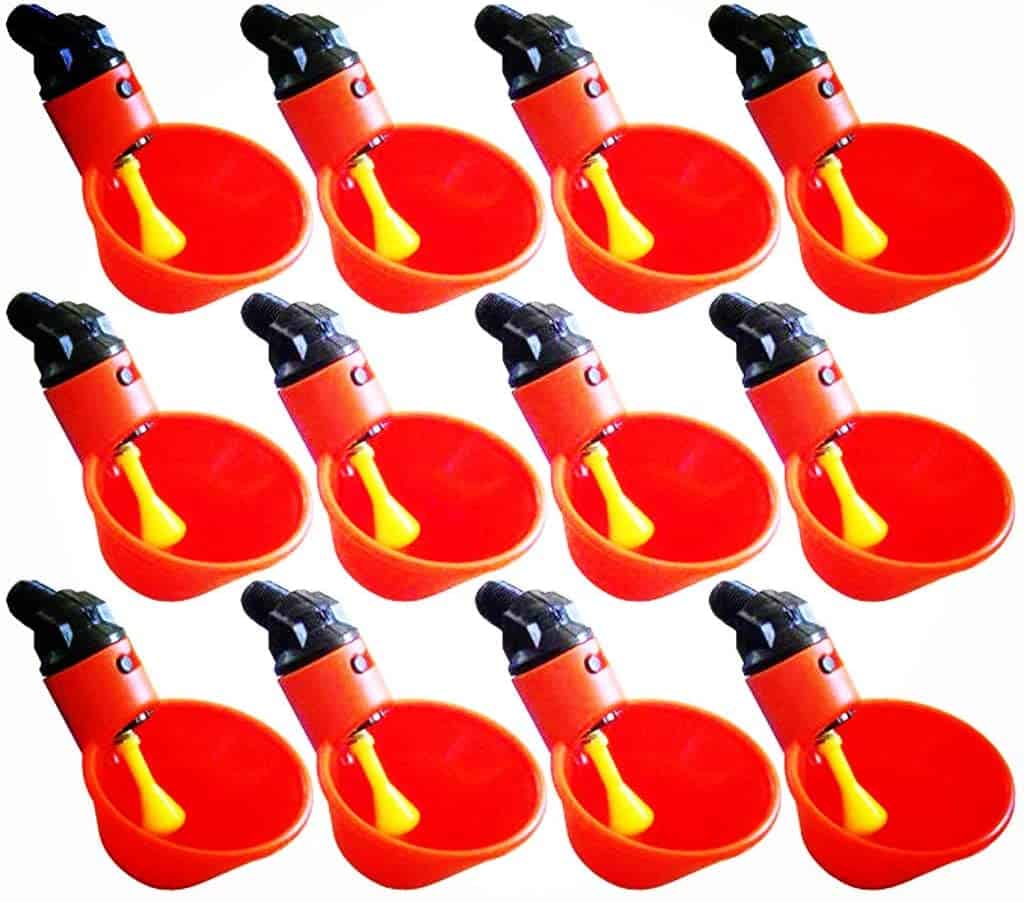
    9. Fully Automatic Poultry Drinking Machine Chicken Drinking Cup, Chicken Drinking Machine/Poultry Drinking Machine (12 Pieces)

    chicken waterer cups

    Description: Again, if you prefer to go the more DIY route, you may like this waterer option the most. Instead of a full waterer, you can pickup the automatic cup attachment and make your own waterer.

    This comes as a 12 pack which is enough to make 3 good sized (5 gallons or so) waterers. You will just need to provide the buckets and assemble them yourself, following the provided instructions.

    Each cup has a bright yellow trigger, to which chickens are attracted to. They will peck the trigger, releasing the valve, causing the cup to fill with water. The valve only opens when pecked and only fills enough for the chicken to drink.

    This design helps cut down on water waste and pads in more time between refilling. Cleaning is pretty simple as each cup is easy to remove and small in size.

    Just like the unit above, you can heat the water bucket but not the cups. However, because this unit has a trigger mechanism, the cups are less likely to freeze.

    Features: bright yellow trigger makes training chickens to cups easier, chickens filling cups is completely automatic, cups do not refill unless triggered so there should be no leaks

    Specifications: Dimensions (L x W x H): 3.5 x 2 x 2.5 inches, Weight: 4.8 ounces

    Pros:

    - low cost
    - trigger system makes leaks and water waste minimal
    - less leaks and waste means longer times between refills

    Cons:

    - not a complete watering system, must provide reservoir and assemble yourself
    - some reviews state that cups can be leaky
    - may require additional tools to assemble correctly

    10. RentACoop Make Your Own Waterer Kit - Horizontal Side Chicken Nipples + Installation Piece (12 Pack)

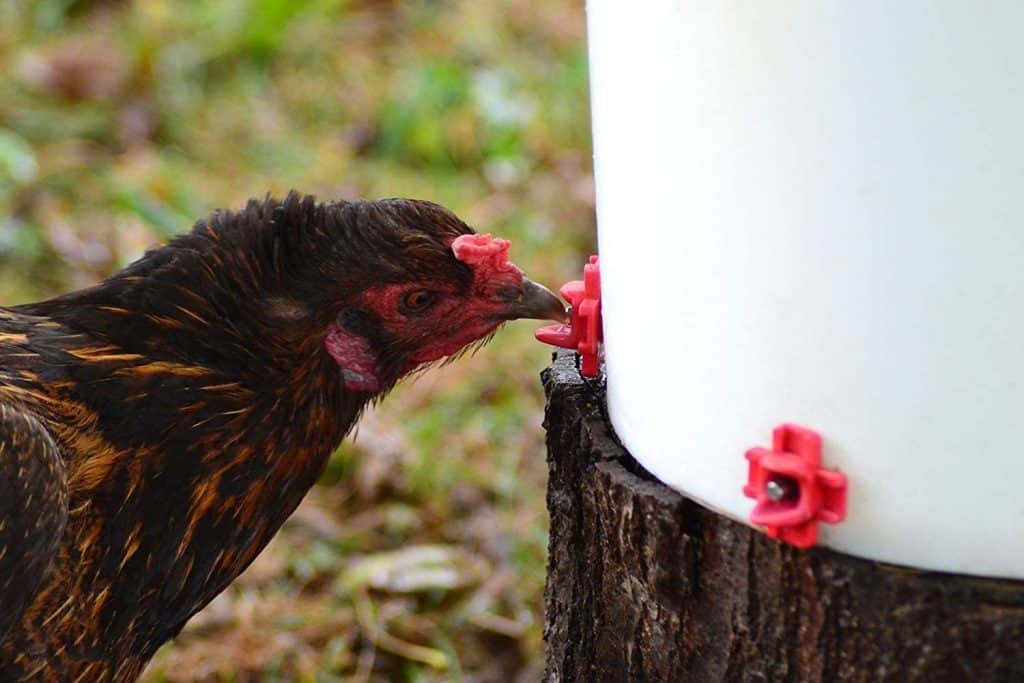
    make your own chicken waterer

    Description: This is the final DIY entry on this list. Like the previous two, you will need to provide your own reservoir and follow the provided instructions for assembly.

    The horizontal nipple system is great because it requires the chicken to hit a trigger to release the water. If they don't hit it, it won't release and there is no cup or channel with water that can be splashed out or gotten dirty. The chicken's water stays fresh and clean.

    Another benefit is, unlike the previous cup based automatic waterers, horizontal nipples will not freeze in cold weather, provided the reservoir has a heat source.

    Features: simple flush design allows waterer to sit anywhere, can be used on multiple reservoirs (cooler, PVC pipe, 55 gallon rain barrell, etc), inexpensive, works with chickens of all ages

    Specifications: Dimensions (L x W x H): 6 x 4 x 1 inches, Weight: 4.2 lbs

    Pros:

    - inexpensive
    - will not freeze
    - works on any size reservoir
    - any size/age of chicken can use it

    Cons:

    - must provide reservoir and build yourself
    - must train chickens to nipple

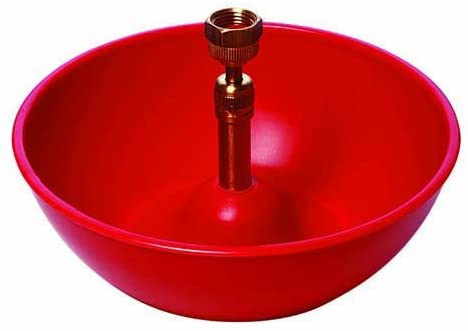
    11. Little Giant King Size Automatic Poultry Fount (1.5 Quart) Heavy Duty Plastic Waterer Bowl with Hose Attachment

    poultry fountain

    Description: Last, but not least, is the only true, completely automatic waterer.

    You just connect a hose, set your preferred level using the adjustment nut, and it will keep your chickens watered indefinitely. It will hold up to 1 ½ quarts of water and will keep up to 250 chickens watered.

    It does require a bit of effort up front, but can be worth it to not have to worry about refiling aver again. The reviews state that a lot of people will hook it to a PVC pipe and have water constantly flowing to it. Because it works on a pressure system, it will not overflow when the water reaches the appropriate height.

    It is also not heated which can open things up to freezing. However, if freezing is not an issue in your area, this can be a perfect solution for your watering needs.

    If roosting is an issue, you will need to purchase an additional bowl guard.

    Features: constant water flow means never having to refill, connects to any standard half-inch NPT pipe, strong flow rate, high capacity of water can water up to 250 chickens

    Specifications: Dimensions (L x W x H): 10 x 10 x 4 inches, Weight: 6.4 ounces

    Pros:

    - completely automatic means never having to refill
    - large bowl can accommodate up to 250 adult birds
    - made from durable heavy plastic

    Cons:

    - price
    - need to purchase additional bowl guard if you want to avoid roosting
    - may require additional plumbing if you do not want to use a hose

    Why do you need a waterer?

    Chickens, just like any living creature (humans included) need water to survive. The average chicken needs at least a pint of water a day. This amount can vary depending on the weather and temperature, as well.

    Your chickens need a waterer so that they can have a constant supply of fresh, clean water whenever they need it.

    Where should it go?

    That really depends on your coop setup. If at all possible, it should go in their coop with them. Chickens get thirsty just like us and shouldn't have to go overnight without access to water.

    If it is not possible to keep it in their coop, it should be in a location that is easily accessible for your flock. We like to keep our waterers elevated at least 6 inches from the ground to help keep dirt and debris from collecting.

    What To Consider When Buying?

    You've gone through the list and have several options. Now, how do you decide which are the best chicken waterers for you? Here are a few things to consider when making that choice.

    Size

    How big is the waterer in comparison to your coop. As we mentioned above, it is preferable to have the water inside the coop. If that isn't an option, how much space do you have available for their waterer?

    Design

    Do you want something that is as simple as a bowl on the ground? Would you like something that is a bit cleaner and doesn't need as much attention? Do you have enough time to make sure it is full every day?

    These are some of the questions you'll need to answer when deciding on the appropriate design for you. An automatic waterer may fit your schedule better than a bowl or a gravity waterer.

    Flock Size

    How big is your flock? If you only have 3 or 4 chickens, you may not need an automatic waterer capable of watering 250 chickens. A bowl may work just fine (cleanliness aside).

    If you have a medium sized flock, you may want to pick out a 5 gallon waterer instead of a 3 gallon. This can save you a day or so between refilling times.

    Heating

    Do you want your waterer to be heated? If you live in a warmer climate, this isn't an issue. But if you live in an area where temperatures can dip below freezing, you'll find out quickly that breaking up frozen waters is no fun.

    You can buy self heating waterers or standard waterers with an additional heated base.

    Material

    How and with what the waterer is made is also an important factor. The two primary materials used in waterers are metal and plastic

    Metal

    Metal tends to be sturdier and last longer than plastic waterers. However, they are also much more expensive and can rust. Even the galvanized steel waterers that claim to not rust can show rust under the right conditions; like hard water, for example.

    But, if you have a particularly rowdy flock or a flock protecting dog that likes to chew things, a strong and durable metal waterer may be exactly what you need.

    Plastic

    Plastic waterers are almost always less expensive than metal ones. They can be a bit more fragile, especially in cold weather. But, with the proper care, they can last a really long time and save you a ton of money. Especially if you have a waterer that can hang, your chickens are less likely to be able to destroy it.

    Ease Of Use

    Finally, how easy it is to maintain is possibly the most important factor. Depending on which waterer you pick it may need to be refilled often. You will want this to be an easy task.

    Even waterers that don't need refilling will need to be cleaned. You will want t waterer that is easy to disassemble, but also, and more importantly, easy to reassemble. You don't want to spend a lot of money on a nice waterer only to clean it and not be able to reassemble it without it leaking

    Conclusion

    There you have it! Our full review of the best chicken waterers. Here's to a happy flock of well hydrated chickens!

    How Long Do Chickens Live? The Life Cycle of A Chicken

    By MrAnimal Farm

    4 baby chicks in the grass. text reads, "how long do chickens live. the life cycle of a chicken"

    If you have your own chicken flock, or maybe you're just starting to raise baby chicks, you may start asking yourself "how long do chickens live?"  After all, you will want to be prepared for how long you will have your chickens, right?

    4 baby chicks in the grass. text reads, "how long do chickens live. the life cycle of a chicken"

    When we started thinking about getting chickens, one of the first questions that we had was "how long do chickens live?".  We wanted to know how long we might have our first chickens as well as how often we may need to replenish our layer flock.

    So, how long do chickens live?

    In general, chickens live to be around 5 or 10 years old. That makes their average lifespan around 8 years, give or take. Now, that's the simple, easy answer.  But, there are a ton of factors that can make a huge difference in how long they will actually live.

    Other factors to consider

    First, although the life cycle of a chicken may average 8 years - that is just how long they can live in general.  Most chickens these days, especially ones in backyard chickens probably live much shorter lives. Why?

    Predators

    Other than those specific chicken breeds being raised for slaughter (meat birds), predators are the leading cause of a premature chicken death. I can't tell you how many times we get messages from people who have purchased silkies or pullets asking if we have more available because something got their birds. Building them a safe and secure chicken coop and run will help significantly extend your chickens' life span.

    General health

    Another factor is their care.  There are a lot of people jumping into backyard chickens.  Which is great - they can experience fresh eggs (which are SO good), as well as have some adorable pets.

    However, most people with backyard chickens aren't going to run their chickens to the vet (like they might their dog) if they get sick.  And the fact is, chickens can be fragile at times. 

    Baby chicks need certain care.  Adult chickens can get all sorts of things like Marek's or respiratory diseases - sometimes simply from wild birds flying through.

    That's not to say that raising chickens is SUPER hard, it really isn't that bad 😉  However, when issues do arise, the likelihood that chickens are getting top notch medical care is just not realistic.

    So, clearly, health and medical care will play a large role in the answer to the question how long do chickens live.

    Need some help keeping your chickens health and care taken care of? Check out the Organized Chicken Keeper for an easy to follow system.

    Housing and supplies

    Having a clean and secure chicken coop is essential to keeping your chickens healthy and safe. If you make sure their hatch door is secured and the windows are AT LEAST doubled covered with chicken wire, it will go a long way to keep them safe from nocturnal predators. Remember, a good chicken coop is the best defense against predators.

    Another way to keep them healthy is to make sure they have a dedicated feeder. You can buy or build a DIY chicken feeder yourself. They'll also need high quality food, and the best chicken waterer you can get.

    Slaughter

    Slaughtering also skews the data a bit in favor of hens since they are generally seen as more "valuable" because of their egg laying ability. Roosters are often seen as "disposable" and are slaughtered at a much higher rate. So it's not exactly clear whether hens or roosters would live the same amount of time or not.

    Side note: we do not find the terms valuable or disposable to be a very humane way to view any living creature. The above terms are in quotes because that is a common viewpoint we have come across over our time as farmers. Raising your animals for meat is a personal decision and we do not cast judgement on those that do. We only find that particular verbiage to be inhumane.

    ::steps down from soapbox::

    Does Breed Type Affect how long they can live?

    Yes! The breed of chicken can definitely play a large role in a chicken's lifespan.

    Meat breeds

    For example, just out of purpose, most chicken breeds used as meat birds, such as Cornish Cross and Jersey Giant, are not going to live very long.  Not only are they butchered young, but most are bred to grow very quickly.  This fast growth often times can cause significant health issues if they are alive much after butchering age.

    How Long do chickens live before slaughter?

    Most chicken breeds used as meat birds live to about 2 or 3 months before they are butchered.  Raising meat chickens can be a much different experience than raising birds for egg production.

    High egg production breeds

    Also, there are production chicken breeds, like sex link and leghorns.  These chicken breeds are bred to have large eggs and to produce like gangbusters quickly. 

    This means they start laying early and lay super often (5 - 7 times a week usually).  So, how long chickens lay eggs can affect their overall lifespan.

    flock of juvenile age chickens

    This constant egg laying can ultimately take a toll on their overall health and potentially cause health issues.  Which can cause them to have a shorter life span.

    Heritage chicken breeds

    Many heritage chickens can have longer life spans. Many are dual purpose chickens. That means they are bred to be decent egg layers but can also be raised for meat.

    Since they aren't bred for high production of either there is less of a pull on their body's resources. Therefore they can live longer. Some more well known heritage chickens are Rhode Island Reds, Black Australorp, and Barred Rock.

    How long do bantam chickens live?

    Bantam chickens should have the capability of having the same lifespan as other chickens within their same breed.  However, being a bantam means being smaller and this can make them more susceptible to getting taken by predators.

    white chicken

    As you can see, a chicken's life span really can vary.  On average, as we have reviewed, it's about 8 years.

    However, that answer is not really the end all, be all as there are a lot of other factors that will be at play.  Particularly, the chicken breed, medical care, health, and potential predators all contribute to exactly how long a chicken can live.

    In our flock, we do have a few girls who have reached the 8 year age range now and still seem to be clucking along just fine 🙂  However, unfortunately, it is more common to lose some chickens earlier in life due to predators and other issues.So, when you are thinking about getting chickens, it's probably best to assume that 8 or so years is about how long they'll live - that way you are prepared to have and take care of your chickens for their entire lives if they make it to a ripe old age. 

    However, be prepared, that is can be normal to lose chickens at a younger age when all of the life variables are taken into account.

    If you need more help with taking care of your chickens, check out The Organized Chicken Keeper for a complete system for managing their health through keeping their supplies stocked and coop clean.

    Access The Organized Chicken Keeper Here

    Best Egg Incubators

    By MrAnimal Farm

    chicks hatched in incubator

    When we got our first chicks we never dreamed we would dive into the world of hatching. But we very quickly picked up a small Brinsea incubator and not too long after that we bought our first cabinet. If you are following a similar path and want to know the best egg incubators you can buy, you've come to the right place

    incubator full of chicks

    When it comes to egg hatching, we've done it all. Seriously, we've used small incubators, cabinet incubators. We've stuck eggs under a broody hen; we've done it all.

    We have distilled that experience and made this list of the top 7 best egg incubators. They vary in size and features but should cover your needs, no matter what the may be.

    7 Best Egg Incubators

    1. Little Giant White Miller Manufacturing Company 9300 Digital Still Air Incubator

    2. GQF Thermal Air Hova-Bator

    3. Brinsea Manual Egg Incubator - Octagon 20eco

    4. HovaBator Genesis 1588 Advanced Egg Incubator Combo Kit

    5. Magicfly Digital Mini Fully Automatic Egg Incubator

    6. GQF 1502 Cabinet Incubator Hatcher

    7. Brinsea Ova-Easy 380 Cabinet Incubator

    More details

    Incubators can be split into 3 categories; still air, circulated air, and cabinet/automatic. Depending on your incubating goals, you will want to choose according to one of these categories.

    Still air incubators

    Little Giant White Miller Manufacturing Company 9300 Digital Still Air Incubator
    best egg incubators

    Description: The Little Giant Digital Still Air Incubator features an LED lit LCD display with temperature and humidity reading. This unit has both a thermostat and hygrometer built into the display. The digital control panel is located directly between two large viewing windows so you can observe your eggs and chicks without disrupting the temperature or humidity levels.

    This incubator is made of a sturdy and durable styrofoam. The styrofoam material also helps insulate and maintain a consistent temperature. This is the lowest price incubator on this list and is an excellent choice for an entry level incubator.

    Features: large windows for viewing, built-in thermostat, holds 41 chicken eggs or 120 bantam/quail eggs, styrofoam build insulates and retains heat

    Specifications: Dimensions (L x W x H): 17.75 x 17.75 x 8 inches, Weight: 3.1 lbs

    Pros:

    - quiet
    - low price
    - backlit, digital display for easy temperature reading
    - large viewing windows so you can see and not disturb your eggs/chicks

    Cons:

    - temperature can fluctuate and create "hot spots"
    - made of styrofoam
    - built-in hygrometer is not always reliable. May need to purchase one separately
    - may need to experiment with egg placement to insure proper temperature

    GQF Thermal Air Hova-Bator
    best egg incubators

    Description: GQF and their Hova-Bator product line are a well known manufacturer of incubators. In fact, we owned one of their cabinets featured later in this list). This Hova-Bator is another choice at a great price point if you are looking to get into incubating your own eggs.

    This model features two small windows on the lid so you can observe your eggs and chicks without disturbing them too much. Its large size accommodates up to 42 chicken eggs. However, it is able to stay lightweight at under 2 lbs due to its styrofoam build.

    The temperature requires manual adjustment. You also must turn your eggs manually, however, there is an automatic turner that can be purchased separately.

    Features: exhaust system allows constant flow of air, two viewing windows, can hold 42 chicken eggs

    Specifications: Dimensions (L x W x H): 46.35 x 46.35 x 13.08 inches, Weight: 1.18 lbs

    Pros:

    - easy to clean
    - well known brand
    - low cost
    - lightweight

    Cons:

    - large footprint
    - difficult to add water
    - thermometer can be unreliable
    - will need hygrometer

    Circulated air incubators

    Brinsea Manual Egg Incubator - Octagon 20eco
    best egg incubators

    Description: We have owned 2 of these units. We purchased the first one and, as we ramped up our hatching schedule, purchased a second. We can honestly say, this is one of the best egg incubators on the market.

    This Brinsea model can easily accommodate up to 24 medium sized chicken eggs, even more if you are hatching a smaller bantam breed. The kit include removable rails so you can adjust for multiple egg sizes.

    The entire lid is transparent which makes it very easy to observe your eggs and chicks without letting the heat or humidity escape. The temperature can be adjusted from the outside and is under a tamper proof panel. This unit also includes a fan to keep the air circulating.

    The thermometer included is a bit difficult to read and there is no hygrometer included. We remedied that issue by purchasing a digital hygrometer that doubled as a thermometer.

    Features: tamper proof temperature guage, built in thermometer, hold 24 chicken eggs or equivalent size, fan for air circulation, clear plastic housing for easy viewing, ABS plastic construction for easy cleaning

    Specifications: Dimensions (L x W x H): 13 x 9.5 x 10 inches, Weight: 8 lbs

    Pros:

    - simple to use out of the box
    - easy to clean
    - durable

    Cons:

    - thermometer is difficult to read
    - needs hygrometer to measure humidity (sold separately)
    - can be difficult to maintain high levels of humidity for lockdown
    - fan can be loud

    HovaBator Genesis 1588 Advanced Egg Incubator Combo Kit
    best egg incubators

    Description: The Hova-Bator 1588 Genesis is a fully automatic incubator. The entire kit includes everything you need to start hatching eggs, and will allow you to do it with relative ease.

    The unit itself is made of durable styrofoam which will help keep a constant temperature and humidity level. The lid has a built in digital display with both a thermometer and a hygrometer. The thermometer also includes a thermostat so you can truly set your temp and forget it.

    Another great feature is the "IncuTurn" automatic egg turner. The egg turner slowly turns your eggs 6 times a day so you dont have to do this manually. It claims this pattern is to mimic a mother hen in nature.

    The egg tray is universal in size and made to hold multiple sized eggs. HovaBator estimates an egg capacity of 42 chicken eggs, 70 quail eggs, or 28 goose eggs.

    The Amazon reviews for this unit are almost all stellar. Honestly, the only cons I could think of were maybe the price. I would want something sturdier than styrofoam for the price point. But, then again, the Amazon reviews don't seem to mind.

    Features: automatic thermostat, automatic egg turner, built in temperature and humidity gauge, holds 42 chicken eggs

    Specifications: Dimensions (L x W x H): 19.25 x 19.25 x 5.6 inches, Weight: 5.64 pounds

    Pros:

    - holds temperature accurately
    - holds humidity
    - automatic egg turner
    - large, clear display for easy egg/chick viewing

    Cons:

    - price
    - styrofoam

    Magicfly Digital Mini Fully Automatic Egg Incubator
    best egg incubators

    Description:

    This unit is perfect for a hobbyist just wanting to hatch a few chicks. It only holds up to 12 eggs, so you wont be able to hatch with any kind of high volume. But, as a hobbyist, you shouldn't need more space.

    One thing you will read in a lot of incubator reviews is the thermostat is not reliable. Nearly every review for this unit spoke highly of the accuracy of the temperature. It also includes a forced air fan. The fan helps to circulate the air and keep the temperature regulated. This is likely a big reason why the thermometer is so reliable. That and the small size of the unit.

    The MagicFly can easily sit on a countertop and not take up too much space. The fan is effective yet quiet. This unit also includes and automatic egg turner. You will need to purchase a separate hygrometer, as there is not one included. But other than that, you have an extremely well rounded, compact, egg hatching machine!

    Features: automatic egg turner, fully automatic, holds up to 12 chicken eggs

    Specifications: Dimensions (L x W x H): 13.98 x 7.48 x 6.89 inches, Weight: 13.77 pounds

    Pros:

    - automatic turner
    - easy to use
    - thermostat is reliable
    - small
    - quiet

    Cons:

    - display shows temperature in celsius (not exactly a con but some will need to convert to fahrenheit)
    - needs a separate hygrometer
    - adding water can be cumbersome
    - egg turner needs manual adjustment

    Cabinet style & automatic incubators

    GQF 1502 Cabinet Incubator Hatcher
    best egg incubators

    Description:

    This is the second entry on this list that we have owned personally. We cannot say enough good things about this unit. If you are really looking to increase your hatching program, this is one of the best egg incubators and you can't go wrong with this cabinet.

    It is a fully automatic system. The trays turn and rotate your eggs on a schedule. The thermostat is pinpoint accurate, as well as the internal hygrometer. Everything is easily monitored from the digital display located on the side of the unit.

    You can fit 270 large chicken eggs in the 6 trays that are provided. The water reservoir holds about a gallon of water at a time so it does not need to be refilled constantly. There is even a water reserve system you can purchase separately which will make refills even less often.

    This unit also comes with a hatching drawer located in the bottom of the unit. The drawer easily pulls out and the eggs are able to be placed in it once lockdown begins. Our only complaint about the drawer is you will need to put something textured in the bottom. It is made of a sturdy cardboard but can be a bit slick for new born chicks. Our first hatch had a few chicks with splay leg, but once we added some textured material, we no longer had that problem.

    Cleaning the unit is simple. it has plenty of room inside so you can easily run a wash cloth along the inner walls and vacuum out the fan, as needed. Overall, this is a great machine and our top pick if you want to really ramp up your hatching schedule.

    Features: digital thermostat and humidity, large water reservoir, 6 piece hatching trays, will hold up to 270 chicken eggs, hatching drawer

    Specifications: Dimensions (L x W x H): 30 ¼ x 15 ¾ x 31 ¾ inches

    Pros:

    - fully automatic
    - maintains temperature and humidity well
    - easy to clean

    Cons:

    - price
    - hatching drawer bottom can be too slick. needs textured material

    Brinsea Ova-Easy 380 Cabinet Incubator
    best egg incubators

    Description:

    This is Brinsea's second appearance on this list. The Ova-Easy unit is for the true high production hatcher. This cabinet is built to incubate a whopping 384 chicken eggs!

    Obviously, a unit with that capacity is going to be a bit larger than the other entries on this list. It stands at over 3 feet tall, over 3 feet long, almost 2 feet wide, and weighs 180 lbs. So you will need a dedicated space for it.

    The Ova-Easy has a digital display conveniently located right on the front of the machine. You can easily check the temperature, the humidity level, control the ventilation, and check on your eggs all at the same time.
    Possibly the best feature of all, is the HUGE clear door. Some of the other units have small windows which can be difficult to see through when the cabinet is dark. This unit has a nice, clear window through which you can see everything happening in your egg hatching process!

    Features: holds 384 chicken eggs, can accommodate any size egg (for larger fowl), digital control system for temperature and humidity monitoring

    Specifications: Dimensions (L x W x H): 37 x 22 x 37 inches, Weight: 180 lbs

    Pros:

    - trusted brand
    - incubate and hatch in one cabinet
    - fully automatic

    Cons:

    - price
    - need to purchase additional product if you want to avoid refilling water - during incubation
    - large footprint
    - heavy

    Why do you need an incubator?

    Duh! It's to hatch chicks. But why not just use an old broody hen and let nature take it's course?

    You could incubate eggs under a broody hen. We've done it and it can work. However, the hatch rate is not going to be nearly as high as an incubator. The chicks also have a tougher time outside than they do in a nice, climate controlled incubator.

    You can always buy chicks every year from a hatchery, a local farmer, or a farm store. That can get expensive after a while. Plus, hatching your own chicks is more fulfilling.

    Finally, if hatching and selling chicks is one of the ways that you make money with chickens, you can use an incubator to create a reliable hatching schedule. You can plan out exactly when you want to incubate, how many chicks you want to hatch, and how large of a supply you will have to sell.

    Types of Incubators

    As mentioned above, incubators fall into 3 categories; still air, circulated air, and cabinet/automatic incubators. Each have their own distinct characteristics and can be great choices depending on why you would like to get an incubator.

    Still air incubators

    Still air incubators are basically hot boxes in which you can hatch your eggs. They are called still air because you set the heat, close the lid, and wait. There is no fan to circulate the air.

    Typically, still air incubators are lower cost than circulated air incubators, simply due to the fact that they contain less hardware. They are good entry level incubators but require much more attention. Depending on their size, you can have pockets of air which are hotter or cooler than the thermometer might say.

    Circulated air incubators

    Circulated air incubators are the opposite of still air incubators. These units typically contain a fan to keep the air moving. Since the air is moving and not just sitting, the temperature stays much more consistent throughout the entire incubator.

    You will still need to monitor the temperature with a thermometer but you can be much more confident you aren't chilling (or coooking) your chicks in their shells.

    Cabinet style & automatic incubators

    Cabinets and automatic incubators are our particular favorite category for best egg incubators. We lump them together because most cabinets are fully automatic. A cabinet, at it's core, is simply going to be a circulated air incubator with a much larger egg capacity. Whereas, a small incubator will generally not hold more than 50 eggs, a large cabinet can hold several hundred!

    Automatic just means that the machine will do most of the routine tasks you would normally have to do by hand. Such as, eggs must be rotated to stay healthy. Automatic incubators will turn them for you. Most have internal thermostats and hygrometers to maintain the correct temperature and humidity level, respectively. Most even have separate units to supply water so you don't even have to refill the humidity reservoir.

    Cabinets and automatic incubators are where high capacity hatching and convenience cross paths.

    What to look for in an incubator

    When selecting the best egg incubator, here are some of the features, specs, and details you will need to look for and take into consideration.

    Size

    How many eggs will it hold? Are you a hobbyist with a small flock that only wants to hatch a couple chicks at a time? The MagicFly may be the unit for you.

    Are you wanting to start up a full hatching schedule and care for hundreds of baby chicks at a time? If that is your goal, you're going to need a large cabinet.

    If you fall somewhere in the middle, there are also several mid sized incubators for you to choose from.

    Footprint

    How much space will it take up in your home? Incubators can be really small and fit on your counter top. The can also be huge and need their own area. Some of the larger cabinets will have ventilation holes on their back and sides that can't be blocked. You will need to decide how much space you have in your home to dedicate to an incubator.

    Time

    How much time can you dedicate to egg incubation?

    If you are hatching a small amount of chicks at a time and this is a passion project for you, you may not mind turning your eggs a few times a day. but if you are hatching at higher volumes, you may not have the schedule to turn hundreds of eggs 6 times a day.

    The openness of your schedule plays a huge factor in deciding whether you should get a completely manual incubator or a fully automatic incubator with all the bells in whistles.

    Automatic Vs Manual

    One of the major differences in incubators is whether or not they are automatic or manual. The difference being, manual incubators require you to play an active role in all of it's functions. Automatic incubators will perform a lot of them for you.

    Personally, in our opinion, the best egg incubators are mostly, if not fully, automatic. They just make hatching so much easier.

    Humidity

    Eggs must be kept at a certain humidity level curing incubation and a different humidity level during hatch. Some automatic incubators will monitor, control, and manage a water reservoir to maintain perfect levels of humidity.

    Manual incubators will require you to fill with water. You will need to purchase a hygrometer to measure the humidity level as well as adjust the vents to keep humidity within the correct range. You will also need to monitor the humidity to adjust for any household changes that could cause the humidity level to change.

    Temperature

    Automatic incubators will have a thermostat that will maintain the correct temperature. Manual will require you to monitor the temperature yourself.

    With manual, in addition to monitoring the temperature you will also need to adjust the ventilation to maintain the proper humidity level without losing heat.

    Egg turner

    Automatic incubators have egg turners set to a timer to keep the yolk moving throughout the early stages of incubation. Manual incubators will require you to turn the eggs yourself on a schedule.

    Cleaning

    Keeping your incubator clean is a MUST. Nothing is worse than an unfertilized egg that has been kept warm for a few weeks that decides to pop. When (and we mean WHEN) this happens, you will want to have an incubator that is easy to clean, but also easy to put back together.

    Aside from the random exploding egg, it is also important to routinely clean your incubator from chick fluff and egg shells particles. You may not think about it as an important factor when initially researching incubators, but ease of cleaning is a major factor.

    Conclusion

    You have several choices to pick from this list of the best egg incubators. Each are certainly worth using!

    Is A Pepper A Fruit?

    By MrAnimal Farm

    Closeup of Jalapeno and Anaheim peppers.

    Just like asking if a tomato is a fruit, this question can also spark a pretty lively debate. So what do you think? Is a pepper a fruit?

    Unfortunately, the answer isn't super clear cut and it can be answered in three different ways. We can answer from a botanical/scientific perspective, we can give the horticultural point of view, or we can answer according to culinary standards.

    Well go into a little more detail below. Keep in mind that this information applies to all types of peppers.

    Closeup of Jalapeno and Anaheim peppers.
    [feast_advanced_jump_to]

    Is a pepper a fruit or vegetable?

    Very technically, by scientific or botanical definition a pepper is a fruit. However, if following culinary or horticulture definitions, peppers are considered to be vegetables.

    We all have our preconceived notions and ideas on what the difference is between fruits and vegetables. When in fact, there are a whole host of plants people think are vegetables that are actually fruits.

    Scientific/botanical Reasoning

    So without getting into too much detail, according to Britannica, the scientific definition of a fruit is an edible portion of the flower that contains seeds. Basically, the plant will flower and then from that flower a seed bearing piece of fruit will develop.

    So since a pepper plant will produce flowers and then those flowers will eventually produce a colorful pod full of seeds, it is safe to say that the pepper is a fruit.

    Easy peasy, next question, right? But not so fast, there are other points of view.

    Horticultural Reasoning

    The definition of horticulture is basically the art or practice of cultivating a garden and managing that garden. So according to the International Society for Horticultural Science, the definition of a vegetable includes fruits and flowers of edible and mainly annual plants. They also typically consider fruits to be crops that come from trees, bushes, and perennial vines.

    Essentially, if it comes from a traditional, stalky, green, more fragile plant, it would be considered a vegetable. But if it comes from something a bit sturdier and thicker, like a tree or a bush, it would be considered a fruit.

    Using the definition above, it would seem, from a horticultural view, that a pepper is a vegetable. Since it does not grow on a tree or a bush, and instead grows on a leafy, green, stalk type of plant. Either way, growing peppers is really quite easy.

    So far we're 1 to 1 in the debate of whether a pepper is a fruit or vegetable.

    Bell peppers and anaheim peppers on a table.

    Culinary Reasoning

    The final perspective and whether or not a pepper is a fruit or vegetable is from the culinary world. And honestly, this is probably the perspective that most of us are familiar with and the perspective that we use when determining in our own minds whether something is a fruit or vegetable.

    The culinary perspective kind of falls in line with the horticultural view. The key difference with the culinary view is that fruits are typically considered to have a higher fructose content and are thus sweeter. Whereas other plants that are more savory than sweet are considered vegetables.

    So from a culinary perspective, going strictly on taste, alone, the pepper would be considered a vegetable. Even sweeter, bell peppers are not quite as sweet as something like an apple and thus are considered a vegetable.

    If you need help getting your garden crops planned right check out The Ultimate Gardening Calculators so that you have just the amount you need, set aside the right amount of space and know exactly when to plant them.

    Access The Ultimate Gardening Calculators Now

    Results

    So, is a pepper a fruit or vegetable? There are strong arguments that it can be either or it can be both. The commonly accepted answer is that it is a vegetable, however the botanical or scientific definition places it firmly in the camp of being a fruit.

    pinterest image of purple bell peppers. text reads, "is a pepper really a fruit?"

    How To Grow Blackberries

    By MrAnimal Farm

    blackberries

    We love pretty much any kind of berry in this house and blackberries are no exception. Since high quality organic produce is sometimes expensive, we thought it would be important for us to learn how to grow blackberries.

    blackberries on a plant

    How to grow blackberries?

    Growing blackberries, just like growing blueberries or growing strawberries, was an inevitable thing for us. There's only so long you can stand looking at high prices of good produce before you think, "I can grow that myself".

    There are a ton of different varieties of blackberries. When we decided what kind of blackberries we were going to grow, we really weren't concerned with anything other than whether or not they were thornless.

    We tried a few different varieties of blackberries and they're all pretty similar in how quickly they grow, the way in which you plant them, and how prolific their production is. And trust us when we say you will get a lot of blackberries; so many in fact you will probably want to learn how to freeze blackberries so you don't have to throw any out.

    BlackBerry plants are also pretty versatile. Following the same techniques as container vegetable gardening, you can also grow blackberries pretty easily.

    If you're new to gardening, check out this Ultimate Beginner Gardening Bundle it has you covered for all you need to know to get started including planting dates, building compost and more!

    combination of red and black blackberries

    How to plant blackberries

    Similar to growing blueberries, blackberry plants can take a while to mature. Typically it will take about two years for your blackberry plant to reach maturity and show fruit. But once they do, they will produce very heavily and will live up to 15 years.

    You can purchase seeds online if you like. We did not want to wait the full two years for the blackberry plant to start producing, so we purchased already started plants.

    As we mentioned, we didn't want to wait the full maturity time for our plant to start producing, but we also wanted to make sure that we had a healthy plant that was coming from a reputable, high quality source.

    adding and working soil in raised bed

    Where is the best place to plant blackberries?

    As soon as we got our plants, we started them in food grade 5 gallon plastic buckets.We used a mixture of organic potting soil, organic compost, and peat moss. This mixture is similar to what you would use in square foot gardening.

    Make sure to drill plenty of holes in the bottom of your bucket. If you do decide to go that route. This will allow plenty of drainage for any water so it does not get trapped.

    Need some help getting your garden crops planned? Check out the Ultimate Gardening Calculators for a system that will auto-calculate for you.

    If you like, you can leave your blackberry plants in these buckets. You need to prune them as they grow to make sure that they do not outgrow the container. Also be aware that as they grow they can become restrained and root bound within that bucket.

    If your blackberry plant becomes root bound within the bucket, it's not difficult to fix. All you need to do is remove the plant from the bucket, carefully trim the root ball, shake free any loose soil, and replant in the same container with fresh soil.

    If you decide that you do not want to leave them in buckets permanently, you'll want to choose a space outside that has a lot of sun. You also want to make sure that they have soil that has a pH of at least 5.5 to 6.5. The peat moss in your soil mixture should take care of the acidity for you.

    When we are ready to plant our started blackberries, we prepare a raised bed with a organic potting soil and organic compost mixture with a bit of peat moss added as well. You'll notice this is the same mixture we use in our containers.

    raised bed ready to plant

    When transplanting from your bucket into your raised bed, you'll need to dig a hole that is about a foot wider and six inches deeper than the root ball of the blackberry plant. Then remove your plant from its container, use your hand to break up the soil around the root ball, and place it into that hole. Gently pack dirt around and water.

    We made sure to plant our blackberries approximately 2 to 3 feet apart. This allows them to spread out and have some room and to stay healthy.

    Do I need a trellis for my blackberries?

    It really depends on what kind of blackberries you have. Typically, you'll find blackberries either trailing or erect/semi-erect. Trailing should be fine. They will grow on their own and do not need support.

    However, erect and semi-erect blackberries do need some sort of trellising system. If you decide to go this route, you will need a couple of DIY trellis ideas.

    When to pick blackberries

    You'll know that your blackberries are ready to harvest when they are firm, and a bit shiny. This is typically later in the season, usually late summer or early fall.

    blackberries ready to pick

    Do blackberries have worms in them?

    It is not uncommon for wild blackberries or blackberries growing in your own garden to have small worms in them. These worms are the larva of fruit flies.

    You will likely never notice that they are there. However, to be on the safe side and to keep things sanitary, it is always best to wash your berries before consuming them.

    You can do this by giving them an ice water bath. Place your blackberries in a bowl of ice water and let them sit there for awhile. If you want to be extra prudent and get rid of all of the worms, you can add some salt in the water as well.

    If you need help getting your garden crops planned right check out The Ultimate Gardening Calculators so that you have just the amount you need, set aside the right amount of space and know exactly when to plant them.

    Access The Ultimate Gardening Calculators Now
    pinterest image of blackberry, cherry, and strawberry. text reads, "how to grow blackberries at home"

    For more gardening tips

    [pt_view id="5f37129sdf"]

    How To Freeze Bread

    By MrAnimal Farm

    slicing zucchini bread in bread pan

    Every once in a while we'll get a wild hair and decide that we want to bake. Anytime this happens, we end up with way too much bread. So instead of throwing it out, what do you do? They learn how to freeze bread.

    slicing zucchini bread in bread pan

    So learning how to freeze bread is not just a few over bake in batches.It's also great if you happen to be in the grocery store and you see a bunch of Lowe's on bread on sale because they're about to go bad.

    Go ahead and grab the whole cartload for 25 cents each because you can just freeze them when you get home.

    Steps for how to freeze bread

    Just so you know, this method works with white bread, wheat bread, banana bread, zucchini bread, pumpkin bread, any kind of bread you might have.

    It's super easy to freeze your bread. We will show you exactly how in just three steps.

    banana bread

    Step One

    The first thing we do anytime we're going to freeze bread is slice it. We use a good, sharp bread knife and bread slicer.

    Should I slice bread before freezing?

    You don't have to slice bread before freezing, but we definitely recommend it. If you freeze a full loaf of bread, then when it comes time to thaw, you have to thaw the entire loaf.

    If you slice it before hand, you can pull slices out as you need it.

    Step Two

    This next step really depends on how long you want to freeze your bread. If you are planning for a short-term freeze, say you're going to use it within the next month, you can just put a loaf or your slices in a gallon sized freezer bag and be done with it.

    However, if you are wanting to freeze your bread for a longer time, you will want to take a little more preparation.

    Take your slices or full loaf and wrapped them tightly in plastic wrap. You'll want to make sure that no air or moisture can get to your bread.

    Next, you'll want to wrap your loaf again, this time using aluminum foil. The extra layer of wrapping will actually help keep your bread safer from any sort of moisture or air. This will keep it from becoming frostbit or stale too soon.

    If you want even more protection, you can put everything into a gallon sized freezer bag after that.

    Need to get all your food preserved easily? Check out the Ultimate Guide To Freezing Food so that you can fill your freezer without in minimal time.

    Step Three

    Step three is the easiest step of all. Take your wrapped bread and stick it in the freezer. That's it, you're done.

    How do you thaw frozen bread?

    Obviously if you have frozen your bread then you will want to know how do you unfreeze bread? More importantly, how do you defrost your bread without making it soggy?

    You have a couple of options. If you've sliced your bread prior to freezing, you can pull individual slices out and stick them directly into your toaster.

    Your next option takes a little longer. We recommend planning for an overnight thaw.

    If you don't want toasted bread, you can take your individual slices and place them flat on a baked goods cooling rack. This will allow airflow but will keep your bread from sitting in any moisture that can accumulate while it thaw.

    The second method works best if you freeze a full loaf and then you can just let your full loaf sit out overnight on your countertop or on your cooling rack until it is completely thawed. Then you can just cut it like you normally would.

    How long is frozen bread good for?

    Frozen bread can stay fresh in your freezer for around six months. It will still be safe to eat after six months, but it typically will start to taste stale and maybe a little frostbitten.

    If your bread has gone stale, you can always use it for other purposes, like toasting it, making French toast, or feeding it to your chickens.

    Now you know how to freeze your bread. You'll never have to miss out on another sale again!

    If you need more help getting your foods frozen, check out the Ultimate Freezing Food Guide for a complete quick start reference so that you can have a well-stocked freezer.

    Access the Ultimate Freezing Food Guide Here
    pinterest image of bread slice. text reads, "the best way to freeze bread. an easy to follow preservation guide"

    For more gardening tips

    [pt_view id="5f37129sdf"]

    Chickens That Lay Blue Eggs - Adding Blue Eggs to Your Flock

    By MrAnimal Farm

    Chickens That Lay Blue Eggs

    Whether you are just getting into chickens or have had them for a while, you may think that eggs come in just one or two colors.  Usually, when you think of chicken eggs, you think of white eggs or brown eggs.  However, did you know that there are chickens that lay blue eggs?

    Chickens That Lay Blue Eggs text over easter egger chicken next to a blue egg

    When we first found out that there are blue egg chickens we HAD to add some to our flock - IMMEDIATELY.  I mean, how cool to have a different, fun color in your egg basket, right?  We immediately started looking for some.

    There are so many different chicken breeds out there that I guess it shouldn't be too terribly surprising that not all lay the same colored eggs.  However, I still get excited when we go out to collect eggs and get some brilliantly colored blue eggs.

    What Chickens Lay Blue Eggs?

    • Araucana
    • Ameraucana
    • Cream Legbar
    • Easter Egger
    • Super Blue Egg Layer
    • Whiting True Blue
    • White Sapphire
    • Lakeside Egger

    These 8 breeds are all blue egg laying chickens. The Araucana, Ameraucana and Cream Legbar are purebred standalone chicken breeds. While the other 4 are either hybrids (created be breeding two breeds together) or new breeds that are or have been developed through selective breeding.

    People have begun developing these hybrids due to the popularity of blue colored eggs. The hybrids often times are crossed with high egg production birds like Leghorn chickens to get very prolific layers of blue eggs.

    Additionally, all, except the Easter Egger are guaranteed to lay a blue egg. Easter Eggers can lay other colors as well, so owning that breed is not an absolute guarantee at getting blue eggs.

    1) Araucana

    Aracuanas are one type of chicken that lays blue eggs.  They are a more unique chicken breed and are not super common.

    araucana chicken

    Aracuana chickens are usually rumpless and have tufts, so they are definitely an interesting addition to any flock. They are not super common, so you have to really look for a good breeder for this breed.

    They are originally from Chile and started to become popular in the US in the 1970s. Unfortunately the gene that creates their cool tufts also can be deadly and so this breed can be difficult to hatch.

    2) Ameraucana

    Ameraucanas are also chickens that lay blue eggs.  They are more common that Araucana's, but they are also often confused with Easter Eggers.  There are many differences between Araucana, Ameraucana and Easter Egger chickens.

    ameraucana chicken

    Ameraucana's have muffs and beards and come in a whole variety of colors including Blue, Black, Splash, Wheaton and others. They are really pretty decent egg layers.  So, they make a good addition if you are looking for a solid backyard flock bird.

    Need some help keeping your chickens health and care taken care of? Check out the Organized Chicken Keeper for an easy to follow system.

    3) Cream Legbar

    Cream legbars are a fun breed that makes blue eggs.  They are not a super common breed, but they are popular among many chicken owners.

    Due to the fact that they are a little less common, they do also tend to be a little more expensive.

    cream legbar chicken
    By Jack Berry [CC BY 2.0 (httpscreativecommons.orglicensesby2.0)], via Wikimedia Commons

    However, their cost is definitely worth it as they not only lay blue eggs, they are also an autosexing chicken breed.  That means that you can tell pullet from cockerel at hatch!  It's not always so simple to tell how to sex a chicken.

    Cream Legbars are also usually friendly birds who are good egg layers and good foragers.  This means they will give you a decent amount of eggs without eating too much feed.  If you are looking for one of the most interesting chickens that lay blue eggs, this breed may well be it!

    4) Easter Eggers - sometimes.

    Easter Eggers are one of our personal favorite chicken breeds.  They come in a variety of colors, patterns, and sizes (like Bantam Chicken Easter Eggers).  And they often times have interesting features like muffs and beards.

    chickens in run
    By Amanda DeVries from Ottawa, Canada (Ameraucana Chickens) [CC BY 2.0 (https://creativecommons.org/licenses/by/2.0)], via Wikimedia Commons

    Easter Eggers are not a true breed however.  They are a hybrid or mix of chicken breeds.  Due to this fact, it is not guaranteed that they will all lay blue eggs.  Easter Eggers are also one of the chickens that lay green eggs.

    Easter Eggers are typically created by breeding a dark brown egg layer like a Marans or Welsummer with a purebred blue egg layer like an Ameraucana (this is why a lot of Easter Eggers have muffs and bears).

    5) Super Blue Egg Layer

    There are several "newer" blue egg chickens that are also hybrids - similar to Easter Eggers.  However, unlike Easter Eggers, these blue egg layers have been bred specifically for blue eggs only and high production.

    The Super Blue Egg layer is an example of one of these newer hybrid breeds. These don't specify which breeds were used to create them. However, their pea comb seems to indicate it's likely Easter Egger or Ameraucanas crossed with another production laying bird.

    They lay extra large eggs around 5 times per week, so are pretty prolific egg layers.

    6) Whiting True Blue

    Whiting True Blues are a newer breed that was developed by Tom Whiting (a poultry geneticist) via selective breeding. Since they are actually considered a breed and not a hybrid, this means that they will breed true.

    Breeding true means you can create more of the same birds by breeding them together. (Unlike with hybrids, where you will not get standard offspring).

    Whiting True Blues lay large eggs and are heat tolerant, so will do well throughout the summer. Additionally they are not very large birds and they enjoy free ranging, so they will not the cost to feed these chickens is not too high.

    7) White Sapphire

    White Sapphires are another hybrid chicken that was bred specifically to be a prolific blue egg layer. They are a mix of Cream Legbars over Leghorns. Which has resulted in a pretty neat looking bird.

    They are mostly white in color and have little crests like Cream Legbars do. But sometimes will have flecks of color, mostly black in amongst their white coloring.

    They lay a large blue egg and do not go broody often. Additionally, they are both heat and cold tolerant which means they will lay well year round.

    8) Lakeside Egger

    Yet another hybrid that lays blue eggs, the Lakeside Egger was again developed specifically to lay lots of blue eggs year round.

    They are a stunning looking bird with that is a black and white chicken breed with a barred feather pattern, crests and beards. Though, it is not mentioned exactly what birds are bred together to create this hybrid, their looks indicate that Cream Legbars are likely involved.

    They are both cold and heat hearty. You can expect 4 - 5 medium to large sized blue eggs per week from this breed. Additionally, they typically start laying a smidge earlier than average at abut 4 - 5 months of age.

    How do they do it?

    Ok, so you may wonder, how do they do it?  Afterall, the majority of chickens do lay white or brown eggs.  So, what makes for a different color such as blue?

    Without getting too "scienc-y", chickens that lay blue eggs basically deposit that blue color onto the eggs.

    You might be interested to know that all chickens eggs start out as white (source).  Chickens that lay white eggs just simply lay the eggs in that original form.

    In order to make the eggs a different color, there it is laid onto the egg shell.  The eggs start as a white egg and as it is being formed it basically has a pigment put on it.  This pigment, called oocyanin, takes the white egg and turns it into a blue egg.  This color change happens as the egg is being formed in the chickens oviduct. (source).

    blue egg on table

    So, essentially, chicken egg color is sort of similar to skin color in that the pigment put into it will dictate the tone and color.  Like when you tan - melanin is produced in your skin creating a darker "tan" color.  Not exactly the same process, obviously, but sort of a similar idea.

    A difference between making these and brown eggs is that the blue pigment goes through the entire eggshell.  This means that the inside of the eggshell also appears blue, not just the outside.

    Blue Eggs - do they taste the same as "other eggs"?

    Now that you know what breeds to choose from, you may wonder if blue eggs taste the same as other eggs.

    Yes, the simple and easy answer is yes!  As we discussed above, these eggs are produced the same exact way a white or brown egg is, but with a simple addition of a pigment right before final laying.  Therefore, they should be otherwise the same.

    eggs in egg carton

    The only difference is the pigment that is laid into the egg during the shell formation.

    We have also been asked if they are safe to eat.  Again, this is a resounding yes!  They really are the same as the egg colors you are used to in terms of nutrition and all.

    They have gotten more and more popular, and I have even seen some being sold in the grocery store now!  But they are SUPER expensive.  They cost probably two to three times the other eggs, so it would be way cheaper to just add a few of the breeds above and get your own instead of buying them.

    Now that you know all about chickens that lay blue eggs, which ones will you be adding to your flock?

    If you need more help with taking care of your chickens, check out The Organized Chicken Keeper for a complete system for managing their health through keeping their supplies stocked and coop clean.

    Access The Organized Chicken Keeper Here
    Chickens That Lay Blue Eggs

    What Vegetables Are Actually Fruits?

    By MrAnimal Farm

    Tomatoes and peppers on a paper towel.

    There are a ton of vegetables that we grew up eating that are not actually vegetables at all. They are in fact fruits. So, what vegetables are actually fruits?

    In order to answer this question, we will review what the actual differences between vegetables and fruits are. And, then, we will review 16 of the most common plants that are called vegetables when they should actually be classified as fruits.

    Tomatoes and peppers on a paper towel.
    [feast_advanced_jump_to]

    What is the Difference Between Vegetables and Fruits?

    We are going to answer this question by the botanical definition. This is important to note because there is also a culinary and horticultural definition of what is a fruit or vegetable and sometimes that definition is in opposition to the botanical definition.

    Essentially a fruit is a mature ovary of the plant that contains it's ovules or seeds. It is a separate part of a plant that is seed bearing. So this part will separate itself from a plant in order to spread the plant seed. Typically, you will see these "fruits" formed from flowers on the main part of the plant.

    While a vegetable is actually a part of the plan, so the things we eat like stems, roots, and leaves.

    Now that you know how to tell the difference between a fruit and a vegetable (botanically speaking), keep reading below to find out about 16 of the most common vegetables that should actually be classified as plants.

    Tomatoes

    Now this one you might have already known. In fact, we wrote our own blog called are tomatoes a fruit? This one does have a twist to it though.

    While the tomato is technically a fruit. In the culinary world, it is actually considered a vegetable due to its low fructose content. This answer applies to all types of tomatoes.

    And, according to the Supreme Court, tomatoes are vegetables - for customs purposes anyway.

    Yellow squash flower bloom on the plant.

    Yellow squash

    Yellow squash is just one of many types of summer squash. One thing that's very interesting about growing yellow squash and pretty much any kind of summer squash is you'll notice a large, very beautiful flower blossom before the squash grows.

    In fact, sometimes the blossom will not even fall off before the fruit is finished growing. So you will see a wilted flower on the end of your yellow squash.

    Zucchini growing on the plant with flower bloom on the end.

    Zucchini

    Like yellow squash above, zucchini is also in the summer squash family, thus, a fruit. The reason we include zucchini in this list directly under yellow squash is because zucchini looks very different than yellow squash.

    Oftentimes people will see something that is green and just assume that it's a vegetable. But, again, just like the yellow squash above, when growing zucchini it will show the same type of flower blossom and sometimes even have that blossom on the end of the zucchini fruit.

    Butternut Squash growing on the plant with flower bloom on the end.

    Butternut squash

    I know what you're thinking, another summer squash? You couldn't be more wrong.

    The Butternut Squash is a type of winter squash. But just like summer squash, the winter squash is also a fruit. The difference between the two is summer squash has a thin skin and winter squash has a hard, shell-like husk.

    So the Butternut Squash, alongside, the acorn squash, and spaghetti squash, among others, all fall into the fruit category.

    Need some help getting your garden crops planned? Check out the Ultimate Gardening Calculators for a system that will auto-calculate for you.

    Tomatillo

    The tomatillo plant is in the same nightshade family as the tomato. So it should come as no surprise that the tomatillo is also a fruit.

    The tomatillo plant grows similarly to a tomato plant, in that it grows as long stalks. They're often even grown in tomato cages.

    Peas

    Most often you'll see these growing on a bush or some kind of Vine. But all peas are also part of the fruit category. This includes sweet peas, sugar peas, snap peas, snow peas, and everything in between.

    Chickpeas

    Chickpeas grow on bushes. Similar to beans or peas, they grow in small pods. Contrary to what the name may say, chickpeas are not actually peas. They belong to the same legume family as many other beans. Which is why they also have the name 'Garbanzo bean'.

    Beans

    Beans might be a little bit tricky in this area. I never personally really thought of beans as a vegetable or a fruit. But that assumption is often made.

    Because beans are the seed themselves for the plant, and they grow most often in pods that detach themselves from the plant, they do, in fact, fit the criteria for fruit.

    Eggplant

    Eggplants grow hanging from stalks similar to tomato plants. The leaves are large and lush and provide plenty of shade for the fruit. They, like summer squash develop out of a flower and have seeds inside, thus making them a fruit.

    Peppers

    So peppers are one of the reasons that this article includes 16+ in the description. The reason being we only list 16 vegetables that are really fruits, we're not mentioning every sub category.

    For example, when we say peppers are fruits, we mean all types of peppers. From the sweetest of bell peppers to the hottest of ghost peppers. Every single pepper is a fruit.

    Okra

    Okra is honestly the one that we are most shocked about. I've always lumped okra into the same category as maybe celery or broccoli.

    I've always just thought that it was a stalk kind of vegetable that I personally only really liked if it was battered and fried.

    But if you look at the way okra grows, it is actually more like a pepper plant than broccoli or celery. The okra grows in little pods, and not stalks at all.

    Cucumber growing on the plant with flower bloom on the end.

    Cucumbers

    Learning how to grow cucumbers is super easy and they are therefore popular in vegetable gardens.

    I think it's the association with salads that earns cucumbers the reputation of being a vegetable. That and, as I mentioned before, the fact that it's green.

    But cucumbers (all types of cucumbers) are in fact fruit. Here is a whole list of reasons that a cucumber is considered a fruit.

    Olives

    Olives may not seem as surprising to you if you realize that they grow on trees. They're definitely not vegetables, and grow more like cherries versus something like a grapes on a vine.

    Avocados

    Avocados, like olives, also grow on trees. If you were to find them in the wild or grow them on your own, you would notice that they bear fruit similar to a pear tree or an apple tree.

    Green beans growing on the plant with flower bloom on the end.

    String beans/Green beans

    Second to maybe the tomato, the string bean or green bean is probably the most often confused fruit for vegetable. When talking about vegetables, people often use the phrase "eat your greens".

    And like the zucchini above, because the green beans are in fact green, people just assume that they are vegetables.

    But whether you are growing green beans on a vine like string beans, or on a bush like bush beans, they are all fruit. You will notice a small flowering bud growing just before the green bean starts to grow.

    Corn

    Corn is probably one of the more surprising entries in this list. Once knowing the definition of a fruit, it makes sense. But, typically, we consider fruit to have a fleshy inside. Corn is anything but a large, single, juicy treat. It is several small kernels packed into one big ear.

    Are there any other vegetables that are really fruits in disguise that we didn't mention? Let us know in the comments below.

    If you need help getting your garden crops planned right check out The Ultimate Gardening Calculators so that you have just the amount you need, set aside the right amount of space and know exactly when to plant them.

    Access The Ultimate Gardening Calculators Now
    pinterest image for 'what vegetables are actually fruits' with basket of green beans and zucchini. text reads, "what veggies are really fruits?"

    How to Cut Your Chicken Feed Cost in Half - 5 Simple Ways!
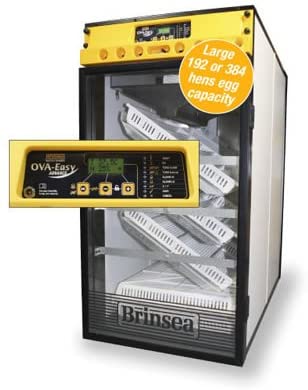
    By MrAnimal Farm

    cut your chicken feed cost

    Cut your chicken Feed Cost in Half, you say? If you're like me, you lie in bed at night dreaming of cheap chicken feed. No? Maybe you lie awake thinking of cheap chicken feed? No? Passively think about it sometimes? I thought so!
    feature image for how to cut your feed costs in half

    It can't be possible to cut your chicken feed cost in half, right?  I mean, they have to eat.

    Of course, you should also keep in mind that feed is not the only cost to keep chickens, so make sure you are prepared for other costs also.

    And chicken feed costs a certain amount, so is it possible to decrease your feed bill by 50%?  Yes, it certainly is!  Let me tell you all the (5) ways to make your cheap chicken feed dream a reality...

    Back in the day, we had a small flock of laying hens (15, to be exact).  They had a large run area that we painstakingly built so they would be safe and happy.

    These 15 laying hens were eating 3+ 50 pound bags of organic chicken feed per month.  They had a hanging feeder in their coop and we let it flow with whatever feed they could eat.

    When talking about expanding the flock, the feed bill became the key con for getting more hens.  Afterall, in addition to having funny chickens to watch and yummy eggs to eat, we would like to save some money by raising our own eggs.

    In order to add new layers, we had to figure out how to make cheap chicken feed. In fact, lowering our feed costs is one of the ways that we save at least $2500/year on our homestead.

    5 (Simple) Ways to decrease feed costs:

    1.  Ferment your feed

    Fermented chicken feed will not only save you a TON of money on feed, but it is also healthier for your chickens.  So, really it is a win-win.

    chicken eating from mason jar of fermented feed

    Plus, instead of that $20 hanging feeder, you can feed your flock from these small metal dog bowls we LOVE!  You can also use bigger rubber tubs/bowls which cost a little more, but hold more feed.

    By fermenting our feed alone, we cut our chicken feed bill almost in half.  Until, of course we added more chickens....like 30 more.

    However, we still only go through about 2 to 3 fifty-pound bags of feed now with around 45 layers! So, if you only choose one thing to cut your chicken feed cost, this is the one.

    2. Free-range

    Free-ranging is not always possible.  This will not be an option if you have neighbors close by or a lot of predators.  However, if your situation allows for free-ranging, this is cheapest of the cheap chicken feed options.

    flock of 7 chickens and 1 rooster

    Free-ranging encourages your chickens to get up, get moving and find their own (FREE) food.  The more they can find and eat for free, the less feed you need to pay for thus making it a great way to cut your chicken feed cost down.

    Need some help keeping your chickens health and care taken care of? Check out the Organized Chicken Keeper for an easy to follow system.

    3. Garden & Kitchen Scraps

    We always try to repurpose and use everything on our homestead.  By feeding your chickens garden extras (maybe even planting extra specifically for them) and any kitchen scraps you have left over it provides them with a feed source which otherwise would have gone to waste.

    This idea is an excellent way to cut your chicken feed cost as you are using food that you already have (FREE).  Plus, it's really fun to watch them run around fighting for pumpkins and other special treats.

    chickens eating garden scraps

    4. No Waste Chicken Feeder

    One of the main ways feed bills can start to get out of control is simply all the waste that occurs.  Watch your lovely chickens eat from their hanging feeder.  They're so cute, right?

    Now, watch them and look for all the feed they are scratching out of the feeder onto the ground.  It's like dumping dollars into the dirt.  There are a wide variety of no waste chicken feeder designs out there.

    You can make one really simply from PVC pipe or a more elaborate no waste feeder.

    5.  Grow Your Own Fodder

    Fodder is essentially growing your own greens for your chickens.  It does take a little work up front to get your fodder growing system in place.

    sprouted seeds

    Once you are growing fodder for your chickens you will see how it can really replace some of the grain in their diet.  Fodder can significantly cut your chicken feed cost.

    There you have it, try a few (or all) of these tips to cut your chicken feed cost in half.  Although it may seem impossible at first, it is totally possible to decrease your feed bill drastically.

    If you want to be able to track how much you are spending in chicken feed, check out these profitable homesteading worksheets which provide a complete walk through and template for how we track our feed costs!

    What step will you try first to decrease your feed bill?

    If you need more help with taking care of your chickens, check out The Organized Chicken Keeper for a complete system for managing their health through keeping their supplies stocked and coop clean.

    Access The Organized Chicken Keeper Here
    pinterest image. top block: flock of 6 hens and 1 rooster. bottom block: bin of chicken feed. middle text block states, "5 simple ways to cut your feed cost in half"

    How to Make Fermented Feed - Learn How in 5 Easy Steps

    By MrAnimal Farm

    fermented feed

    Fermented Feed and how to make it is a must!  Everyone who has chickens is familiar with the term chicken math.  And for those of you just looking at getting chickens, you will soon learn about chicken math.

    featured image for how to make fermented feed

    Essentially, most chicken keepers start out with a modest little flock and somehow that flock seems to just exponentially multiply.  While chickens, overall, are pretty simple to care for, quickly growing numbers of chickens can cause one yucky consequence - Large Feed Bills!

    When we started expanding our flock, we started looking at how to cut chicken feed costs.  We buy organic feed and it is not cheap. The cost to feed chickens can lead to quite a bad case of sticker shock.

    Our layers already free range, so they get to find themselves lots of extra goodies.  They also get garden scraps and some left over food from our meals.

    However, the (at the time) flock of 17 was still going through about 3 -  50 pound bags of feed a month.  You can figure out how much food your chickens will need a month to figure out your estimated feed cost.

    We were just going through way more feed than we wanted to.  So, here is where fermented feed entered the picture.

    Upon first reading about fermented feed, it almost sounded too good to be true.  Not only is it more healthy for the chickens, but they eat less and waste less leading to a decreased feed bill.

    It did take a while for us to make the leap to fermented feed because, for some reason, it seemed so complicated to do (it really is not!).  We have cut our feed bill in half since starting with fermented feed.

    Plus, there are lots of other benefits:  there is virtually no waste with chickens scratching the feed out of the feeder, the chickens are able to better digest the feed, their poop seems to be less in amount and grossness, and, did I mention it cut our feed bill in half?!

    Need some help keeping your chickens health and care taken care of? Check out the Organized Chicken Keeper for an easy to follow system.

    How to Ferment Feed Step-by-Step:

    Fermenting feed seemed at first like a big task, but it really isn't.  If you are ready to start fermenting, here is a quick how-to:

    1) Get your containers

    Get some jars or containers to store the feed.  We bought 1 gallon pickle jars and emptied them out to have some nice, large glass containers for cheap.

    We have since switched to a large 5 gallon food grade bucket. We can make more feed less often and is not as fragile as glass  jars.

    2) Get a scoop

    Get a spoon specifically for the fermented feed.  You can use a large cooking spoon or ladle to use.  Trust me, the fermented feed can be messy and smelly and you will want a spoon dedicated specifically for this use.

    3) Fill your containers

    You will put the dry feed into your jar (a canning funnel cuts down on the mess), add water to cover the feed plus an inch or so, stir and cover.  The feed will expand....A LOT.

    We started with about half the amount of dry feed we usually fed.  We did have to adjust amounts a little until we got the right amount.

    You don't want the chickens to leave excess feed out, but also don't want them to eat it all and still be hungry.  If you keep an eye on them, you should be able to find the right amount after a few feedings.

    4)  Track the fermentation process

    You want to always keep water up over the line of feed, so you may need to add additional water and stir once a day or so. It is important to make a habit of this. If the container goes too long without being opened it can build up too much pressure.

    If the container has too much pressure, in the best cases it will start to leak stinky fermented feed juice from under the lid. Worst case, it can crack your jars and create a glass hazard.

    5)  Set a schedule

    We do things on a 3 day rotation.  One jar is enough feed for one day - morning and evening feeding.  So, as we empty the jars at night, we refill with feed and water.  This way, since we have 3 jars, when we use the feed it will have been fermenting for 3 days at the time of use.

    If you'd like to see the step-by-step process, check out our YouTube video (and don't forget to subscribe!):

    If you need more help with taking care of your chickens, check out The Organized Chicken Keeper for a complete system for managing their health through keeping their supplies stocked and coop clean.

    Access The Organized Chicken Keeper Here

    Square Foot Gardening

    By MrAnimal Farm

    square foot gardening grid in garden

    We switched over to square foot gardening a couple of years ago and have never looked back. Honestly, it made our gardening experience so much simpler by using less space, being quicker to weed, and much easier to harvest that we love it.

    square foot gardening grid in garden

    Does square foot gardening really work? In a word, yes.

    We have found that square foot gardening makes planning our garden a lot easier. It saves us a ton of space. And it generally keeps your back and knees in a whole lot better shape because you don't have to work as hard to get your plants to produce like you want them to.

    grid made with stakes and twine

    What is Square Foot Gardening?

    Square foot gardening is a method designed originally by Mel Bartholomew. He wrote a book called Square Foot Gardening. The intention behind square foot gardening is to use less space, less water, and require less work. In our experience, we can confirm that to be true.

    To follow Mel Bartholomew's method, he requires three key components; raised beds, a specific soil blend that he calls Mel's mix, and a 4 x 4 foot grid.

    In our experience, found success using only one of the three. Can you do square foot gardening without raised beds? We were able to have pretty positive results without raised beds and without using Mel's mix.

    If you do use raised beds but want a cheap way to fill your raised garden beds there are many different materials you can use.

    Why you should give it a try

    We really can't recommend square foot gardening enough. If you don't have a lot of land or you just have a small area in which you can garden, square foot gardening will help you maximize your space so that you can get the most gardening bang for your gardening buck.

    Since you will be spending less time waiting and more time being able to tend to your plants, you will almost always experience a bigger yield. Typically, you can expect to feed one person for an entire season on 100 square feet.

    Our favorite part of square foot gardening? The ease in which you can harvest. Since each planting box is only 4 x 4 feet, you will never have to reach further than two feet from any point of the box to reach your crops. Trust us, if you have a stool from our gardening supplies list your knees and back will thank you for not having to dig further into a garden just to harvest.

    trellising with square foot gardening

    Potential cons

    So if you read around online for reviews on square foot gardening, the one consistent negative is that it can be a bit pricey to get started. This is true if you are building your own raised beds and using a very specific soil mix.

    However, we have found that if you want to just get started cheaply and see if you enjoy square foot gardening you don't need raised beds. And you can use your own soil and compost pile.

    Need some help getting your garden crops planned? Check out the Ultimate Gardening Calculators for a system that will auto-calculate for you.

    How to start a Square Foot Garden

    The first thing you want to do is get a gardening planner and figure out what exactly you want to grow this season. With a planner you can plot what plants are going to go where, what you're going to grow next to each other, and if you're into it, you can even plan out further seasons on how you will rotate your crops.

    If you're not sure when to start your plants, this Ultimate Gardening for Beginners will help you out!

    Next, you'll want to set up your garden area. If you are following Mel Bartholomew's method and building raised beds, you will plot out where everything is going to go. You will also want to start building your raised beds. Remember, you do not want to use treated wood as those chemicals can leach into your soil and your plants will then absorb those chemicals.

    You can use bricks, cinder blocks, galvanized steel, or food grade plastic to build your raised beds. However, as we mentioned, you can also use this method directly on the ground in your existing garden area.

    When preparing the soil for your garden, you can use Mel's mix. This soil mixture is just peat Moss, vermiculite and compost. It's a really easy ratio. You just use equal amounts of each.

    If you're using raised beds, you will need to figure out how deep you want your soil to be. We used a wheelbarrow to make our mixture and then just dump the right amount and depth into each of our garden squares.

    Next, you'll need a grid. You can purchase a grid that you can just assemble from a local hardware store, gardening center, or online. Some people will purchase a grid for each of their raised beds or gardening squares.

    We used the same DIY grid for each of our boxes and just moved it after planting. More details below for making your own grid.

    Finally, just plant your plants. You follow the same spacing directions as you would follow in normal row gardening. You just plot them in your single square foot blocks.

    How to make a square foot gardening grid

    As we said above, you can make your very own Square foot gardening grid. You can make your grid out of a couple of stakes and some string. You can also use PVC pipe to make a pretty sturdy grid.

    We made our grid out of wood. Go to your local hardware store into their lumber department and find their 1 x 2 strips of wood. If you can find the ones that are 8 feet long, grab three of them and cut them in half.

    Next, arrange the six pieces into a grid. You can use 1 ½ inch wood nails or screws and secure them at each cross section. Viola! You have your own Square foot gardening grid.

    transplant plants into square foot gardening grids

    What can you grow using this method?

    Anything! Seriously though, you can grow pretty much anything using this method. We've grown tomatoes in cages. We've trellised vining cucumbers (there are lots of trellis ideas that work in this method). We've grown Bush beans. We've even grown zucchini and squash.

    Best plants for square foot gardening

    Growing tomatoes in a square foot gardening box is really easy. How many tomatoes can you plant in a square foot? We will usually plant one plant per square foot.

    You can easily grow cucumbers in a trellis in a square foot panting box. How many cucumbers can you plant in a square foot? We are able to plant 4 to 6 in each box.

    You can grow a lot of strawberries. In a full 4 x 4 planting box you can grow as many as 32 plants!

    How many lettuces are in a square foot garden? Depending on what type of lettuce you can grow lettuce 2 to 4 in each square.

    When growing yellow squash and growing zucchini the plants can get pretty large. We tend to plant 1 plant every other space.

    Spinach is pretty prolific. You can grow up to 9 in each square!

    Let us know about your square foot gardening experiences in the comments below.

    If you need help getting your garden crops planned right check out The Ultimate Gardening Calculators so that you have just the amount you need, set aside the right amount of space and know exactly when to plant them.

    Access The Ultimate Gardening Calculators Now
    pinterest image with square foot gardening grid. text reads, "how to start squarefoot gardening"

    For more gardening tips

    [pt_view id="5f37129sdf"]

    Are Tomatoes A Fruit?

    By MrAnimal Farm

    pinterest image of green tomato. text reads, "are tomatoes a fruit? you'll be shocked"

    This is one of those seemingly harmless questions that can split a group in half in no time. In fact, you might be at one of those gatherings right now when somebody asks are tomatoes a fruit?

    closeup of green tomato
    pinterest image of green tomato. text reads, "are tomatoes a fruit? youll be shocked"

    Well, the answer is obvious, right? They grow in a garden, on a vine, go in salads. They are most definitely a vegetable.

    But they're also kind of brightly colored, juicy, have seeds, a little sweet. So maybe they are a fruit.

    Just like when considering if peppers are fruits, you need to take into account a few different areas of information when answering this question.

    peppers, tomatoes and watermelon on paper towels on a wooden counter

    So, are tomatoes a fruit?

    Tomatoes really are a pretty versatile plant. You can eat them raw or cooked. They go great in just about any kind of dish, from soups, sauces, toppings, and salads. You can even use them as an ingredient and drinks.

    Like with types of cucumbers, there are several different types of tomatoes that you can use for things like slicing, puree, or snacking.

    And if you're into gardening, growing tomatoes is pretty easy, and they're one of the fastest growing crops.

    Uses for tomatoes

    A nice tomato based soup is almost synonymous with chilly weather. You can't go wrong with a good tomato and white bean soup.

    If you have a garden, you have likely been surprised by the sheer volume of tomatoes you have harvested. A terrific use for those tomatoes is a delicious tomato sauce for pasta.

    Pasta and sauce is good, but we're a bit partial to something a bit spicier. Nothing can beat a bag of tortilla chips and some homemade, restaurant style salsa!

    Tomatoes can also be entrees on their own. Take for example, Baked Tomatoes.

    Need some help getting your garden crops planned? Check out the Ultimate Gardening Calculators for a system that will auto-calculate for you.

    Fruit or vegetable?

    The fact is there are actually a lot of foods that people consider vegetables that are actually fruits.

    According to Encyclopedia Britannica, from a scientific perspective, tomatoes are considered a fruit since they contain seeds and develop from the flower of a plant.

    However, from a nutritionist perspective, fruits are typically considered to have a higher fructose level and thus are sweeter. This is likely why a lot of people call tomatoes vegetables.

    So technically, tomatoes should be considered a fruit. However, there is enough of an argument for them to be called in vegetable that you're annoying uncle will probably insist he's right anyway. Sorry.

    If you need help getting your garden crops planned right check out The Ultimate Gardening Calculators so that you have just the amount you need, set aside the right amount of space and know exactly when to plant them.

    Access The Ultimate Gardening Calculators Now
    pinterest image of green tomato. text reads, "are tomatoes a fruit? you'll be shocked"

    For more gardening tips

    [pt_view id="5f37129sdf"]

    13+ Gardening Supplies You Must Have!

    By MrAnimal Farm

    gardening tools hanging up

    So, technically, all you need for gardening is some dirt and some seeds, and you can really grow anything. However, it'll be much, much easier if you have these gardening supplies to help you out along the way.

    gardening supplies hanging up

    As with pretty much anything in life, if you have the correct tools to do it, it will be a lot easier. Not only will having the right supplies make things easier, but you can also be sure that you are doing a more efficient, thorough, and subsequently, higher quality job.

    What Gardening Supplies Do I Need?

    So you really use your gardening supplies in different stages. These stages are soil preparation, planting, nurturing, and harvesting.

    What tools do I need to garden?

    For soil preparation, you'll need things like a tiller or a shovel. Planting you'll need something like a trowel and obviously seeds. Nurturing, you'll need a hose, water, and pruners. In harvesting, you'll need things like gloves and a harvesting basket.

    Where can I buy gardening supplies?

    Fortunately, you can find gardening supplies almost anywhere. Most of these supplies are widely available at Department stores like Walmart or Target, hardware stores like Lowe's or Home Depot, your local farm store, online through Craigslist or Amazon. You can often times find great deals on gardening supplies just driving around and shopping local yard sales.

    The supplies list (with links)

    Here's a full list of gardening supplies that will make your job so much easier. We've also included links in case you want to grab them.

    Preparation

    So obviously you need to have soil to start out with. We recommend using a good organic planting soil. If you are following the traditional square foot gardening method, you can also use a combination of peat Moss, vermiculite, and compost.

    Once you've planned out your garden and you know what area you'll be using, you'll want to use a tiller to break that soil up and make it really easy to work with.

    man tilling garden

    A shovel is just a handy tool to have anytime you're doing any kind of soil work. You will inevitably come across a stone or rock or something that your Tiller just can't get out of the way. A shovel will make removing that much easier.

    This is, of course, optional, but raised beds make weeding your garden a breeze. You'll want to use a high quality untreated wood to build your boxes and make sure that you have gardening fabric under it to keep the weeds from growing up through your box.

    If you're skipping the full garden altogether and you are just trying your hand at container vegetable gardening, you'll obviously need containers. Containers range in quality from Super Fancy and ornate all the way down to food grade 5 gallon plastic buckets. The buckets aren't pretty, but they're cheap and get the job done.

    Need some help getting your garden crops planned? Check out the Ultimate Gardening Calculators for a system that will auto-calculate for you.

    Planting

    The whole purpose of having a garden is to grow crops. So you are going to definitely need seeds.

    You'll use a trowel to dig up a little bit of a hole so you can plant your crops. As a recommendation, spend a little bit of extra to get the trial with the comfortable handle. You will thank us later.

    garden trowel

    To go along with the slightly more expensive trowel. You'll want to get yourself a nice high quality pair of gloves. Gloves will one keep your hands from getting filthy, which is always nice. But they will also keep your hands from getting torn up and calloused from constantly working with them.

    Just about anything you plant as a seed will need to be watered a bit. We recommend using a watering can. That way you don't have to lug out your hose and sprinkler just for the planting phase.

    Nurturing

    When it comes time to nurturing your plants, the one thing all plants have in common is they need water. You'll want to get yourself a nice high quality hose that preferably is kink resistant.

    sprinkler in garden for gardening supplies

    Sprinklers make watering your garden a breeze. You can set it up to gently water your plants instead of a heavy or high pressure stream hitting them. It's even easier if you can have it set to a timer.

    A lot of plants will put off vines or tendrils that you'll need to cut back in order for them to stay healthy. You can use pruners to cut these plants back safely and not harm the plant. With some plants, like when growing strawberries, you can actually cut the runners, replant theme, and grow even more strawberries.

    We prefer to avoid commercial pesticides. If you do too, you are probably wondering what a spray can is doing on this list. You can actually mix your own pest deterrents. You can find many different recipes online for things that pests won't like but are safe for you and your family.

    Harvest

    There is not enough that can be said about how nice it is to have a stool to sit on while harvesting your garden. You can get down on your hands and knees and work, but your back will thank you if you have a stool to sit on.

    harvest basket of tomatoes

    And last but not least, you're going to need a nice high quality harvest basket to put all of your fruits and vegetables in once you have successfully grown a harvest.

    Are there any gardening supplies that you like that you don't see on this list? Let us know in the comments below.

    If you need help getting your garden crops planned right check out The Ultimate Gardening Calculators so that you have just the amount you need, set aside the right amount of space and know exactly when to plant them.

    Access The Ultimate Gardening Calculators Now
    pinterest image of tiller in garden. text reads, "13+ items you must have in your gardening supplies toolkit"

    For more gardening tips

    [pt_view id="5f37129sdf"]

    Types of Cucumbers

    By MrAnimal Farm

    cucumber cut into spiral

    Did you know there a multiple types of cucumbers for a variety of different uses? Let's go over them so you know what kinds and when to use them.

    cucumber cut into spiral

    Choosing what types of cucumbers to grow can be a little confusing. If you don't know what you want when growing cucumbers it is difficult to decide what variety to plant.

    Fortunately, it is not too difficult to figure out what each type of cucumber can be used for. Similar to the different types of tomatoes, cucumbers can be split into three categories; slicing, pickling, and burpless/mostly seedless.

    Also, similarly to tomatoes, all types of cucumbers are actually fruits. There are many foods that are commonly called vegetables which are actually fruits.

    Sometimes a specific cucumber can be used for multiple purposes, but there are three categories, none the less. All these cucumbers can be frozen and saved for later.

    Types of cucumbers

    Slicing

    Typically, if you're thinking about eating cucumbers, you are thinking of slicing cucumbers. They're the ones you're most likely to find in the grocery store because they are ready to eat. They generally have smooth, tough, dark Green skin.

    However, English cucumbers are typically thin, have more delicate skin, mostly seedless, and you'll find them wrapped in plastic at the store.

    cucumbers for slicing
    By Photo taken by Muu-karhu - Own work, CC BY-SA 3.0, https://commons.wikimedia.org/w/index.php?curid=1744968

    Straight Eight cucumber

    One of the more common types of slicing cucumbers that you'll find are straight eight cucumbers. You'll recognize them by the fact that they are perfectly straight. They have a smooth, dark green skin and usually grow around 6 to 8 inches long. In the grocery store, they will almost all look identical.

    When growing cucumbers, you will want to train the vine to a trellis so that they can grow vertically. There are tons of different trellis ideas that you can use.

    And believe it or not, we harvest them when they are unripe in a green state. If they ripen all the way to being yellow, they become bitter and sour.

    Straight eight cucumbers are most often used as slicing cucumbers, but they are pretty versatile in that they can pull double duty as a pickling cucumber as well.

    Need some help getting your garden crops planned? Check out the Ultimate Gardening Calculators for a system that will auto-calculate for you.

    Pickling

    Technically, any cucumber can be pickled. The major difference between pickling cucumbers and slicing cucumbers is size. Pickling cucumbers are usually shorter, ranging 3 to 4 inches long and only one inch wide.

    They don't typically have the same uniformity of shape that slicing cucumbers have and their skin is generally bumpy and not smooth. The color will also vary from yellow all the way to dark green.

    pickling cucumbers
    Publc Domain, https://commons.wikimedia.org/w/index.php?curid=418386

    Bush Pickle

    Similar to the straight 8 cucumbers, Bush Pickles will also grow straight. they are however a good bit shorter, usually in the 4 to 5 inch range. They have a sweet flavor and typically have a dark green bumpy skin.

    They are one of the fastest growing vegetables. It is not uncommon for a Bush Pickle plant to reach maturity in as few as 45 days!

    Burpless or Seedless

    Burpless/seedless, or rather mostly seedless, cucumbers have a thinner skin than most other cucumbers and have a sweeter taste. They get the name Burpless because it is reported that the seeds in cucumbers will give the eater gas.

    Since these cucumbers typically do not have seeds. Then they do not give the eater gas. Again, due to the lack of seeds, they are easier to digest.

    You'll most commonly find these grown in green houses. Because they are a mostly seedless variety they are more of a hobby cucumber plant. You can find some that will grow up to two feet in length.

    burpless/mostly seedless cucumber
    By Ariya shookh - Own work, CC BY-SA 3.0, https://commons.wikimedia.org/w/index.php?curid=15214940

    Lebanese cucumbers

    Lebanese cucumbers are one of the more popular types of burpless cucumbers. Named after the part of the world from which they come, Lebanese cucumbers are known for their distinct flavor and aroma. They are typically thin and recognizable by their smooth, dark green skin.

    Lebanese cucumbers in bag

    What are your favorite types of cucumbers? Let us know in the comments below.

    If you need help getting your garden crops planned right check out The Ultimate Gardening Calculators so that you have just the amount you need, set aside the right amount of space and know exactly when to plant them.

    Access The Ultimate Gardening Calculators Now
    pinterest image for types of cucumbers. Text reads, "did you know there are 3 different types of cucumbers?"

    For more gardening tips

    [pt_view id="5f37129sdf"]

    Chicken Breeds: Types of Chickens for Your Flock

    By MrAnimal Farm

    Chicken Breeds

    If you are thinking about raising chickens one of the first things that you will need to do is to decide what chicken breeds will be best for your flock.  When we first started looking at chickens, we were SHOCKED at how many different types of chickens there are!

    Whether you will be hatching your own chicks, buying and raising day old chicks or buying started chickens you will need to know why you are getting chickens in the first place.  Knowing your reason why will help you to narrow down which chickens are best for you.

    We started with day old chicks and graduated pretty quickly to hatching out own with a small starter incubator and eventually a full sized cabinet.

    polish chicken chick. text reads, "chicken breeds. different types of chickens for your flock."

    If we are being honest, when we first got chickens we didn't really look at the different types of chickens and what their uses were.  We basically looked at the options available and thought - ooh that one is cute, and that one has a cool pattern, and I love that one's cool feathers!

    Picking out chicken breeds based just on what they look like provided us with a fun to look at flock.

    However, if you are looking to have chickens that are more than just "fun to look at", then you probably want to think a little harder about which birds will meet your needs best.

    Chickens eating sour cream

    Chicken breeds from A to Z

    Here is a very large list of chicken breeds (and there are still hundreds more). We will start with an A to Z list with a short need description. Then, in the second half of this article we will look at what breeds in categories like the best for different purposes, egg colors, features, and more!

    Without further ado, let's get to the list!

    Altsteirer

    Altsterier chickens are originally from Austria and Slovenia, specifically in the Styria region of these countries. This breed is a great dual purpose breed as it has a decent sized body and also lays a large number of eggs. Their eggs are white.

    Altsteriers come in a variety of different colors including black breasted red, cuckoo, partridge and white. It is considered to be a rare breed.

    Amberlink

    Amberlinks which are also known as Dekalb Amberlinks are a hybrid chicken. They were bred by Isa Hendrix genetics in an effort to make a chicken which can lay many eggs, quickly. They were developed in the 1970's.

    This breed of chicken can lay around 270 Medium to Large sized brown eggs every year. They tend to be friendly and are both cold and heat hardy meaning that they will lay well year round.

    In terms of their appearance, the males tend to be 5 - 6lbs while females are slightly smaller at 4 - 5 lbs. And both males and females are red and white. However, males are mostly red with a little white and females are mostly white with just a red tint.

    Ameraucana

    First things first, they are NOT AMERICANAS!

    Now that we have that settled, let's talk about the Ameraucana chicken. They are a rare breed often confused with an Easter Egger and/or Araucana. Typically because they lay blue eggs; similar to those other breeds. They are used for egg production, usually laying 150-200 medium blue eggs a year, in various shades of blue.

    The physical differences you will notice is that Ameraucanas will ALWAYS have both muffs & beards. They are a moderately sized bird. An Ameraucana has an average weight of 6 to 7 lbs. This breed is sweet and has a fun personality. They prefer to be in colder regions and will usually lay consistently throughout the winter.

    Ameraucanas come in a wide variety of colors and patterns. Those recognized by the APA are Black, Blue, Blue Wheaten, Brown Red, Buff, Silver, Wheaten, and White. They also have a small pea comb and 4 toes on their feet.

    Ancona

    The Ancona chicken is a pretty production bird. It's appearance has a mottled, or spotted/speckled, pattern of black & white feathering. Both the single and rose combs recognized by APA, as well. You will also find 4 toes on each foot.

    This rare Mediterranean breed is mostly used for egg production, laying 5 large white eggs a week or 260 a year. Despite their high production value, they are also large enough to be meat birds, if you desire once they no longer lay. They will typically grow to be about 6 or 7 lbs.

    Anconas are not particularly friendly. However, they are very productive, cold hardy, and do not go broody often.

    Andalusian

    Originally from Andalucia, Spain, the Andalusian is a beautiful and rare Mediterranean chicken breed. They generally sport a lacing pattern on their feathers and you will find them in black, blue, and white, however, the APA only recognizes blue.

    They are not a particularly small bird, weighing around 6 or 7 lbs, as an adult. They have a bright red single comb with matching wattles, as well as, 4 toes on each foot.

    Andalusians do not usually like the cold but are pretty heat hardy. They are an active breed and not very docile. You can expect to get around 3 large white eggs per week or 150-200 a year. Finally, if you want a breed that does not go broody often, add this one to your list of options.

    Appenzeller Barthühner

    The Appenzeller Barthühner is a rare breed of chicken from the Swiss Alps. Being from such a cold climate has made them a very cold hardy bird. They were specifically bred to be that way as well as crossed with breeds to enhance their egg laying abilities. You can typically expect them to lay around 2 or 3 eggs a week.

    This breed was also crossed with Italian chickens to get their rose comb and bearded appearance. Over time they have become exceptionally rare but in the mid 1980s, a conservation project was started to rejuvenate the breed.

    Appenzeller Spitzhauben

    The Appenzeller Spitzhauben is a remarkable looking chicken. It has an instantly recognizable forward pointed crest and v-shaped comb. Perhaps it's physical flair is why it is the national chicken of Switzerland. In addition to it's crest and comb, it also sports a wide array of impressive feathering; Barthuhner, Black Spangled, Blue Spangled, Gold, Gold Spangled, Silver Spangled.

    The Appenzeller Spitzhauben, likely due to it's Swiss origins, is well suited for mountain life. They are skilled climbers and will often choose the branches of a tree as their roosting place. These chickens are very free-spirited and alert to their surroundings. They do not take to confinement very well. Only consider this breed if you have the room for them to freerange most of the time, as they are active foragers.

    Appenzeller Spitzhaubens are usually only 4 to 5 lbs. Despite their small size, they lay a respectable amount of decently sized eggs. You can expect around 3 medium white eggs per week or 150-200 a year. They are also very adaptable to most climates. This breed is both cold and heat hardy.

    Araucana

    Not to be confused with Ameraucanas or Easter Eggers, this rumpless (meaning no tail feathers), chicken is a very good layer. Which is fortunate because that is it's intended purpose on a farm. They will lay around 150 to 200 medium blue eggs a year.

    They are recognizable by their unique, sometimes uneven, tufts of feathers on their cheeks. While this is an adorable trait, unfortunately, the gene related to tufts can cause Araucana chicks to die before they can hatch.

    Though you may often see Araucanas listed on hatchery sales, it is unlikely they are selling the real deal. This breed is very rare and generally only available through Araucana breeders.

    That's not to say those hatcheries are lying, but often times, even experienced chicken folk, cannot tell the difference between Araucanas, Ameraucanas, and Easter Eggers.

    A true Aracauana is recognized by the APA to have Black, Black Red, Golden Duckwing, Silver Duckwing, and White feathering, 4 toes on each foot, and a pea comb. They are not a super friendly or docile breed. However, they are not difficult to catch if you need them because they do tend to go broody from time to time.

    Asil (or Aseel)

    The Asil, or Aseel, is an old Indian (the country, not Indigenous folk) breed. Initially bred as fighters, this rare breed is now an ornamental/show bird. Which is good because it is one of the worst layers in all chickendom. They tend to be broody and just sit on the 1 medium cream color egg they lay each week.

    Asils are impressively colored. They are recognized in Black Breasted Red, Dark, Spangled, White, and Wheaten. They have a pea comb and 4 toes on each foot. You can raise them in cooler climates as they don't really like the heat. Despite their violent origins, they are surprisingly sweet, docile, and very smart.

    Austra White

    The Austra White is a hybrid chicken. It is the result of crossing a Black Australorp rooster with a White Leghorn hen. They are mostly white but splashed with small black spots or speckles. This breed sports a single comb, wattles, and 4 toes on each foot.

    This hybrid breed was intended to be a production bird and, let me tell you, they succeeded. Do not be at all surprised if you end up with 4 to 6 light brown (very) large eggs a week or 200 to 300+ eggs a year! They are also a moderately sized bird with the hens weighing around 5 lbs and the roosters only 6.5 lbs. They can live anywhere due to them being hardy in any climate; hot or cold. Austra Whites also make great pets due to their docile and laid back, friendly nature.

    Australorp

    The Australorp is very similar to the Orpington. In fact, the Australorp is the Australian version of an Orpington. They were bred to be large and productive dual purpose chickens. They will typically grow to be 7 to 8 lbs. Australorps are also excellent layers; Often laying 5 large brown eggs week and around 250+ year.

    They are beautiful birds. At first glance they look completely black. But as you focus, and the sunlight hits them, you will see shimmering hints of green and purple. Australorps are friendly and docile. They also do very well in colder climates.

    Ayam Cemani

    The Ayam Cemani is perhaps the most unique chicken you will ever see. It is completely jet black. We mean COMPLETELY! Feathers, skin, eyes, feet, beak, comb, even their internal organs are black! This is due to a rare genetic condition called fibromelanosis.

    Ayam Cemanis are a rare Indonesian chicken breed. These days, you are likely to find them displayed as ornamental birds, if you see them at all. Despite their ominous look, they are surprisingly friendly and gentle.

    Again, the Ayam Cemani is almost exclusively an ornamental breed. They will only lay an average of 2 small cream color eggs a week. Worse yet, they will lay in batches, a few weeks at a time, then long periods of nothing. They are not a broody breed but that is likely to them not laying very often.

    Barbezieux

    The Barbezieux hen can lay somewhere between 160 and 200 large eggs a year. On top of that, they are a dual purpose bird, meaning they can also be used for meat; growing to 8 pounds for a hen and the rooster at 10 pounds.

    Barbezieuxs are wonderful backyard breeds, as well. They are just fine being left alone to free-range but are also friendly enough to be picked up and handled. This breed is both heat and cold hardy making them suitable for just about any environment.

    Barnevelder

    Barnevelder chickens originally come from the town of Barneveld in the Netherlands. Their unique lacing make them some of the most beautiful birds you can buy. The 200 chocolate colored eggs they lay a year stand out from many other breeds because of how deep and rich the color is.

    This Dutch breed is a cross between many chickens across Asia, known as Shanghai chickens. However, the prevailing crosses are the Croad Langshan and a smaller chicken resulting in a bantam sized Barnevelder, as well.

    Bresse

    Bresse chickens are a unique meat bird from France. Their exact history is not known, but they are known for the distinct taste of their meat. To be a true Bresse chicken, they must be from the Bresse region of Eastern France.

    While the most common color being white, they do come in other colors: black, blue and grey. They tend to be around 5 - 6 pounds, fairly healthy and great foragers.

    Deathlayer

    The Deathlayer Chicken is originally from Germany; where they are known as Westfälische Totleger. Their name, despite it's ominous connotations, has nothing to do with anything deadly, at all. It is merely commenting on their incredible egg laying abilities. Deathlayers can lay up to 200 eggs a year, which is not unheard of in other breeds.

    The difference? Their name is meant to imply that they will lay up to the day they die. Whether that's true or not is unknown. They will, however, lay much longer than the rest of your flock. Being an active breed, they're always free ranging for more food; possibly because of the energy to produce eggs for so long. They are also a hardy bird; thriving in both hot and colder climates.

    Polish chicken

    If you have never seen a Polish chicken before, do yourself a favor and click the link on this section. We'll wait...

    Back?

    Adorable. Right?

    The Polish chicken, with it's magnificent crest and spunky personality will easily capture the heart of anyone wanting to raise them. They are very small and will only lay around 2 or 3 eggs a week for you. Since they are poor layers and too small to eat, what are they good for (need to click the link again)?

    The Polish Chicken has a permanent home in the chicken show world as a very popular ornamental breed. Black and white is just one of the multiple colors in which you can find them.

    Sussex

    If you are looking for a reliable layer, the Sussex Chicken is one of the best around. Originating in Sussex, England , they are one of the oldest breeds in existence. Through time and breeding, they have became extremely great production birds. You will get several large, light brown eggs a week. On top of that, they are also an excellent protein source for those who like to raise dual purpose chickens. They are a cold hardy breed but are also comfortable in warmer regions, as well.

    Swedish Flower Hen

    Swedish Flower Hens are a landrace breed that originated in Sweden. They are also known as Skånsk Blommehöna. They are a calm, intelligent breed that tends to be very easy to care for.

    They lay around 200 large to extra large cream or light brown eggs per year. They are a cold hardy breed, so they tend to lay well through the winter.

    They are a really beautiful looking bird with a flower like pattern on their feathers (hence their name). Some of these birds have a crest and others do not.

    Welsummer 

    The Welsummer is another Dutch breed from Welsum in the Netherlands. The came about when Dutch farmers in the early 1900s starting crossing many of the local chicken breeds together. This mish mash of chicken genetics eventually became the Welsummer chicken.

    Welsummers will grow to be around 7 lbs or so. But they are most well known for their beautiful, dark, chocolate brown eggs. Their eggs will often have speckles all over them too; they almost look like candy. You can expect to get around 150 to 200 of these eggs a year, too!

    Wyandotte

    The Silver Laced Wyandotte is just one pattern and color of many in the Wyandotte family. You can also find them in gold laced, columbian, blue, and black, just to name a few. Each color and pattern is just as stunning and impressive as the last. They are so impressive that the APA recognized them way back in 1883.

    Wyandottes will lay around 250 large brown eggs per year. They are also large enough to be dual purpose; meaning they can be meat birds.

    Yokohama

    The Yokohama chicken is a very small, heat hardy, chicken from Japan. Unlike many other breeds, the Yokohama doesn't mind captivity and is perfectly happy being cooped up all day with fresh water and food.

    You are not likely to find this breed at your local farm store or hatchery. They are more of a rare or unique chicken that is well suited for the chicken show life.

    Need some help keeping your chickens health and care taken care of? Check out the Organized Chicken Keeper for an easy to follow system.

    Chicken breeds and their many uses

    There are several hundred different types of chickens. So, it might seem a little daunting knowing that there are so many different options to choose from!  Size, egg, meat, colors, pets; there's a breed for every purpose and some breeds can pull double duty and serve more than one purpose.

    The first thing you can do is decide on the purpose of your flock. This will help to narrow down the different breeds.

    Large fowl Vs Bantams

    Before we talk about specific breeds, it's important to know chicken breeds come in two main sizes:  standard or large fowl and bantam chickens. 

    silkie rooster

    Bantams are simply smaller than average sized chickens. You could consider them mini chickens. Most breeds come in both large and Bantam sizes. But some, like Silkies and Seramas, are only Bantam sized. Cochins and Easter Eggers are types of chickens that come in both bantam and large fowl sizes.

    Large fowl chickens are chickens that are your standard size. Within large fowl, some breeds are of course larger than others.  Generally, you can think of large fowl as large, medium or small.

    gold laced orpington in a chicken run

    In large fowl, the largest chicken breed is often noted as the Jersey Giant. Other large fowl are the Brahma, Cochin and English Orpington. The largest chickens listed here are usually a minimum of 8 pounds, but some have been known to get closer to 15 to 20 pounds!

    gold laced orpington on top of a chicken coop

    Most large fowl, however, are a little smaller and run more in the 4 to 8 pound range.  Some other common large fowl breeds are: Speckled Sussex, Barred Rock, Rhode Island Red and Easter Egger.

    Purpose is the other deciding factor when looking at different types of chickens.

    Generally, chickens can be divided into 4 different purposes - or uses.

    Eggs

    Not all chicken breeds were created equally when it comes to laying eggs.  You might think when you are just getting started with chickens that all chickens lay eggs, therefore, it shouldn't really matter which ones you get.

    That is definitely NOT the case though!  Some will lay 5 - 7 times a week (like Rhode Island Reds, Black Australorps and Leghorns).  Others will lay more like 3 - 5 times a week.

    pile of multi colored eggs

    Weather can also affect how well a chicken breed lays eggs.  Some types of chickens are made to lay well year round. Others are cold hardy and some are heat hardy.

    Additionally, not all eggs themselves were created equally.  Some chicken breeds lay smaller eggs (like silkies) while others lay large eggs (like Orpingtons).

    So, as you can see, if you are looking to get chickens specifically just for eggs, you will probably want to choose the chicken breeds that lay the largest eggs most often.

    In addition to the amount of eggs a chicken lays.  Certain chickens lay different colored eggs!  There are chickens that lay white eggs, chickens that lay brown eggs, chickens that lay green eggs, and even chickens that lay blue eggs!

    Meat

    If you are getting chickens as a way to raise your own meat, then it will be important to get chicken breeds that are well suited for that purpose.  While it is true that all types of chickens will generate some meat if you raise and butcher them, they may not all be the best for that purpose.

    If you get smaller breeds, slow growing breeds or less meaty birds you may well be pretty disappointed after you spend the time and money to raise them and butcher them.

    Therefore, if you will be raising chickens for meat, you will want to get chicken breeds that are well suited for that purpose.  Most chicken breeds used for meat are heavy, big birds that mature and grow fast.

    If you have heavy, fast maturing birds then you will get the most meat in the shortest time which is a big bonus.

    Some common chicken breeds used for meat are Cornish or Broilers.  Be prepared, most meat chicken breeds are big, ugly and don't live much over their butchering age since they have been bred specifically to grow super big in a short timeframe.

    Dual Purpose Chickens

    If you want chickens that will meet the needs for generating both meat and eggs, you probably want to look at dual purpose chicken breeds.  These are types of chickens that will produce decently for both meat and eggs.

    Jubilee Orpington rooster

    You may not get THE BEST egg layer or THE BEST meat bird by getting chicken breeds that do both things well.  However, there are several chicken breeds that will suit both needs without disappointment.

    Dual purpose chicken breeds are ones that will lay decently over time, but also get heavy enough and mature fast enough that you can butcher them for meat.

    Often times, people will raise dual purpose chicken breeds and they will keep the hens (females) for eggs. They will then butcher the roosters (males) when they are old enough for meat.

    Fun

    The fourth bucket that you can divide chicken breeds into is for fun!  Now, having chickens for fun may mean a lot of things.  It could mean you want friendly chickens for pets, fancy chickens to show or just chickens that you think look cool for your yard, like Frizzle chickens.

    silkie hen

    Of course, there are some types of chickens that are great egg layers and friendly so they can be wonderful pets too.  But there are many chickens that their main selling point, or best characteristic is that they are friendly or easy to handle making them great for pets.  Silkies are one super friendly chicken breed that makes a great pet.

    Another fun reason some people keep chickens is for show.  People will show their chickens just like you show dogs. Most any APA accepted breed can be used for show.  They, of course, all have their specific breed and color standards.

    And then, there are chickens that just look cool.  Personally, I think a lot of the crested breeds like Polish and Sultans are some of the coolest looking chickens.

    Need some help keeping your chickens health and care taken care of? Check out the Organized Chicken Keeper for an easy to follow system.

    Rare Chicken Breeds

    Usually people will get rare breeds if they are looking to help conserve a certain breed that they really like.  Rare Chicken breeds are also good choices if you are looking to make money raising chickens. 

    Ayam Cemani chicken

    Having a rare chicken breed means not as many other people will also have that breed. Typically, this will make it easier for you to market and sell the chickens.

    A few rare chicken breeds are:  Ayam Cemani (don't be shocked at their HIGH price tag!), Sumatra and White Breese.

    So, how will you decide which of these chicken breeds is the best for you?

    Now that you have an idea of just how many different types of chickens that there are to choose from, you might be feeling overwhelmed at all of the choices!  The best way to decide which chicken breeds are right for you is to decide WHY you are getting chickens. That will narrow the options down.

    After you know why, then you can start looking at the specific chicken breeds that match up to your purpose.

    Do you have a favorite chicken breed?  Let us know which one below!

    If you need more help with taking care of your chickens, check out The Organized Chicken Keeper for a complete system for managing their health through keeping their supplies stocked and coop clean.

    Access The Organized Chicken Keeper Here
    pinterest image of polish chick. text reads, "Chicken Breeds. what kind of chickens are in your flock?"

    For more on raising chickens, check these out:

    [pt_view id="3d0b212jvx"]

    Trellis Ideas

    By MrAnimal Farm

    trellis made of stakes and fencing

    When we started gardening we found you could utilize much more space by having your plants grow up instead of out. Once we realized this, we started thinking of all sorts of trellis ideas.

    trellis made of stakes and fencing

    Your trellis doesn't need to be fancy. If you like, you can go to the store and buy a really nice pretty trellis. That way everything in your garden will match and you'll have nice aesthetic.

    But if you know anything about us, you know we like to go the DIY route most of the time. Our first trellises consisted of some old sticks with old fencing zip tied to them. While growing cucumbers, they provided more than enough support.

    cucumbers in front of fencing trellis.

    What are some trellis ideas I can use?

    There are a lot of different ways you can make a trellis. Honestly, if a vine can grab it and hold itself up it can work as a trellis.

    cucumber vine grabbing trellis

    If you too would like to go the DIY route, you can make your own trellis out of a couple of wooden stakes, stuck straight into the ground on either side of your box. Then, just run some other pieces of wood width wise across the box. 

    One of our cheaper DIY ideas, besides the old fence with old sticks, was made of t-posts and cattle panel. Now, if you don't have cattle panel readily available on your homestead, that's not exactly a cheap option.

    But if you do have cattle panel that you've used for something else, and you have scrap pieces laying around, it is a perfect upcycle for those spare pieces. The cattle panel trellis worked great when we were growing spaghetti squash.

    We prefer to have the traditional one long row of trellis that the plant can grow up. There are other forms of Trellising where you have the trellises on either side of the plant leaning into the center and meeting in a triangle type shape.

    This method will work, but we find it much more difficult to harvest anything that's growing towards the center of those Plants.

    You can make other trellises specific to the type of plant you are growing. This tomatoes trellis, for example, makes a perfect archway so you can easily access its low hanging fruit.

    What kind of trellis do you prefer? Let us know your trellis ideas. In the comments below.

    If you need help getting your garden crops planned right check out The Ultimate Gardening Calculators so that you have just the amount you need, set aside the right amount of space and know exactly when to plant them.

    Access The Ultimate Gardening Calculators Now
    pinterest image with cucumber vine grabbing trellis. text reads, "do you need some trellis ideas for your garden?"

    Types of Peppers: Pepper Varieties You Should Try

    By MrAnimal Farm

    Assorted colorful varieties of hot and sweet peppers

    There are almost as many types of peppers as there are people in the world. Well, maybe that's an exaggeration, but there certainly are a lot of pepper varieties.

    Assorted colorful varieties of hot and sweet peppers

    How Many Types of Peppers Are There?

    When you are thinking about the different types of peppers, first, you can break them into two general pepper types:  hot and sweet.  Both hot peppers and sweet peppers can be delicious, it will really depend on what you are using them for as to which general type of pepper you will want to use.

    Then, within, each of those general types of peppers you have specific pepper varieties.  A quick look online will tell you that there are upwards of 50,000 different pepper varieties!

    Peppers are one of the easiest vegetables to grow. (Or, peppers actually a fruit that easy to grow?)  Since they are so easy, we usually add several types when we learn how to grow peppers in our garden each year.

    That means we get a LOT of peppers.  We usually freeze peppers so that we can use them all year round.

    With at least 50,000 types of peppers to choose from, it may seem a little overwhelming when you try to decide which peppers would be best to add to your garden. We always try to add a few sweet peppers and a few hot peppers since they are used in different foods.

    Most of the types of peppers that we usually plant are pretty common - that way they can be used in multiple ways and multiple dishes over the year.

    Scoville Heat Unit

    The most common way to rank the heat or spiciness of peppers is through the Scoville Heat Unit (SHU) method. SHU measures the level of capsaicinoids, the chemical that burns in peppers. The SHU ranking goes from 0 (bell peppers) to over 3,000,000 (military grade pepper spray).

    The Big List Of Peppers

    You should consider adding one or multiple of these types of peppers to your garden plans this season.

    NameTypeScoville Heat Unit
    Chocolate Bell PepperSweet0 SHU
    Shishito PeppersSweet50 to 100 SHU
    Banana PeppersSweet0 to 500 SHU
    PepperonciniSweet100 to 500 SHU
    Cherry PeppersSweet100 to 500 SHU
    Piquillo PeppersSweet500 to 1,000 SHU
    Cubanelle PeppersSweet1,000 SHU
    Anaheim PeppersHot500 to 2,500 SHU
    Poblano PeppersHot1,000 to 1,500 SHU
    Pasilla PeppersHot1,000 to 2,500 SHU
    Jalapeño PeppersHot2,500 to 8,000 SHU
    Fresno PeppersHot2,500 to 10,000 SHU
    Yellow Chili PeppersHot10,000 to 15,000 SHU
    Serrano PeppersHot8,000 to 22,000 SHU
    Guajillo PeppersHot2,500 to 30,000 SHU
    Cayenne PeppersHot30,000 to 50,000 SHU
    Tabasco PeppersHot30,000 to 60,000 SHU
    Rocoto PeppersHot30,000 to 100,000 SHU
    Bird's Eye PeppersHot50,000 to 100,000 SHU
    Piri Piri PeppersHot50,000 to 175,000 SHU
    Habañero PeppersHot150,000 to 350,000 SHU
    Scotch BonnetHot80,000 to 400,000 SHU
    Ghost PeppersHOT!!!1,000,000 SHU
    Naga Viper PeppersHOT!!!1,382,118 SHU
    Trinidad Scorpion Butch T PeppersHOT!!!1,463,700 SHU
    Komodo Dragon PeppersHOT!!!1,400,000 to 2,200,000 SHU
    Carolina ReaperHOT!!!1,000,000 to 2,000,000 SHU
    Dragon's BreathHOT!!!2,480,000 SHU (unofficial)
    Pepper XHOT!!!3,180,00 SHU

    Chocolate Bell Peppers

    Chocolate bell peppers are one of the more unusual vegetables you can grow.  They are a type of sweet pepper.  They are, as the name would suggest, a bell pepper variation.  Chocolate bell peppers will turn a beautiful chocolate color upon ripening.

    chocolate bell pepper
    Photo by: Suzie's Farm http://suziesfarm.com/

    Despite behind categorized as a sweet pepper, they, unfortunately, do not actually taste like chocolate. They are however, delicious in their own right and will make a fun and colorful addition to any garden.

    Scoville heat units: 0

    Shishito Peppers

    Scoville heat units: 50 to 100

    Need some help getting your garden crops planned? Check out the Ultimate Gardening Calculators for a system that will auto-calculate for you.

    Banana Peppers

    Here is my personal favorite of all the peppers; the banana pepper.

    Banana peppers are considered to be a sweet type of pepper. They are called banana peppers because they are long and yellow and look, well, kind of like little bananas.

    several banana peppers on a butcher block

    Banana peppers have a mild flavor so they make great toppings for things like sandwiches, salads, or pizza.  Again, like poblanos, banana peppers are one of the most versatile types of peppers.

    One common use for banana peppers is to pickle them. So, that makes these a great pepper to grow a bumper crop of and then preserve for later.

    Pickled banana peppers are even great just to snack on.  You can eat them alone or with a cheese and cracker platter - which makes a great, cheap and easy snack tray if you have guests over

    You can also add banana peppers into things like salsa to give it just a little hint of sweet.  YUM!

    Scoville heat units: 0 to 500

    Pepperoncini

    You probably recognize Pepperoncinis from your salad at Olive Garden. They are pretty similar to banana peppers in shape and color but can be a tad bit spicier at times. They are also a little smaller than banana peppers.

    Scoville heat units: 100 to 500

    Cherry Peppers

    These peppers are also known as pimento peppers.

    Scoville heat units: 100 to 500

    Piquillo Peppers

    Scoville heat units: 500 to 1,000

    Cubanelle Peppers

    Scoville heat units: 1,000

    Anaheim

    Anaheims are some of our favorite types of peppers. They are comparable to poblano peppers in size, shape, and flavor. They can have a little more kick depending on the strain you find.

    They are typically harvested when green but are still good once they've turned red. They are best around 6 inches long.

    Scoville heat units: 500 to 2,500

    Poblano Peppers

    Poblano peppers are considered to be hot peppers, but are on the lower end of the spiciness scale. Therefore, they are good for those of us who aren't into the super spicy peppers.  They provide a little spicy kick to your food without burning your mouth off.

    Poblano pepper
    By stef yau from Seattle, USA (Poblano Pepper) [CC BY 2.0 (http://creativecommons.org/licenses/by/2.0)], via Wikimedia Commons

    Poblano peppers are a decent sized pepper; only slightly smaller than a bell pepper. We like to use them to make stuffed peppers.

    They are spicy enough to add a little flavor, but not so spicy that they overwhelm a dish if they are a main ingredient.  Given this, poblano peppers are really one of the more versatile types of peppers.

    Poblano peppers can be frozen whole (just wash and chop off the top) for use later.  Or, if you are planning to make stuffed peppers like we do, you can go ahead and make them and then freeze the stuffed peppers for an easy ready made meal later on.

    Since we use these as the main part of a dish, we usually plant several poblano pepper plants.  This allows us to make stuffed peppers several times over the course of the year.

    Scoville heat units: 1,000 to 1,500

    Fresno Peppers

    Scoville heat units: 1,000 to 1,500

    Pasilla Peppers

    Scoville heat units: 1,000 to 2,500

    Jalapeño Peppers

    Jalapeño peppers may well be one of the most popular types of peppers.  When most people think of peppers, the jalapeño is THE pepper they think of.

    Jalapeño peppers are also in the family of hot peppers.  They are also super easy to grow crop.  We planted them one year and then forgot about them. Despite the neglect, they flourished and we brought in a TON of Jalapeño peppers to spice up our meals.

    Jalapeno pepper on the plant

    You can get quite a few peppers off of a single plant, and as you pick, they will keep on producing.  These are great to grow for use in salsa and they also freeze well.  Since they can be used in several different foods, we usually plant several Jalapeño pepper plants.

    Scoville heat units: 2,500 to 8,000

    Yellow Chili Peppers

    Scoville heat units: up to 15,000

    Serrano Peppers

    Scoville heat units: 8,000 to 22,000

    Guajillo Pepper

    Scoville heat units: 2,500 to 30,000

    Need some help getting your garden crops planned? Check out the Ultimate Gardening Calculators for a system that will auto-calculate for you.

    Cayenne Pepper

    For a small pepper, cayenne can pack quite the punch. You will usually find them in the 2 to 5 inch range and ranging in color from green to red. Most people are familiar with cayenne peppers in their selection of spices. It is not uncommon for people to use dried cayenne pepper as a spice for certain recipes or as a pizza topping.

    Scoville heat units: 30,000 to 50,000

    Tabasco Peppers

    If for nothing else, you've likely heard of Tabasco peppers from the hot sauce. They are a very small pepper, usually growing no longer than 2 inches. You can find them growing in multiple colors from yellow, green, orange, and red.

    Scoville heat units: 30,000 to 60,000

    Rocoto Peppers

    Scoville heat units: 30,000 to 100,000

    Bird's Eye Peppers

    Scoville heat units: 50,000 to 100,000

    Piri Piri Peppers

    Scoville heat units: 50,000 to 100,000

    Habañero Peppers

    Habañero Pepper
    By The original uploader was Fir0002 at English Wikipedia. - Transferred from en.wikipedia to Commons by Sreejithk2000 using CommonsHelper., CC BY 2.5, https://commons.wikimedia.org/w/index.php?curid=105575799. Habañero Pepper

    Scoville heat units: 150,000 to 350,000

    Scotch Bonnet Peppers

    Scoville heat units: 80,000 to 400,000

    Ghost Peppers

    These are a type of hot pepper.  And hot they are!  In fact, hot may be considered an under statement when it comes to ghost peppers.  They are actually on record as one of the hottest types of peppers in the world.  So, don't grow these unless you REALLY, REALLY like hot peppers.

    Justin is a big fan of super hot, but a little goes a long way when it comes to ghost peppers.  So, we usually only plant one plant worth for this type of pepper.

    Ghost peppers
    By PepperParadise (Own work) [CC BY-SA 3.0 (http://creativecommons.org/licenses/by-sa/3.0)], via Wikimedia Commons

    They can be used fresh, dry, as a food or spice so they're really are versatile....as long as you can handle the heat.

    Scoville heat units: 1,000,000

    Naga Viper Peppers

    The Naga Viper pepper is a hybrid pepper. It was crossed with three of the hottest peppers available at it's time of creation; the Naga Morich, Bhut jolokia, and the Trinidad Scorpion.

    Trinidad Scorpion Butch T Peppers
    By Kouya - Own work, CC BY-SA 4.0, https://commons.wikimedia.org/w/index.php?curid=37788228

    Scoville heat units: 1,382,118

    Trinidad Scorpion Butch T Peppers

    Was once considered by the Guinness Book of World Records to be the hottest pepper in the world with an official SHU of 1,463,700! This pepper gets it's name because of it's shape. It is said to have a point like a scorpion tail.

    Scoville heat units: 1,463,700

    Trinidad Scorpion Butch T Peppers
    By Kouya - Own work, CC BY-SA 4.0, https://commons.wikimedia.org/w/index.php?curid=37788228

    Komodo Dragon Peppers

    The Komodo Dragon pepper, while not as hot as some of later chilis on this list, packs a sneaky punch. It takes about 10 seconds for the full heat to sink in. This evil pepper will lull you into a false sense of security and then utterly destroy your hopes and dreams.

    Komodo dragon pepper
    By Db6667 - Own work, CC BY-SA 4.0, https://commons.wikimedia.org/w/index.php?curid=81334594

    Scoville heat units: 1,400,000 to 2,200,000

    Carolina Reaper

    If these peppers are comic book villains, then the super villain lair is a place called (I'm not kidding) PuckerButt Pepper Company and is run by super villain and pepper breeder himself, "Smokin'" Ed Currie. This lair…er…farm is located in Rock Hill, South Carolina, hence the name.

    This pepper is bright red, has a bumpy texture, and practically screams, "Eat me and you will die." While no clinical tests have been performed, there has been speculation that this pepper can be dangerous to eat. It is suspected, at the very least, your body can have a stress response to the heat and cause headaches.

    By the way, this pepper was certified in 2017 as the hottest pepper in the world with a SHU of 1,641,183 by the Guinness Book of World Records.

    Carolina Reaper
    By Dale Thurber - Own work, CC BY-SA 3.0, https://commons.wikimedia.org/w/index.php?curid=31105886

    Scoville heat units: 1,000,000 to 2,000,000

    Dragon's Breath

    The Dragon's Breath pepper has the ability to numb skin upon contact. This phenomenon has led researchers to believe it's oils could be used as an alternative anaesthetic for those that may be intolerant to traditional anaesthetics.

    While this pepper has not officially been tested for entry as a world record it claims to have 2.48 million scoville heat units. Sadly, we may never get an official ruling on it's SHU due to our next entry.

    dragon's breath pepper
    By ShadowBee - Own work, CC BY-SA 4.0, https://en.wikipedia.org/w/index.php?curid=66654958

    Scoville heat units: 2,480,000 SHU (unofficial)

    Pepper X

    As if the Carolina Reaper wasn't enough, Ed Currie took 10 years to create this monstrosity of a hot pepper. This pepper is claimed to be twice as hot as the Carolina Reaper measuring with a SHU over 3 million (3.18, to be exact)!

    Scoville heat units: 3,180,000 SHU (unofficial)

    As you can see, there is a huge variety of peppers out there. This is just a small list of them ranging from sweet and mild to "possibly end up in the ER" hot.

    If you need help getting your garden crops planned right check out The Ultimate Gardening Calculators so that you have just the amount you need, set aside the right amount of space and know exactly when to plant them.

    Access The Ultimate Gardening Calculators Now
    pinterest image. text reads,

    Want More Gardening Tips?

    [pt_view id="5f37129sdf"]

    Container Vegetable Gardening

    By MrAnimal Farm

    peppers & tomatoes on counter

    If your home doesn't have a very big yard or you live in an apartment where you have no yard at all then container vegetable gardening is perfect for you.

    peppers & tomatoes on counter

    So, what exactly is container gardening? It's exactly what it sounds like. It is growing vegetables that you would normally plant in a garden and a container such as a pot, raised bed, or a planting box.

    Why should somebody consider container vegetable gardening instead of planting a traditional garden? There are several reasons why somebody might want to do container gardening.

    Why should you try container vegetable gardening?

    As we mentioned above, you might not have enough room for a full garden. A full garden for a family of four is probably going to be at least 25 by 15 feet, and that's a lot of space. You may not have that much space available or you might not want to use that space just for gardening.

    You may also live in a large city or in an apartment where you have no yard space at all. If this is the case, you may still want to try growing your own food, but you don't have the space to do it. In these circumstances, container vegetable gardening is the perfect solution for just about anybody.

    closeup of green tomato

    Of course, if you are limited on space there are other gardening methods you can try like square foot gardening or creating a victory garden.

    One of the other benefits of container gardening, and possibly my favorite reason, is there is a lot less weeding involved. When your container is separate from the ground and raised above the typical soil level. It is very difficult for weeds and grass to get into the container.

    What would normally be hours on your knees crawling around the ground in your garden turns into just a couple of minutes a week pulling small plants that sprout up in your container. If nothing else, your knees will thank you for container gardening.

    raised bed for container vegetable gardening
    raised beds are a less portable form of container gardening

    Unlike a traditional garden where you work the soil for a long time and you break your back, making it perfect, if you ever decide to move, that garden stays there and can't go with you.

    With some types of container gardening, if you move you can take your plants that you have cared for anywhere you want to go.

    Need some help getting your garden crops planned? Check out the Ultimate Gardening Calculators for a system that will auto-calculate for you.

    How do you start a container vegetable garden?

    The process is really easy. Figure out what you want to grow, get the seeds, and get your containers. You can use anything that can support the weight of soil and water. We've built raised beds and also used food grade plastic buckets.

    Find out what soil requirements your plants need, pickup a bag of organic potting soil, and just start planting. Its that easy!

    blueberries growing in buckets

    We love our container gardens because we can grow pretty much anything we want in them. Pretty much anything that you can trellis or cage, like growing tomatoes or growing cucumbers, are great space savers with container gardening.

    Growing peppers in your window is not only an easy thing to do but will also give your house a nice pop of color. Growing lettuce is not quite as colorful, but nothing beats having a fresh salad that you grew yourself.

    So, are you convinced? Let us know what plants you're growing in containers in the comments below.

    If you need help getting your garden crops planned right check out The Ultimate Gardening Calculators so that you have just the amount you need, set aside the right amount of space and know exactly when to plant them.

    Access The Ultimate Gardening Calculators Now
    pinterest image with peppers and tomatoes. text reads, "how to start container vegetable gardening"

    For more gardening tips

    [pt_view id="5f37129sdf"]

    Types of Lettuce

    By MrAnimal Farm

    lettuce in garden

    Who knew there were so many types of lettuce. Some are good for sandwiches, others for salads. But they are all delicious and healthy.

    lettuce in garden

    4 Major Types of Lettuce

    There are 4 major types of lettuce from which you can choose. They are almost all sensitive to heat, other than romaine. But all of them fall into our fastest growing vegetables category. Growing lettuce is an easy way to add to your vegetable garden.

    Butterhead

    Butterhead lettuce can be split into two types of lettuce; Boston and Bibb.

    Boston

    The major difference between Boston and Bibb lettuce is their size. Both are round with loose leaves. Boston is a bit larger and fluffier.

    Boston lettuce
    By Dwight Sipler - https://www.flickr.com/photos/photofarmer/4988502260 - Attribution 2.0 Generic (CC BY- 2.0)

    Bibb

    Bibb lettuce is one of the more expensive types of lettuce you will find out there. Like Boston, it has soft, loose leaves. They are very tender and have a sweet flavor to them.

    bibb lettuce
    by jannanab - https://www.flickr.com/photos/jannanab/2680020099/ - Attribution-NoDerivs 2.0 Generic (CC BY-ND 2.0)

    Bibb lettuce are much smaller than most other types of lettuce. A typical head of Bibb lettuce is about the size of a baseball.

    Iceberg

    If you've ever had a salad at a steakhouse, you have had iceberg lettuce. It is, by far, the most popular lettuce in the US. It has a higher water content, and therefore, lower nutritional value.

    iceberg lettuce
    By en:User:Geographer - enwiki, CC BY 1.0, https://commons.wikimedia.org/w/index.php?curid=2344199

    It is recognizable by it's crisp and refreshing texture. It goes great with creamy dressings. Unlike butterhead lettuce, it's leaves are packed tightly, almost like a cabbage.

    Need some help getting your garden crops planned? Check out the Ultimate Gardening Calculators for a system that will auto-calculate for you.

    Leaf or Looseleaf

    Leaf lettuce is recognizable by the way they grow. The leaves extend from one stalk. They are also mostly used for salads like baby salads and spring mixes.

    They also come in three varieties; red, green, and oak.

    red and green leaf lettuce

    Red, Green, and Oak

    Red and green are pretty similar. Both have a mild flavor, perfect for salads. They major difference is their color. Green leaf is, obviously, green in color. Red has a darker red around the edges of the leaves.

    red leaf lettuce

    Oak leaf lettuce is the oddball out in this group. Like red leaf it has a dark, almost magenta, color around it's edges with green toward the center. It is a bit more crinkled in texture.

    The flavor is the biggest difference though. While green and red are both mild in flavor, oak leaf has a nutty, almost spicy flavor to it.

    Romaine

    And now to our favorite type of lettuce. Romaine is easy to grow, prolific, and resistant to heat. It is distinct in it's hard spines that develop as the stalks grow upright.

    Romaine has a sweet center and the leaves become more bitter as you reach the edges. This contrast makes them taste great when paired with a tasty strong cheese and a cream or vinegar based dressing.

    romaine lettuce
    By Rainer Zenz - Own work Rainer Z … 14:24, 5 November 2016 (UTC), CC BY-SA 3.0, https://commons.wikimedia.org/w/index.php?curid=642664

    What is your favorite lettuce? Let us know in the comments below.

    If you need help getting your garden crops planned right check out The Ultimate Gardening Calculators so that you have just the amount you need, set aside the right amount of space and know exactly when to plant them.

    Access The Ultimate Gardening Calculators Now
    pinterest image for types of lettuce. Text reads, "the four different types of lettuce"

    For more gardening tips

    [pt_view id="5f37129sdf"]

    Types of Tomatoes

    By MrAnimal Farm

    5 beefsteak tomatoes

    There are so many different types of tomatoes it can get a little overwhelming. With so many tomato varieties, how do you know which ones to choose?

    5 beefsteak tomatoes

    Picking a tomato can be a little confusing. What are the best tasting tomatoes, what are heirloom tomatoes, do I want green, red, or orange tomatoes? How do I know which tomato I should grow? The list of questions can go on and on.

    To make life a little easier, we have selected our top 15 tomatoes based on slicing for sandwiches, tomatoes for sauces or tomatoes for salsa, and tomatoes for snacking. No matter which you choose, it is easy to learn how to grow tomatoes.

    Quick tomato fact: Did you know, tomatoes are actually fruits?

    Type of tomatoes for every occasion

    Best Tomatoes for Slicing

    Slicing tomatoes are perfect for sandwiches and salads. Here are some of our favorties.

    Beefsteak

    Beefsteak, aside from maybe cherry or Roma, is probably the most well known variety of tomato. Technically, beefsteak is a classification of tomatoes, but if you're looking in the store, you will likely just see the beefsteak label.

    a beefsteak tomato next to a cherry tomato
    By Berrucomons - Own work, CC BY-SA 3.0, https://commons.wikimedia.org/w/index.php?curid=2844565

    If you're looking for the most bang for your buck in gardening, try the Steakhouse hybrid out. They can get up to 48 ounces in size!

    Brandywine

    Brandywine tomatoes are a specific type of beefsteak tomato. They are perfect for sandwiches. If you grow them in your garden, they are relatively easy to care for and can be quite productive.

    They will generally get to be in the 1 to 2 pound range.

    Porterhouse

    The porterhouse variety of beefsteak tomatoes are HUGE. Their mature size starts at 2 pounds and just goes up from there.

    Need some help getting your garden crops planned? Check out the Ultimate Gardening Calculators for a system that will auto-calculate for you.

    Big Beef

    If you just want tomatoes for your sandwiches without having too much extra to store, Big Beef are perfect for you. They grow to around 10 to 12 ounces so you can slice one up and not have to toss the rest and waste it.

    Cherokee Purple

    Cherokee purple get their name from their deep color. They are similar in taste and texture to a Brandywine and will grow up to 13 ounces.

    two cherokee purple tomatoes being held
    Dave Whitinger / CC BY-SA (http://creativecommons.org/licenses/by-sa/3.0/)

    Best Tomatoes for Sauce or Salsa

    I don't know about you but I love a nice spicy salsa with my chips. And nobody can argue how good a nice, rich, flavorful sauce can enhance a pasta dish.

    Fortunately, there are several tomatoes that work for making either sauce or salsa. They are what is referred to as a paste variety of tomatoes. That just means, they are best used for mashing in things like salsa or sauces.

    Amish Paste

    Amish paste tomatoes get their name because they are reported to have originated in Amish colonies in the late 1800s. Amish paste are one of the larger types of paste tomatoes, growing up to ¾ pound.

    amish paste tomato
    By terri_bateman - https://www.flickr.com/photos/134468672@N06/20277230435/, CC0, https://commons.wikimedia.org/w/index.php?curid=57948355

    Fresh Salsa

    Fresh salsa tomatoes are a hybrid tomato. They are either deep red or golden in color. They are pretty small, around 4 to 5 ounces in size.

    Roma

    Roma tomatoes are another one of those types that you will always see in the grocery store just labeled as Roma. Roma tomatoes are plum shaped and wildly popular in most canning projects. If you arent sure what tomato you want to use in your sauce or salsa, you ca not go wrong with Romas.

    roma tomatoes
    By Goldlocki - This is of my own making, CC BY-SA 3.0, https://commons.wikimedia.org/w/index.php?curid=1661838

    Viva Italia

    If you love pickles, you have to try growing cucumbers. Watching them climb a trellis is really exciting. They will mature in about 56 days but will regenerate as you pick them throughout the season.

    Again, they make great pickles but are also perfect for your salads and sandwiches. They are also resilient to mildew and appreciate full exposure to the sun.

    Big Mama & Little Mama

    Technically these are two different tomatoes but we thought they should both be mentioned. They are both plum shaped and similar to Roma's. The major difference between these two, as their names indicate, is their size.

    Little Mama tomatoes grow to be in the 3 to 4 ounce range. Big Mama tomatoes can get up to 10 ounces!

    Tomatoes for Snacking

    If you're looking for some nice, healthy snack types of tomatoes, you can't go wrong with a good small tomato. Here are some of our favorite grape and cherry tomato varieties for snacking.

    cherry tomatoes
    By I, Luc Viatour, CC BY-SA 3.0, https://commons.wikimedia.org/w/index.php?curid=3581661

    Tomaccio

    Tomaccios were developed in a very specific breeding program. They are small in size and fruit early in the season. They are perfect if you are looking for sun dried snacking tomatoes.

    tomaccio tomatoes
    By Goldlocki - This is of my own making, CC BY-SA 3.0, https://commons.wikimedia.org/w/index.php?curid=1661607

    Sun Sugar

    Sun Sugar tomatoes are unique in both color and flavor. They are extremely sweet and almost fruity in flavor. They are also bright orange in color, instead of the more traditional tomato red.

    Fantastico

    Ill be honest, we picked these next two varieties because they have the greatest names of the list. Tomato Fantastico are unique in they way they grow. They grow in what almost looks like a tomato bush and in clusters, like grapes.

    Favorita

    Favorita tomatoes are a specific favorite for greenhouse growers. In the right type of climate, they can grow a continuous harvest. They grow in an almost vine type of plant. They are small in size and perfect for bite sized snacking.

    Matts Wild Cherry

    Named after Dr Matt Liebman who cultivated these in Maine based on seeds from Mexican wild tomatoes. They are small in size, sugary in flavor, and grow in midseason clusters.

    Matts wild cherry tomatoes
    By ancapron - This is of my own making, CC BY 2.0, https://www.flickr.com/photos/47301944@N00/6078058183

    What are some of your favorite tomatoes? Let us know in the comments below.

    If you need help getting your garden crops planned right check out The Ultimate Gardening Calculators so that you have just the amount you need, set aside the right amount of space and know exactly when to plant them.

    Access The Ultimate Gardening Calculators Now
    pinterest image for types of tomatoes. text reads, "15+ different types of tomatoes"

    For more gardening tips

    [pt_view id="5f37129sdf"]

    Growing Spaghetti Squash

    By MrAnimal Farm

    featured image for growing spaghetti with several spaghetti squash

    We love pasta but it isn't always the healthiest option. If you haven't tried it before, you have GOT to start growing spaghetti squash. It is an awesome alternative to pasta.

    several spaghetti squash

    Spaghetti squash is a winter squash. They are different than growing zucchini or growing yellow squash, which are both type of summer squash.

    The main difference between summer and winter squash is the skin of the fruit. You will notice yellow squash and zucchini skin will come right off even if you barely scrape them. Whereas, spaghetti squash, and other winter squash have a hard, almost shell like rind; similar to that of a coconut.

    How to grow spaghetti squash

    We prefer to only plant non-GMO and organic seeds. We don't use pesticides, so we like to have confidence that our seed suppliers are doing the same. So we always get our organic seeds online.

    spaghetti squash on vine

    How to plant spaghetti squash

    You can almost always get specific plant instructions on the back of the seed packet. If they are not on yours, you can always come back here and use this handy guide.

    Need some help getting your garden crops planned? Check out the Ultimate Gardening Calculators for a system that will auto-calculate for you.

    When to plant spaghetti squash

    Spaghetti squash is best when the seedlings are started inside and then you transplant the started plants into your garden later. You will want them to be large enough to go out once the last frost has passed.

    Figure out your gardening zone. Then you can figure out when the last frost date will be and start your plants inside accordingly. All you need to start your plants is a light source, organic potting soil and starting trays.

    If you do not want to start them inside, you can sow directly into soil that is between 75 and 95 degrees. Obviously, this will also be after the last frost.

    Spacing for spaghetti squash

    When we garden, we like to maximize our space so we utilize the square foot gardening method. Basically, we use boxed grids instead of rows. Each box is 4 feet by 4 feet with single square foot planting pods.

    square foot gardening grid

    Whether you are transplanting or sowing directly, you will want to create mounds for your plants or seeds. If you are planting seeds, put 4 or 5 seeds ½ to 1 inch deep. Space them out every 6 to 8 inches.

    If you are transplanting, keep the same mounds and just plant every 6 to 8 inches. We will sometimes use a trellis with our spaghetti squash as well.

    They like to vine and will grow up if you train them appropriately. Unfortunately, the squash can sometimes get too large and heavy to support themselves. When this happens, you can use strips of fabric, old pantyhose, or any kind of material to help support them as they grow.

    image of full garden

    How long does it take for spaghetti squash to grow?

    Spaghetti squash has a pretty quick germination time. You should start season the first signs of your new plant in about 8 and 10 days.

    several gourds and winter squash

    When to pick spaghetti squash

    Spaghetti Squash will reach it's maturity in about 90 days, or 3 months. At this point, your fruit should be ready to pick and enjoy.

    How to tell if spaghetti squash is ripe is to keep an eye on the color of it's rind. While growing, it will be a cream color. When it is ready to pick it will be a more yellowish buff color.

    Can you store spaghetti squash?

    Storing spaghetti squash is easy. All you have to do is make sure it is in a cool dry space and it will keep for up to 2 months.

    If you need help getting your garden crops planned right check out The Ultimate Gardening Calculators so that you have just the amount you need, set aside the right amount of space and know exactly when to plant them.

    Access The Ultimate Gardening Calculators Now
    pinterest image for growing spaghetti squash on vine. Text reads, "how to grow spaghetti squash"

    For more gardening tips

    [pt_view id="5f37129sdf"]

    Growing Lettuce

    By MrAnimal Farm

    several lettuce plants

    There is nothing better than wanting a nice, refreshing, healthy meal and being able to walk into your own backyard garden and pluck your meal from there. If for no other reason than that satisfaction, we highly recommend growing lettuce in your garden.

    growing lettuce plants

    Like we mentioned above, lettuce is one of the most convenient crops you can grow. All you need to do to get a great meal is walk outside, pull a handful of leaves from the plant, wash them off, and eat them. That is literally all you have to do. Its great!

    Obviously, you might want to put mix some more stuff in with your lettuce and make a salad, or maybe stick it on a sandwich. But lettuce is so easy and its one of the fastest growing vegetables. You really cant go wrong with adding it to your garden planning.

    lettuce in two bowls

    How to grow lettuce

    Pick out the type of lettuce you would like to grow. You can get your seeds locally or online. We prefer to grow organic and non-GMO crops so we usually buy our organic seeds online.

    When we grow lettuce, we usually stick with something like Romaine. In particular, this season we grew a strain called Little Gems.

    package of lettuce seeds

    How to plant lettuce

    Your seeds will almost always have planting and care instructions on the back of the package. If not, you can always use this guide to help you through the process.

    back of pack of lettuce seeds

    When to plant lettuce

    We always start our lettuce inside. It is recommended to do so 4 weeks before you then transplant them to your garden.

    You can also stick them directly into the soil in your garden. Just make sure your soil is workable and not too hard. Lettuce is very cold hardy so colder soil temps are not an issue. They can handle temps between 40 - 65 degrees.

    If you want to continue having lettuce throughout the season, it is recommended that you do successive plantings every 10 to 14 days. Give your plants access to full sunlight unless you live in an area with excess heat. Then just make sure they have some shade during the heat of the day.

    Need some help getting your garden crops planned? Check out the Ultimate Gardening Calculators for a system that will auto-calculate for you.

    Growing lettuce indoors

    If you like, once you start your plants inside, you can just grow your lettuce in containers and never move them outdoors. All you need is a light source, organic potting soil, starting trays, and eventually a larger pot.

    Your lettuce prefers full sunlight but with a decent light source, sun from your window should be fine.

    How far apart to plant lettuce

    We prefer to use square foot gardening. Basically we use planting box grids instead of rows. Each grid square is a square foot and we use a 4 x 4 grid.

    growing lettuce using a square foot gardening grid

    Lettuce should be planted 10 inches apart. Since our boxes are 12 inches, we usually just plant one set per box. We will sow a few extra seeds to make sure we have something in each box. Then we just cull as necessary to make sure each plant has enough space and nutrients.

    If you are sowing directly, you will just want to work the soil a bit for it to loosen up. Then you will plant each seed ¼ to ½ of an inch. Or, your somewhere between your fingertip and the first knuckle past your fingernail.

    image of full garden

    How long does it take for lettuce to grow?

    Like we said earlier, lettuce grows super fast. Your lettuce will start to germinate with a week or 2.

    How to harvest lettuce

    Your plants will reach maturity around 45 to 80 days. You can actually harvest though as soon as the leaves are big enough to be usable.

    We like to just pull leaves off as we need them and let the plant continue to grow.

    Is it safe to eat bolted lettuce?

    Bolting is basically when lettuce will reach the later stages of it's reproduction cycle. It will send up a flowery stalk in an attempt to seed.

    Unfortunately, once they bolt the leaves start to taste bitter and are no longer a tasty meal.

    You can keep bolting at bay by keeping your plants trimmed and cut low. You can also plant them earlier in the year so it is cooler and they will be less likely to reach the bolting stage.

    If you need help getting your garden crops planned right check out The Ultimate Gardening Calculators so that you have just the amount you need, set aside the right amount of space and know exactly when to plant them.

    Access The Ultimate Gardening Calculators Now
    pinterest image of lettuce plant. text reads, "how to get started growing lettuce"

    For more gardening tips

    [pt_view id="5f37129sdf"]

    What Is A Victory Garden

    By MrAnimal Farm

    square foot gardening grid in tilled garden area

    During both World Wars, people were encouraged to plant fruits, vegetables, and herbs on their properties. The public was also encouraged to plant similar gardens in public parks. These types of gardens were coined "Victory Gardens" by George Washington Carver and have been grown throughout the US, the UK, Canada, Australia, and Germany.

    square foot gardening grid in tilled garden area

    The intention was two-fold. One, these gardens were able to help supplement the nutrition of the public during times of war when rationing was not uncommon. The second, and arguably more important reason, was to help give people a purpose and keep their morale up during such uncertain times.

    What is a Victory Garden Now?

    In more modern times, Victory Gardens are still popular especially during times of uncertainty. They allow people to grow fresh and healthy food for themselves and their family.

    Growing your own food to provide for your family certainly doesn't go out of style. Being self sufficient and learning how to use everything on your homestead are great skills to have at any time.

    If you're ready to start your own, let's look at how you can get started.

    Victory garden poster
    By Artist: MorleySize: 27"x19"Publication: [Washington, D.C.] Agriculture Department. War Food Administration.Printer: U.S. Government Printing Office - http://www.art.unt.edu/ntieva/pages/about/newsletters/vol_15/no_1/WarPosterImages.htm, Public Domain, https://commons.wikimedia.org/w/index.php?curid=2030283

    How to Plan

    Victory garden plans can be done the same as any other normal garden planning. The main thing to keep in mind when planning a Victory Garden is that it will likely be in a small areas, such as a front or back yard.

    Because Victory Gardens use small spaces it's important that their plans maximize the use of every inch or foot of the garden area.

    A few ways to do this are with square foot gardening or container gardening. Both of these methods allow maximum planting in minimal space.

    garden grown in bomb crater
    By Office for Emergency Management. Office of War Information. (06/13/1942 - 09/15/1945), Photographer (NARA record: 1138532) - U.S. National Archives and Records Administration, Public Domain, https://commons.wikimedia.org/w/index.php?curid=16573550

    What to plant?

    What is in a Victory Garden? Anything that you want, it is up to you. However, you want to keep in mind, as we discussed above, your space limitations.

    Making sure to plant easy to grow vegetables is important so that you can put in a small amount of work and get a decent harvest. Also including fast growing vegetables, so you can grow zucchini, grow yellow squash, grow lettuce, grow radishes, and grow cucumbers, and start harvesting food for your family as soon as possible.

    tomato plants started in tomato cages

    Also make sure when figuring out what to put in your Victory Garden, that you include any vegetables that are favorites for your family. Don't waste space with vegetables that your family will not eat.

    If you're interested in a few commonly grown fruits and vegetables for Victory Gardens, check out how to grow tomatoes, how to grow peppers, and how to grow blueberries.

    How big is a victory garden?

    The size of a Victory Garden really depends on how many people you need to feed, what plants you would like to grow, and how much space you have available.

    victory garden example plan
    “Victory Garden Diagram” 1942 (doc. 10). Illinois State Archives, Illinois at War, 1941-1945. Office of the Illinois Secretary of State, 1994.

    Some things to think about are how much your family will eat vegetables, if you're planning on freezing or preserving vegetables for later use, and also the average harvest of the plants you are planting.

    For example, it is possible to get up to 10 pounds of zucchini from a single plant! make sure to do your research on each type of plant you will be growing and make sure you have the capacity for them.

    pinterest image of square foot gardening grid. text reads, "how to make your very own victory garden"

    For more gardening tips

    [pt_view id="5f37129sdf"]

    Fastest Growing Vegetables

    By MrAnimal Farm

    bundle of radishes

    I don't know about you but patience is not one of our virtues. That's why when we plant a garden we look for the fastest growing vegetables we can find.

    zucchini feature image for fastest growing vegetables

    After a few years, we decided to compile a list of some the crops with the quickest turnaround time from planting to harvest. We split our list into timelines of 20 to 30 days and 30 to 60 days.

    The fastest growing vegetables you can plant

    20 to 30 Days until Harvest

    These veggies have a super fast turnaround time. You can expect to eat these within a month of planting. ONE MONTH! That's crazy. You may as well install a drive-thru window directly into your garden.

    Green onions

    Green onions may truly be THE fastest of the fastest growing vegetables. They are great because they are quick to grow AND are so versatile. You can harvest after growing them in between 20 and 30 days of planting.

    green onions

    They have a variety of uses and go great on things like soup, roasts, salads, potatoes. You can also cook them or just eat them raw.

    Radishes

    Like, green onions, radishes are in the 20 to 30 day range from planting to harvest. You will want to plant Spring Radishes if you are looking for the quickest turnaround time.

    radishes

    You can usually have them fresh in your salad in 3 to 4 weeks. When growing radishes, they love a lot of sunlight and a lot of moisture.

    30 to 60 Days until Harvest

    This next group of vegetables take a little bit longer but are still pretty quick. You can expect a harvest time of about a month or two.

    Kale

    Growing kale is maybe one of the healthiest crops you can grow. You can expect a yield anywhere from 30 to 65 days with the White Russian variety. They have a sweet flavor which makes them perfect for salads and as a base for your smoothies.

    kale

    You can directly sow them into your garden. They also prefer wet soil and partial sunlight.

    Arugula

    Another leafy type of veggie for your garden. Growing Arugula is different than other types of leafy crops. They have a more peppery flavor which makes them perfect for an extra oomph in your salad or on a sandwich. You can also eat their flowers as an extra snack.

    arugula

    They are ready to harvest in 35 - 50 days. Cool weather is not a problem for them. In fact, they will thrive without a lot of heat. Make sure the have access to partial sunlight and you're good to go.

    Lettuce

    You'll notice, many leafy variety plants are some of the fastest growing vegetables you can plant. Growing Romaine lettuce is probably one of our favorite types of lettuce. You can grow it in as little as 28 days, but no more than 58. It's sweet taste is what give Caesar salads their signature flavor.

    romaine lettuce

    Romaine lettuce is also super resistant to heat and some mildews that can harm your garden. They like partial sunlight but can handle full sun.

    Cucumbers

    If you love pickles, you have to try growing cucumbers. Watching them climb a trellis is really exciting. They will mature in about 56 days but will regenerate as you pick them throughout the season.

    featured image for growing cucumbers. cucumber still on vine with yellow blossom still attached.

    Again, they make great pickles but are also perfect for your salads and sandwiches. They are also resilient to mildew and appreciate full exposure to the sun.

    Green Beans

    We prefer blue lake bush beans when we grow green beans. You can plant them throughout the season and almost always have a full harvest basket when you go inside.

    green beans

    These bush beans also have a really fast maturity time. You can go from plant to harvest in just under 60 days.

    Baby Carrots

    So, the baby carrots that we are all used to seeing in the store don't typically grow in the way we see them. A lot of times they are just large carrots cut down to a smaller size. If you want to grow baby carrots, there a few different methods.

    The first method, is to harvest full size carrots early; in the 50 to 60 day range. They will be small in size and will serve the purpose of baby carrot for your snacking needs.

    baby carrot

    The second method is to plant miniature varieties of carrots. Some of the more popular strains are mega mini carrots, broccoli carrots, little divas, and turnip carrots.

    Yellow Squash

    Here at the MrAnimal Farm we love growing yellow squash. In particular, the straightneck variety. They plants are big and lush. The blossoms are beautiful, in their own right. And you can harvest them as quickly as 42 to 56 days.

    yellow squash

    They are pretty sensitive to frost so you will plant them accordingly. But, they really like warm soil and you can grow a ton and you can freeze yellow squash that you don't use to eat in the off season. Interesting fact, that yellow squash are actually fruits.

    Peas

    We promise, these are fast growing peas and not a protest song from the 60's. Progress #9 peas will be on your table for dinner in 58 to 65 days. Sure 65 is technically over the 60 day criteria we set, but they are just too sweet to leave off.

    peas

    Growing these peas will produce early and will give you high yield all through the season. They love sunlight so you don't have to worry about shade. And they will support themselves so you don't even have to stake them.

    Beets

    Skip your trip to Schrute Farms and grow your own beets in your own garden. Aside from their gorgeous deep red and violet color, these beets are high in folic acid.

    beets

    The Bull's Blood variety of beets will mature in 35 to 60 days. Make sure they have full sunlight.

    Zucchini

    It is well documented that we can not get enough out of growing zucchini on our farm. We especially love the black beauty strain of zucchini. A full plant will grow and mature in 50 to 60 days.

    zucchini

    Black beauty zucchini has a wide variety of uses. You can make zucchini bread, zucchini noodles, zucchini nachos, zucchini lasagna, and a whole host of other zucchini based recipes. You can even eat the blossoms from the male plants in your salad. And, if you grow too much, you can freeze zucchini for the off season.

    Spinach

    Wanna grow up strong like Popeye? While our childhood forearms never quite got to those proportions (in retrospect, that's a good thing) we do still love our spinach.

    spinach

    The verdil type of growing spinach will mature in 50 days. They are an excellent over winter or early sping crop. They are very hardy in cold weather and are resistant to bolt. Once you harvest you can use them in salads, steaming, or a number of other great dishes.

    Turnips

    Turnips seem to get a bad rep as being a bad tasting vegetable. We are not sure who is running the anti turnip agenda, but we want to put a stop to it.

    turnips

    Try out growing turnips yourself. They will mature in 45 to 65 days, so it isn't a huge time investment. The purple top variety is beautiful. They are purple above ground and white underground. You will produce a large turnip but it will also stay sweet and tender. Trust us, you will not be disappointed.

    Turnips are easy to freeze so you can grow a crop that will last you for the whole year if you want even.

    What are some of your favorite fastest growing vegetables? Let us know in the comments below.

    pinterest image for fastest growing vegetables. Packet of zucchini seeds. Text read, "12+ of the fastest growing veggies"

    For more gardening tips

    [pt_view id="5f37129sdf"]

    Unusual Vegetables - Fun & Funky Crops to Try Growing

    By MrAnimal Farm

    Unusual Vegetables – Fun & Funky Crops to Try Growing

    Unusual Vegetables – Fun & Funky Crops to Try Growing feature image with romanesco

    By Aurelien Guichard (Flickr: Borough Market) [CC BY-SA 2.0 (http://creativecommons.org/licenses/by-sa/2.0)], via Wikimedia Commons

    Unusual vegetables can be a really fun addition to your garden.  Of course, you will probably always have your standard go-to's like green beans or romaine lettuce.  However, if you want to add a little color or some cool shapes and sizes to your crops, there are some fun and funky unusual vegetables you can try growing.

    8 Unusual Vegetables for Your Garden:

    1. Glass Gem Corn

    This is really the most beautiful corn.  It has a multitude of bright colorful kernels.  Each ear of corn is different and unique with a different rainbow and pattern of colors.

    You see the pictures online and ask yourself, "Can you eat glass gem corn?". Glass gem corn is not a regular eating corn (for things like corn on the cob).  It is a flint corn and can be ground into meal or used as popcorn.

    Glass Gem Corn

    2. Lemon Cucumbers

    These are a really fun addition for your garden, especially if you are used to huge bumper crops of plain 'ol pickling cucumbers.

    lemon cucumber

    By Jamain (Own work) [GFDL (http://www.gnu.org/copyleft/fdl.html) or CC BY-SA 3.0 (http://creativecommons.org/licenses/by-sa/3.0)], via Wikimedia Commons

    They look like (no surprise) lemons.  They are round and yellow.  These cute cucumbers are good to slice and eat.

    3. Moon and Stars Watermelon

    What, you say?  These cool smaller watermelons are a very dark green in color.  They also have various sized bright yellow spots (hence the moon and stars name).  These melons are great for snacking!

    moon & stars watermelon

    By Nadiatalent (Own work) [CC BY-SA 3.0 (http://creativecommons.org/licenses/by-sa/3.0)], via Wikimedia Commons

    4. Casper Pumpkins

    Again, a very descriptive name that probably is a give away to what this unusual vegetable looks like.  These pumpkins are ghostly white.  They are a very striking addition to a garden.  They can be used in pies.

    Casper Pumpkin

    5. Romanesco

    I bet (unlike the others on our list) you have no real clue what this vegetable may be from it's name.  Romanesco is a cauliflower variation.

    romanesco

    By Aurelien Guichard (Flickr: Borough Market) [CC BY-SA 2.0 (http://creativecommons.org/licenses/by-sa/2.0)], via Wikimedia Commons

    However, unlike your typical cauliflower, it is slightly green in color.  And, it's florets are pointy and spiraled. It truly is mesmerizing to look at!

    6. Rainbow Carrots

    Rainbow carrots get their name, obviously, because they are a wide variety of colors. Typically, a bunch of Rainbow Carrots is actually made up of several types of carrots, each with their own health benefits; Atomic Red, Bambino, Cosmic Purple, Lunar White and Solar Yellow.

    rainbow carrots

    7. Chocolate Bell Peppers

    The chocolate bell pepper is a more rare vegetable. They get their name from their dark chocolate brown exterior color. Like other bell peppers, they are a sweeter than they are hot. They make an interesting twist on any of your traditional pepper recipes.

    chocolate bell pepper seed pack with seeds on top

    8. Rosa Bianca Eggplant

    Unlike your typical long and deep purple eggplants you are used to seeing in the store, these eggplants are more round. They are not as dark in color and have a bit of white striping on them. These differences make it one of the more interesting vegetables to just look at.

    They almost look like little purple peaches combined with a pumpkin. They also are delicious when sauteed and mixed with other vegetables.

    There you have it!

    After you try these 8 unusual vegetables you can start on the fastest growing vegetables.

    pinterest image with romanesco. Text reads, "You won't believe these 5 funky vegetables"

    Easiest Vegetables To Grow: Easy & Productive Crops for New Gardeners

    By MrAnimal Farm

    easiest vegetables to grow

    Our first year gardening there was a fear we were going to do all this garden planning, starting plants inside and then nothing would grow.  Some plants are tricky, but there are also some of the easiest vegetables to grow.  Easy and Productive Crops feature image. peppers on a counter top

    When we say something is easy to grow, we mean that it meets a few criteria.

    That criteria is:

    They are how prolific they may be.

    How resilient they are to weeds, disease, and pests.

    How long can they produce and stay healthy with as little of our interference as possible.

    These 4 crops meet and exceed those expectations by a country mile. If you are a new gardener (or just a gardener looking for some easy crops), then you should try these!

    Top 4 Easiest Vegetables To Grow:

    If you are new to gardening, want to create a quick harvest in your victory garden, or just don't have a green thumb, you definitely want to try these out.

    However, don't limit yourself to vegetables, in fact, some of these commonly thought of vegetables might actually be fruits!  You can also grow these edible flowers!

    1. Peppers

    How to grow peppers is the poster child for easy to grow vegetables. We have talked about how easy peppers are before. They are one of our favorite crops to grow simply because they are easy, prolific, and really colorful and nice to look at.

    red pepper on plant

    They have very few, if any, real pests.  They can withstand some significant neglect.  And they don't go bad if they are left on the plants for a long time, they just get hotter!


    2. Tomatoes

    Tomatoes are not quite as hardy as peppers.  Too much water can cause rot and other issues.  And tomatoes can have some pest issues.  However, overall, tomatoes can be a quite hardy plant. close up of tomato on counter top

    They will also produce a TON of fruit as long as you keep it picked.  Additionally, getting new plants going is easy as you can take off suckers from your main plant and plant them for new plants.

    You can learn everything you need to know about how to grow tomatoes in one easy guide. Add a few plants to your garden this season and see for yourself how easy they can be to grow.

    3. Green Beans

    Green beans can be a bit of a pain to harvest if you don't have them separated enough.  However, growing green beans can get you a lot of harvest in a small area.  This is a very easy and productive crop to get started with as they don't take too much in the way of care. basket of green beans

    Also, green beans mature relatively quickly, so you can often times plant two times in one season. That means double the veggies for you and your family. Plus, you can freeze green beans for the off season.

    4. Summer Squash

    Summer squash (like growing yellow squash and growing zucchini) can be a little tricky in terms of pests.  It is quite common to have squash bugs or squash vine borers come in and decimate all of your lovely plants.

    yellow squash on counter top

    However, if you plant a little early in the season (or use pest control method) you can keep your squash plants going.  And, you can freeze yellow squash for the off season.

    Squash plants produce so much fruit (and there are many types of summer squash).  Just a few plants can produce pounds and pounds of squash.  You can never have too much squash - if you start to get overrun, try this zucchini nacho recipe!

    What do you think are the easiest vegetables to grow?  Have you mastered these and ready to try out some more unusual vegetables or the fastest growing vegetables? Let us know in the comments below.

    For More Gardening goodies, check these out:

    [pt_view id="5f37129sdf"]

    pinterest image of a basket of green beans. text reads, "4 easiest vegetables to grow this season"

    What Do Goats Eat? The Ultimate Guide To Feeding Your Goats

    By MrAnimal Farm

    What do goats eat

    What do goats eat?

    "Anything!", I can hear you yell at your screen.

    Tin cans, newspapers, old license plates...they're basically nature's garbage disposal. Right?

    WRONG!

    feature image with goat eating hay. Text reads, "What do goats eat? the ultimate guide to feeding your goats"

    This is a common misconception about goats. Unfortunately, it is also a dangerous misconception as many people believe this way which can lead to serious injury or even death for some goats.

    Here is how we determine how much it cost to feed goats.

    You want your goats to be happy and healthy. So if they aren't a biological dumpster, what can goats eat? I'm glad you asked.

    ...

    Read More

    How Often Do Chickens Lay Eggs?

    By MrAnimal Farm

    Different colored eggs in grass.

    If you are thinking about getting started raising chickens, or perhaps you are raising baby chicks for the first time, you will likely want to know the answer to the question "how often do chickens lay eggs". Knowing the answer to this question can help you decide how many chickens to get based on how many eggs per day or week you want.

    Different colored eggs in grass.

    You might already have some ideas about your new backyard chickens and their egg laying.  Perhaps you know what the signs your chicken will start to lay eggs soon are.  You might have asked do roosters lay eggs? (They don't and this is an easy way to tell a hen from a rooster, by the way.)

    There are a few things you need to take into account when knowing how often to expect eggs from your chickens including: the breed of chicken, time of year, and health and environment to name a few.

    Keep reading below as we will cover all of these factors and the details involved.

    [feast_advanced_jump_to]

    How Often Do Chickens Lay Eggs?

    If you are looking at the average chicken - so not a breed that is a poor layer and not a breed that is a mass production bird - that is average age and average health, you can assume about 3 - 4 eggs a week.

    Generally speaking, you can expect your chickens to lay once a day or every other day. However, the fact is that it is not simply cut and dry. 

    If you want to about how often your chickens will lay eggs you first need to know about the egg production cycle. Then, you should look at their breed, age/health and the season. These factors are all further detailed below.

    Egg Production Cycle

    In order to fully understand how often you will get eggs from your chickens, it is important to know the basics about the egg production cycle. Or, in other words, how eggs are formed.

    Basically, each egg starts out as just the yolk. It is released from the ovary and goes through different areas and processes to get all its parts (like a shell) before it is fully formed and laid.

    This full process from yolk to laying a fully formed egg takes just over 24 hours. Given this, obviously you can't get more than one egg per day from any one chicken.

    Additionally, the amount of light the chicken is exposed to plays an important role in the speed at which eggs are produced and laid. For optimal laying, chickens need 14 - 16 hours of light to produce an egg.

    Quickly and easily assess your flocks health without missing a step by using this free download: The Chicken Care Checklist.

    Breed

    There are breeds that are specifically for egg laying and those breeds will lay much more often than chickens that are meat birds, dual purpose chickens or unique/rare chickens used as pets. 

    For example, a production bird like a Red Star, Leghorn or Rhode Island Red may lay up to an egg a day during peak production. This will amount to 6 - 7 eggs per week.

    You will only have a chicken laying as often as once per day if they are in prime laying age (2 or under), prime health, Spring time and are a production type breed. Chickens need a certain amount of time, sunlight etc as discussed in the egg production cycle section above.

    Dual purpose, heritage and less production oriented breeds like Barbezieux Sussex or Welsummers tend to lay in the 3 - 4 egg per week range. This is due to the fact that they are not bred to be egg production machines.

    Finally, you have breeds that are used more for pets, show chickens or meat birds. These breeds tend to be poor layers and may only lay 1 - 3 eggs per week.

    Some examples of these breeds include Polish chickens, Houdans and Cornish meat birds.

    Of note, the color of the chickens eggs does not effect how often they will lay, only their breed does.

    Two cartons filled with multi-colored eggs.

    Seasons

    You might be wondering what in the heck seasons have to do with how often a chicken will lay an egg.  If so, you will be surprised to find out that seasons can and do actually play a large role!

    Our first year with chickens (we got them as 2 year olds), we were slammed with eggs through the spring.  We even had to figure out if you can freeze eggs so they didn't go bad.

    In the summer we had a decent amount.  Then Fall hit and suddenly the yard looked like someone had had a massive pillow fight!  Along with that, our eggs went from about a dozen a day to maybe one or two.

    What in the world is going on??  Well, in the Fall, chickens molt (lose their feathers and then grow in new ones).  And molting is a big cause of decreased egg production.

    Not knowing any better, we thought that their production would pick right back up.  So we waited impatiently and got excited as their feathers grew back in.

    However, Fall leads into Winter.  Winter is known for much shorter days which equals several hours less of sunlight.  As mentioned above, a major factor in the egg production cycle is a need for a certain amount of hours of light.

    So, as you can see, seasons can play a really large role in the answer to how often your laying hens will be laying eggs.

    Age/Health

    A chicken's age, general health, and environment are also big factors in laying eggs.  You see, chickens are born with a set number of eggs.

    Depending on the breed, they will start egg production anywhere from 16 weeks to 9 months of age.  The first 2 years of laying are usually the most productive.

    After the age of 2, chickens will start to lay less frequently and layer fewer eggs overall.  This is due to a depleted egg store.

    Health is also an important factor.  Laying eggs is a taxing process.  The chicken has to use a lot of energy to create the egg and lay it.

    Therefore, chickens who have any health strain such as mites, a simple cold or even stress (a move to a new flock or other issues) can really shut down their production to the point that they stop laying eggs completely.

    Keep on top of daily and weekly chicken health checks to keep them in top condition for maximum egg production!

    Chicken Egg Laying FAQs

    Can a chicken lay 2 eggs in a day?

    No, chickens cannot lay more than one egg per day. This is due to the fact that it takes them just over 24 hours to produce one fully formed egg.

    How do chickens lay eggs without a rooster?

    The process for chickens to lay eggs with or without a rooster is the same. The egg is formed the same and laid the same. The only difference is that without a rooster, the eggs will not be fertile.

    How often do chickens lay eggs when they first start?

    Typically when a chicken first starts to lay eggs, they will come sporadically. This is due to their reproductive (egg laying) system just getting going.

    pinterest image with pile of eggs in grass. Text reads, "How Often Will Your Chickens Lay Eggs?"

    Conclusion

    How often you will get eggs from your chickens can vary widely depending on their breed, age, health and the season. The most you can get is an egg per day per chicken when they are a high production breed at peak egg laying age and health.

    If you need more help with taking care of your chickens, check out The Organized Chicken Keeper for a complete system for managing their health through keeping their supplies stocked and coop clean.

    Access The Organized Chicken Keeper Here

    Introducing New Chickens To The Flock - A How To Guide

    By MrAnimal Farm

    Introducing New Chickens To The Flock

    Introducing New Chickens To The Flock

    So, you got a few pullets for eggs.  They have grown up and are outside living happy, cute chicken lives.  And now, chicken math has set in and you are raising more baby chicks  inside that you either hatched or bought.

    Introducing New Chickens To The Flock

    Now comes the hard (sorta) part; introducing new chickens to the flock.

    ...

    Read More

    How to Pasteurize Milk (Goat or Cow)

    By MrAnimal Farm

    pasteurize milk

    feature image for pasteurize milk. 2 quart jars with milk in them.
    So, you have learned how to hand milk your goat or cow, now what?  If you want to pasteurize your milk, the process is pretty simple and does not take too much time.  ...

    Read More

    Goat Supplies - How to Prepare for Nigerian Dwarf Goats

    By MrAnimal Farm

    goat supplies

    If you are getting ready to bring your first goat home, you definitely need to know what goat supplies you will need so that you have everything you need to take care of your goats.

    When we got our first goats, we spent A LOT of time researching exactly what they would need once we got them home.  We knew we needed to figure out how to take care of them and also what the most essential goat supplies to have are.

    Never having owned goats before it was hard to know exactly how to prepare for bringing Nigerian Dwarf goats (or any of the other types of goats) home.

    baby goat on top of feed bin

    We did a lot of reading and research about how to prepare for goats. Not just what supplies they need, but what goat pen or goat shelter and then came the difficult fencing decisions.

    If you need help on that you can see what we did for goat fencing options.

    And if you're having trouble picking your goats, here's how to buy a goat.  Still not sure where to start?  Check out the Raising Goats eCourse!

    We needed to know what goat supplies to get.  We never did find a simple list of things to have and do to prepare for goats, so we thought we would provide one here to help others out.

    Top 7 goat supplies you need for your herd:

    1). Hay & Hay Feeder

    If you have anything other than does in milk you can feed good quality grass hay (such as orchard grass).  Does in milk should have access to alfalfa hay if you want to maximize their milk production.

    bales of hay

    If you can't find alfalfa you might have luck finding a Chaffhaye dealer near you.  You should always choose good quality hay and feed it free choice (always available).

    goat eating chaffhaye

    In addition to hay, you'll obviously need a hay feeder to put they hay in. You can use a standard metal hay feeder, or you can make your own hay feeder. We have done all sorts of thing for hay feeders over the years.

    We have used several regular hay feeders that we purchased. We have also made hay feeders using cattle panels - both tacked in a corner and as a larger square stand alone feeder. We have used animal crates sized just right to hold a single bale of hay. We have used large plastic trash cans with a hole cut in the side.

    We have even used old small chicken coops that we no longer needed. Really as long as the hay fits inside and the goats can get to it safely, you can use it as a hay feeder. Of course, not all are made the same and some create a lot more waste than others.

    hay feeder with hay

    2). Grain or milk stand treats

    Goats can get sick if over fed with grain. But there are certain instances where grain can be important for your goats.

    Originally we fed a mix of BOSS (black oil sunflower seeds), alfalfa pellets and calf manna or goat feed to everyone as a nighttime treat and to milking does on the milk stand. Over time we have experimented with plain goat feed, chaffhaye, just alfalfa pellets and also beet pulp.

    What you use will depend on what your goats need and prefer. Some goats don't need anything extra at all. Others need some when milking or when sick. And some need a little extra to keep weight up in general.

    metal bucket with alfalfa pellets and BOSS

    All three of these get combined into a handy dandy feed bucket such as this.

    If you just have wethers or girls that are not pregnant or milking then grain or milkstand treats are not one of the necessary goat supplies.

    3). Fruits and veggies or other special treats

    One of our girls, Chloe, especially loves bananas, so we bribe her with a few pieces every time we go outside with her.

    goat eating banana slice

    Bananas are not the only treat they love, they enjoy lots of different fruits and veggies like squash, apples and carrot pieces. As you can see, our chickens love them too!

    goats eating veggie scraps
    Chloe also loves vegetables. She does not discriminate.

    4)  Fresh, clean, unfrozen water

    We used these buckets and in the winter we break out these heated buckets.  to help keep waters from freezing.  Make sure not to leave them with dirty water.

    goat drinking from heated water bucket

    Even a stray leaf or goat pellet (poop) in their water will make them refuse to drink it.  (Goats can be pretty picky).  So, be sure to keep their water clean for them.

    5)   Baking Soda and goat minerals

    It is very important to get minerals specifically for goats, not minerals for goats and sheep.  This is because goats need extra copper in their diet.  We use Manna Pro Loose Goat Minerals. Loose minerals are important because they generally don't get enough off of the mineral blocks. Minerals should be left out free choice -available for whenever they want them.

    Goat minerals and baking soda

    They should also have access to free choice baking soda. They will consume this just when they need it to help prevent bloat and other stomach issues.

    You can feed the baking soda and minerals in a simple two compartment feeder placed on the stall wall.

    6)   hoof trimmers

    It is important to learn how to trim your goats hooves.  Without regular hoof trimming they can get really sore feet and other issues. So, make sure to have a good pair of hoof trimmers available.

    goat hoof trimmers being held in someones hand

    7) milking supplies if you have  dairy goats

    Basic milking supplies are a milk stand, stainless steel milk bucket, and stainless steel strainer. Make sure you have learned how to milk a goat  before you get started!

    goat milking supplies on a counter

    You'll also want to be aware of the goat medical supplies that are useful to have on hand just in case you have any sickness pop up with your new goats.  And of course, you will need shelter and fencing for your goats as well!

    That's it!   Now you are prepared for your wonderful new goats!  What goat supplies do you think are must haves?

    If you need more help keeping your goats healthy and well taken care of, check out the G.O.A.T. Herd Management System - worksheets, calculators, supply management and more to keep your goats in tip top shape while cutting down on time.

    Access the G.O.A.T. Herd Management System Here
    goat supplies text on a Pinterest image

    Growing Cucumbers

    By MrAnimal Farm

    featured image for growing cucumbers. cucumber still on vine with yellow blossom still attached.

    When we realized we could make our very own pickles we immediately decided we needed to start growing cucumbers.

    featured image for growing cucumbers. cucumber still on vine with yellow blossom still attached.

    Growing cucumbers is not exactly the same as growing zucchini or growing yellow squash. For instance, instead of smaller, free standing plants, cucumbers are trained to vine and grow up a trellis.

    Is growing cucumbers easy?

    Aside from the initial effort of tilling and planting your crops, cucumbers are a really low effort plant. The most effort we had to put out for cucumbers is to remember to turn our sprinkler on and carrying in the heavy harvest basket from the HUGE loads of cucumbers we got almost every day.

    In fact, I would say cucumbers are so easy, they should get an honorable mention on our list of easy & productive crops. The only reason they are not on there is we had not grown them at the time of writing.

    Since they are so productive, you'll need to preserve them via canning like pickles. Or, you can freeze your cucumbers.

    Like with any crop, we did have to deal a bit with various cucumber pests. However, we do not use any pesticides and they were never a big enough issue that our harvest noticeably suffered. We went with a live and let live pest strategy.

    recently harvested cucumbers and yellow squash

    How to grow cucumbers

    Like any crop, cucumbers come from seeds. You need to figure out what types of cucumbers you want. We went with Sumters because they are good for pickling and snacking. But there are many varieties; some that may fall into the unusual vegetables category.

    Once you know what kind of cucumbers you want, check out your local farm store and pick up some seeds. You can also find some reputable distributors online. We like organic and non-GMO crops so we usually get our organic seeds online.

    packet of cucumber seeds with seeds on top

    How to plant cucumbers

    Your seed packet will likely have instructions on the back. But if not, this guide should be able to give you all of the information you need.

    back of seed packet with planting and care instructions

    We like to start our cucumbers inside with organic potting soil and starting trays. We usually do this about a week and a half to 2 weeks before the last frost of the season.

    You can figure out around when your last frost will be by checking your gardening zone. In fact, knowing what zone you live in will better help you make your entire gardening plan.

    You can also directly sow these seeds into your garden. You just want to make sure that your soil temperature is between 70 and 95 degrees.

    How far apart to plant cucumbers

    We like to use the square foot gardening method. All that means is we plant in grid based boxes instead of your more traditional rows. We find that it saves us a lot of space and allows us to grow a larger garden with less effort.

    When you are ready to either plant or transplant your cucumbers, you will want to decide on whether you will be using a trellis or not. If you do not want a trellis, your cucumber plant spacing is around every 36 inches. Push the seeds gently into the ground about ½ inch.

    square foot gardening grid

    Growing cucumbers on a trellis

    If you plan to train them to a trellis, which we HIGHLY recommend, you can plant every 18 inches. You will notice once your cucumber plants get going, they will start to put out thin little vines. These allow them to "climb" up a trellis.

    When you start noticing them, you can pick the plant up from the ground and literally wrap those vines around your trellis. It also helps to weave your cucumber plant upright through the trellis.

    The more you do this, the more your cucumber plant will be trained to grow up and not out. This, again, will allow you to plant much more in a much smaller space.

    image of full garden

    How long does it take for cucumbers to grow?

    Cucumbers grow really quickly. After planting you will see germination as quickly as 3 days but can take as long as 10 days. They will reach maturity around 56 days. Cucumbers are actually one of the fastest growing vegetables we grow.

    counter of cucumbers and zucchini

    When to harvest cucumbers

    You can pick your cucumbers when they are still small to medium sized. The way we would usually tell is they would usually have lost the blossom on the end and they would no longer be prickly.

    The cucumber as it grows will be covered in small stiff hairs, like a tiny green porcupine you can eat (maybe that's a bad example). They will almost feel like small cacti (better example). Once they are ripe, the needles will mostly just brush off.

    You will want to cut the cucumber off at the stem to allow more cucumbers to grow in it's place.

    And, finally, in case you wanted to ask if cucumber is a fruit. Yes, they are a fruit and not a vegetable. They have seeds on the inside and therefore are a fruit. Take this one to your next trivia night.

    pinterest image of cucumber still on the vine with yellow blossom attached. Text reads, "how to grow your own cucumbers"

    For more gardening tips

    [pt_view id="5f37129sdf"]

    How to Tell if Your Chicken Egg is Fertile

    By MrAnimal Farm

    Fertile Chicken Eggs
    If you want to incubate chicken eggs and hatch your own chicks, then you will need to know whether or not your chicken egg is fertile.

    Fertile Chicken Eggs

    When we first decided to hatch our own eggs, we wanted to make sure that our eggs would be good.

    So, how do you know if your egg is fertile?

    We got a trio of Jubilee Orpingtons as our first breeding chickens.  So, once we figured out how often our chickens would lay, we decided to try it out.

    We also ordered an incubator and all the chicken hatching supplies we needed. So then all we needed was fertilized eggs!  We were waiting (impatiently) for our first eggs from the Orpingtons and we finally got one.

    close up of jubilee orpington rooster

    Then we thought, great, now how do we know if this chicken's eggs are fertile?

    You can always just take the chance and plug them into the incubator, wait a few days and then try candling.  But, who wants to wait?!

    egg candler

    How to tell if a chicken egg is fertile

    You will have to sacrifice at least one potentially fertile egg for this experiment. But, the payoff is you will know that your rooster is doing his rooster thing (do rooster lay eggs?) properly and your eggs should produce chicks.

    The best way to tell is to crack the egg open and look for a "bullseye".   The bullseye is actually called a blastoderm.

    Even an unfertilized egg will have a white spot in it (which is actually a blastodisc).  In the unfertilized egg, the white area is more of an irregular shaped area whereas in the fertilized egg it is a more circular defined area with a bullseye around it.

    fertile egg bullseye

    When we brought in our first Orpington egg and we eagerly cracked it open into a bowl.

    We couldn't see anything at first in the yolk, so we had to carefully turn the yolk over with a spoon.  Luckily, we did find a bullseye!

    If you look closely at the yolk above (toward the middle right) you can see a light bullseye.  (It is difficult to get a good picture).

    This technique is standard across all of your chickens, no matter if they are Frizzle chickens, Silkie chickens, Bantam chickens, or anything else.

    Next step is incubating and then hatching!

    After you know your chicken eggs are fertilize, you can spend the next few days collecting eggs and then set them in an incubator (We recommend the Brinsea Eco 20 or the GQF Digital Sportsman Cabinet Incubator 1502).

    Now that you know how to tell if your chicken eggs are fertile, make sure you know how to use your incubator and how to raise baby chicks.

    incubator full of newly hatched baby chicks

    We can't wait to have little fluffy baby chicks running around.  Do you check  to see if your egg is fertile before starting to set eggs?

    For more on Raising Chickens

    [pt_view id="3d0b212jvx"]

    How To Grow Tomatoes

    By MrAnimal Farm

    a variety of harvested peppers, tomatoes, winter squash, and a pumpkin

    Nothing is better than making your own, homemade, fresh tomato sauce. That alone is a perfect reason to learn how to grow tomatoes.

    featured image for how to grow tomatoes. 5 garden fresh tomatoes on counter top
    ...

    Read More

    • « Go to Previous Page
    • Go to page 1
    • Interim pages omitted …
    • Go to page 4
    • Go to page 5
    • Go to page 6
    • Go to page 7
    • Go to page 8
    • Go to page 9
    • Go to Next Page »

    Primary Sidebar

    kristin, justin and goat

    Hey, we are Justin & Kristin! Welcome to MrAnimal Farm where we share our knowledge on homesteading, livestock and poultry, gardening and food preservation

    More about us →

    Popular Posts

    • Differences Between Ameraucana, Aracana and Easter Egger Chickens
      The Araucana Vs Ameraucana Vs Easter Egger Chicken
    • Chickens That Lay Green Eggs - What Chickens Lay Green Eggs
      Chickens That Lay Green Eggs - What Chickens Lay Green Eggs?
    • brooder box for chicks
      Chick Brooder Plans - How to Build a Brooder in 3 Steps!
    • Curled toes in Chickens
      Curled Toes in Chickens - Causes and Treatment
    • Goat Toys
      DIY Goat Toys: Cheap Toys to Keep Your Goats Busy
    • hen or roo
      How To Sex A Chicken & Tell A Hen From A Rooster

    Fall Homesteading

    • Fresh carrots and beets being held over a wooden table.
      15+ Fall Garden Crops For a Longer Harvest
    • Molting Chickens
      Molting Chickens - What, Why & How to help!
    • two butternut squash on a wood board
      Can You Freeze Butternut Squash ?
    • Goat Breeding Planning - Using ADGA to Make the Right Matches
      Goat Breeding Planning - Using ADGA to Make the Right Matches

    Footer

    Amazon Affiliate Disclosure

    We are a participant in the Amazon Services, LLC Associates Program, an affiliate advertising program designed to provide a means for sites to earn advertising and linking to Amazon.com. As an Amazon Associate we earn from qualifying purchases.

    Privacy Policy

    For details on our privacy policy click here.

    Copyright © 2026 · MrAnimal Farm